Another Day, Another Drop In The US Dollar.

The USD index is now close to breaching its November 2009 low around 74.17, with little sign of any turnaround in prospect. A surprise jump in weekly jobless claims to 412k (380k expected) did little to help the USD’s cause whilst higher commodity prices, and in particular energy prices played negatively.

Indeed, many USD crosses have experienced an increase in sensitivity to oil price movements over recent weeks, with the USD on the losing side when oil prices move higher. Commodity currencies including CAD and NOK are the key beneficiaries but EUR/USD is also highly correlated with the price of oil.

Various Fed comments overnight including supportive comments on the USD’s role as a reserve currency have done little to boost USD sentiment despite the generally hawkish slant to comments. A host of US data releases will keep markets busy.

The data are unlikely to deliver any strong surprises but given the growing FX attention on Fed policy, CPI data may take on more importance than usual. Our expectation of a trend like 0.2% increase in core CPI, which is unlikely to cause any consternation within the Fed, suggests that the USD will garner little support.

The ability of the EUR to withstand a torrent of bad news regarding the eurozone periphery is impressive. In particular, peripheral bond yields continue to rise especially Greek yields as expectations of debt restructuring grow. Comments from Germany’s finance minister have added to such expectations. News that the Bank of Spain approved the recapitalisation of 13 bank and that Spanish banks borrowed only EUR 44 billion last month, the lowest since Jan 2008, may have provided some relief.

However, given that markets are already relative hawkish about eurozone interest rates and given growing peripheral worries as well as overly long EUR market positioning, the upside for EUR/USD is looking increasingly restrained, with a break above technical support around 1.4580 likely to be difficult to achieve over the short-term.

AUD and NZD have registered stellar performances over recent weeks as yield attraction has come back to the fore and risk appetite has strengthened. The gains since their post Japan earthquake lows have been in the region of 7.3% and 10.5%, respectively for AUD and NZD.

The additional element of support, especially for AUD has come from central bank diversification, an increasingly important factor for both currencies. The gains in both currencies have been impressive and neither is showing signs of reversing but there are clear risks on the horizon.

One indication of such risks is the fact that market positioning is stretched especially in terms of AUD positioning, with CFTC IMM contracts registering an all time high. The move in AUD especially has been well in excess of what interest rate / yield differentials imply. Whilst I would not suggest entering into short AUD and NZD positions yet, the risks to the downside are clearly intensifying.
Euro’s Teflon Coating Wearing Thin

EUR has suffered a setback in the wake some disappointment from the European Union summit at the end of last week and the major defeat of German Chancellor Merkel and her ruling Christian Democratic Union party in yesterday’s election in Baden-Wuerttemberg. The EUR had been fairly resistant to negative news over recent weeks but its Teflon like coating may be starting to wear thin.

The setbacks noted above + others (see previous post) follow credit rating downgrades for Portugal by both S&P and Fitch ratings and growing speculation that the country is an imminent candidate for an EU bailout following the failure of the Portuguese government to pass its austerity measures last week and subsequent resignation of Portugal’s Prime Minister Socrates.

For its part Portugal has stated that it does not need a bailout but looming bond redemptions of around EUR 9 billion on April 15 and June 15 against the background of record high funding costs mean that the pressure for a rescue is intense. Complicating matters is the fact that fresh elections cannot be held earlier than 55 days after being announced, meaning that policy will effectively be in limbo until then. A June vote now appears likely.

After what was perceived to be a positive result of the informal EU leaders summit a couple of weeks ago, the outcome of the final summit last week failed to deliver much anticipated further details whilst more negatively the EU bailout fund’s paid-in capital was scaled back to EUR 16 billion (versus EUR 40 billion agreed on March 21) due to concerns expressed by Germany.

Ireland is also in focus ahead of European bank stress tests results on March 31. Ireland is pushing for increased sharing of bank losses with senior bondholders as part of a “final solution” for financial sector. Meanwhile the new government remains unwilling to increase the country’s relatively low corporation tax in exchange for a renegotiation of terms for the country’s bailout. This point of friction also threatens to undermine the EUR.

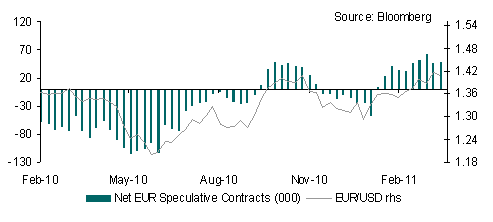
The bottom line is that the bad news is building up and the ability of the EUR to shake it off is lessening. Considering the fact that the market long EUR, with positioning well above the three-month average the EUR is vulnerable to position adjustment. After slipping over recent days EUR/USD looks supported above 1.3980 but its upside is looking increasingly restricted against the background of various pieces of bad news.

Eurozone peripheral tensions

The USD index remains under pressure but will likely continue to consolidate. The USD continues to be undermined by adverse interest rate differentials and is gaining little support from rising risk aversion. One factor that will help dictate USD direction over coming months is the prospects for further quantitative easing once QE2 ends.

Fed officials offered varied views on the subject. Dallas Fed President Fisher hinted he would support cutting short asset purchases before the end of June, whilst Atlanta Fed President Lockhart noted he was “very cautious” about further asset purchases. Meanwhile Chicago Fed President Evans noted that he believes the hurdle for altering the asset purchase plan is “pretty high”.

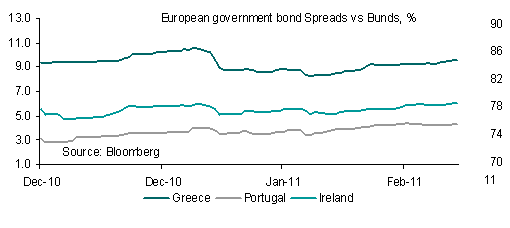
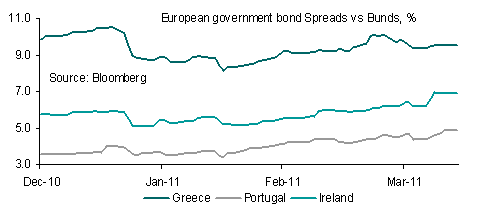
Although there is a lack of first tier data releases in the eurozone this week there is certainly plenty for markets to chew on in terms of peripheral country issues, which may just prevent the EUR from extending its gains. Eurozone peripheral debt spreads have undergone a renewed widening over recent weeks as debt fears have increased and worries that Portugal may follow Ireland and Greece in needing a bailout have risen.

Meanwhile news that Ireland’s incoming government will introduce legislation allowing the restructuring of some senior bank bonds, will add to tensions. Meanwhile, the downgrading of Greece’s government bond ratings to B1 from Ba1 dealt another blow sentiment following hot on the heels of Fitch’s downgrade of Spain’s outlook to negative although the EUR proved resilient to the news. EUR/USD continues to look as though it will consolidate around the 1.4000 level, but worsening sentiment towards the periphery may open up downside as the EUR’s resilience fades.

Upward revisions to eurozone growth and inflation forecasts and of course a hawkish shift in eurozone interest rate expectations may have justified the EUR move higher over recent weeks. However, there does not seem to be much that will provide the stimulus for further gains from current levels.

The market has already priced in an interest hike as early as next month’s European Central Bank (ECB) meeting and further tightening thereafter. The risk now appears asymmetric skewed to the downside especially if tensions between the eurozone core and peripheral countries deepen. How long the EUR can ignore such tensions?

It’s not only the eurozone periphery that should worry about ratings. Japan’s ratings agency R&I has warned that it may be forced to cut Japan’s sovereign ratings before April’s local elections due to current political problems. R&I’s concern revolve around the potential for political problems to delay fiscal reforms. As usual the JPY remains unmoved by political issues and is moving to the stronger side of its recent range against the background of elevated risk aversion.

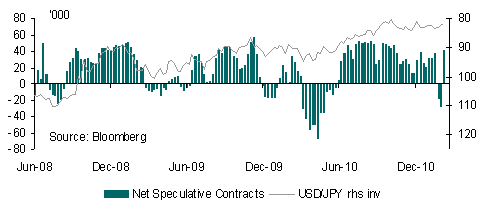
Although the JPY has not been particularly sensitive to risk over recent months shorter-term correlations shows that its sensitivity has increased. Given that Middle-East tensions do not appear to be easing the JPY will remain well supported. Indeed, speculative positioning data reveals the highest JPY net long position since November 2010. As risk appetite improves JPY positioning will be pared back but this is unlikely to be imminent, with USD/JPY set to remain close to support around 81.10.

Data and earnings focus

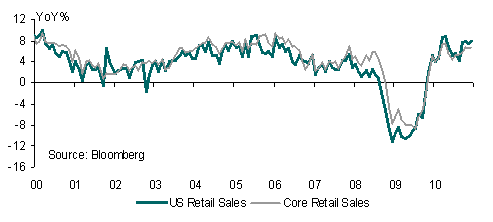
Friday’s round of US data were generally upbeat, highlighting that consumer spending is coming back to life. Inflation pressures however, remain benign at least on the core reading highlighting the Fed’s concern that inflation is running below the level consistent with its mandate. In other words it will be a long time, probably late into 2012 before policy rates increase.

While the Fed is no hurry to raise rates despite a few hawkish rumblings within the FOMC the European Central Bank (ECB) in contrast appears to have become more eager to pull the trigger for higher rates. ECB President Trichet’s hawkish press conference last week set the cat amongst the pigeons and marked a clear shift in ECB rhetoric towards a more hawkish stance.

A very big problem for the ECB is that the eurozone economy is not performing along the lines that its hawkish rhetoric would suggest, especially in the periphery. Growth momentum in the core in contrast, as likely reflected in the January ZEW investor confidence and IFO business confidence survey data this week in Germany, remains positive. Both surveys are likely to stabilize at healthy levels but how long can the likes of Germany drag along the eurozone periphery?

There will be relatively more attention on the meeting of Eurogroup/Ecofin officials, with focus on issues such as enlarging the size of the European Financial Stability Facility (EFSF) bailout fund and development of a “comprehensive plan” to contain the eurozone crisis. Don’t look for any conclusive agreements as this may have to wait until the European Union (EU) Council meeting on 4 February assuming (optimistically given ongoing German resistance) some agreement can even be reached.

Following the success (albeit at relatively high yields) of the eurozone debt auctions last week, sentiment for peripheral debt will face further tests this week in the form of debt sales in Spain, Belgium and Portugal.

The US Martin Luther King Jr. holiday will result in a quiet start to the week for markets but there will be plenty to chew on. This week’s key earnings reports include several banks scheduled to release Q4 earnings. Financials are a leading sector in the rally in equities at present and these earnings will be critical to determine whether the rally has legs.

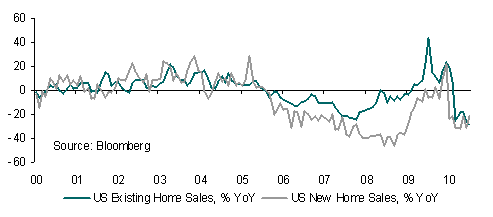
The US data slate includes January manufacturing surveys in the form of the Empire and Philly Fed, both of which are likely to post healthy gains whilst existing home sales are also likely to rise. This will not change the generally weak picture of the US housing market, with high inventories and elevated foreclosures characterizing conditions. As if to prove this, housing starts are set to drop in December. On the rates front, the Bank of Canada is likely to keep its policy rates on hold this week.

After coming under pressure last week much for the USD will depend on the eurozone’s travails to determine further direction. Concrete evidence of progress at the Ecofin may bolster the EUR further, with resistance seen around 1.3500 but don’t bank on it. The ability of eurozone officials to let down often lofty expectations should not be ignored. In any case following sharp gains last week progress over coming days for the EUR will be harder to achieve.

Temporary Euro Relief

Eurozone peripheral country travails continue to garner most market attention. There was at least a semblance of improvement on this front as peripheral bond spreads with German bunds narrowed on Tuesday but this was largely due to European Central Bank (ECB) bond buying than any improvement in sentiment. The fact that German bund yields also rose helped to narrow bund-peripheral spreads further.

A clearer test of sentiment will be today’s debt sales by Portugal followed by actions by Spain and Italy tomorrow. ECB buying of Portuguese bonds has given some relief to other debt, with Spanish and Italian debt spreads narrowing too. Even Greece managed to sell short term debt (EUR 1.95 bn of 26 week T-bills) but at a higher cost than the previous sale.

Perhaps a stronger boost to sentiment will come from the news that European Union (EU) governments are discussing an increase in the EUR 440 billion bailout fund in recognition of the fact that the fund may prove too small to cope if the crisis spreads to Spain. However, don’t expect a decision anytime soon, with next week’s meeting of EU finance ministers unlikely to agree to such a move. Support (or lack) of from Germany may prove to be a sticking point against the background of domestic political pressure.

Other options being considered include the possibility of the EFSF (European Financial Stability Facility) purchasing bonds in the secondary market and lowering interest rates on EFSF bailout loans. News that Japan will buy 20% of EFSF bonds this month as well as recent supportive comments from China suggest that an increase in the size of the EFSF may be easily funded by such investors. The EUR will gain some support against the background of such speculation but its upside may be restrained around its 200-day moving average at EUR/USD 1.3071.

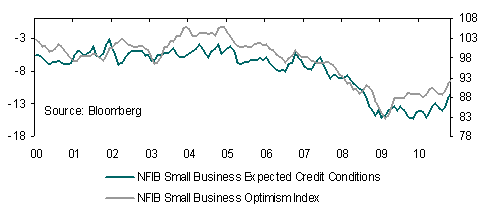
In the US the economic news was not so positive for a change as the National Federation of Independent Business (NFIB) small business optimism survey came in weaker than expected in December, an outcome that will come as a blow given that it suggests some stuttering in the recovery process as well as hiring.

There is only secondary data scheduled today, with most attention on the Fed’s Beige Book later tonight. The survey of Federal Reserve districts will likely reveal a broad based but moderate improvement in economic conditions with the exception of housing activity. A speech by the Fed’s Fisher on Monetary policy will also be in focus. Like the Fed’s Plosser overnight he may highlight some caution about the impact of Fed quantitative easing (QE).

The AUD is increasingly feeling the impact of the flooding in Queensland Australia as the extent of economic damage is revealed. Reserve Bank of Australia (RBA) board member McKibbin estimated that it could knock off at least 1% from economic growth. This may prove too negative and although the flooding will result in a significantly negative impact on growth in Q1 rebuilding and reconstruction will mean that overall growth for 2011 will not be as significantly impacted. Nonetheless, a paring back in RBA policy tightening expectations will see the AUD come under further pressure, with a move down to around AUD/USD 0.9634 on the cards over the short-term.