Euro’s Teflon Coating Wearing Thin

EUR has suffered a setback in the wake some disappointment from the European Union summit at the end of last week and the major defeat of German Chancellor Merkel and her ruling Christian Democratic Union party in yesterday’s election in Baden-Wuerttemberg. The EUR had been fairly resistant to negative news over recent weeks but its Teflon like coating may be starting to wear thin.

The setbacks noted above + others (see previous post) follow credit rating downgrades for Portugal by both S&P and Fitch ratings and growing speculation that the country is an imminent candidate for an EU bailout following the failure of the Portuguese government to pass its austerity measures last week and subsequent resignation of Portugal’s Prime Minister Socrates.
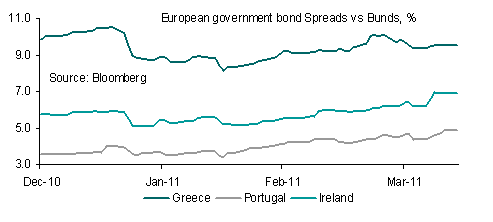
For its part Portugal has stated that it does not need a bailout but looming bond redemptions of around EUR 9 billion on April 15 and June 15 against the background of record high funding costs mean that the pressure for a rescue is intense. Complicating matters is the fact that fresh elections cannot be held earlier than 55 days after being announced, meaning that policy will effectively be in limbo until then. A June vote now appears likely.

After what was perceived to be a positive result of the informal EU leaders summit a couple of weeks ago, the outcome of the final summit last week failed to deliver much anticipated further details whilst more negatively the EU bailout fund’s paid-in capital was scaled back to EUR 16 billion (versus EUR 40 billion agreed on March 21) due to concerns expressed by Germany.

Ireland is also in focus ahead of European bank stress tests results on March 31. Ireland is pushing for increased sharing of bank losses with senior bondholders as part of a “final solution” for financial sector. Meanwhile the new government remains unwilling to increase the country’s relatively low corporation tax in exchange for a renegotiation of terms for the country’s bailout. This point of friction also threatens to undermine the EUR.

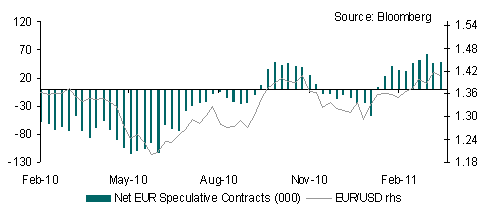
The bottom line is that the bad news is building up and the ability of the EUR to shake it off is lessening. Considering the fact that the market long EUR, with positioning well above the three-month average the EUR is vulnerable to position adjustment. After slipping over recent days EUR/USD looks supported above 1.3980 but its upside is looking increasingly restricted against the background of various pieces of bad news.
Euro resilient but for how long?

The resilience of the EUR to bad news has been impressive but is unlikely to persist. The recent negatives include 1) the rejection of the Portuguese government’s austerity plan and the increased likelihood of a bailout, 2) a likely delay in the decision on increasing the size and scope of the EFSF EU bailout fund, 3) a drop in Eurozone purchasing managers indices in March, 4) downgrades to Portugal’ sovereign credit ratings by Fitch last night and S&P and 5) Moodys downgrades of 30 Spanish banks. Despite all of this, and after hitting a low of around EUR/USD 1.4054, EUR has bounced back close to the 1.4200 level.

Further direction will come from the outcome of the EU leaders’ summit today and the March German IFO business confidence survey. For the former there is unlikely to be a decisive result, with the optimism following the informal March 11 leaders’ summit likely to give way to delay due to wrangling over details. For the latter, a slight moderation in the IFO is expected following February’s upside surprise. However, there is a bigger risk of a downside surprise following the softer than forecast March German manufacturing PMI released. Against this background, EUR/USD is likely to struggle to break resistance around 1.249.

In general FX markets look somewhat more stable and even the pressure on the USD appears to have abated slightly despite a much weaker than expected outcome for US February durable goods orders yesterday, which revealed a drop in both headline and ex-transportation orders. My composite FX volatility measure has dropped sharply over recent days, led by short term implied JPY volatility which has dropped close to pre-crisis levels. Lower volatility has also likely reduced the prospects of further FX intervention although USD/JPY 80 will continue to be well defended.

Lower volatility as also reflected in the sharp drop in the VIX index has corresponded with a general easing in risk aversion as both Middle East and Japan tensions have eased slightly. US data today are unlikely to offer much direction, with a slight upward revision to US Q4 GDP and an unchanged outcome for the final reading of Michigan consumer confidence expected.

Eurozone peripheral tensions

The USD index remains under pressure but will likely continue to consolidate. The USD continues to be undermined by adverse interest rate differentials and is gaining little support from rising risk aversion. One factor that will help dictate USD direction over coming months is the prospects for further quantitative easing once QE2 ends.

Fed officials offered varied views on the subject. Dallas Fed President Fisher hinted he would support cutting short asset purchases before the end of June, whilst Atlanta Fed President Lockhart noted he was “very cautious” about further asset purchases. Meanwhile Chicago Fed President Evans noted that he believes the hurdle for altering the asset purchase plan is “pretty high”.

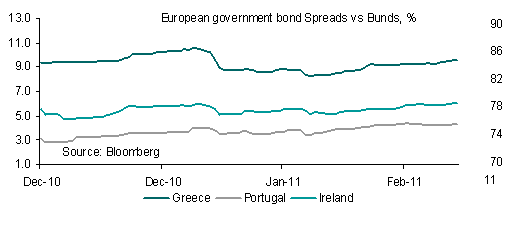
Although there is a lack of first tier data releases in the eurozone this week there is certainly plenty for markets to chew on in terms of peripheral country issues, which may just prevent the EUR from extending its gains. Eurozone peripheral debt spreads have undergone a renewed widening over recent weeks as debt fears have increased and worries that Portugal may follow Ireland and Greece in needing a bailout have risen.

Meanwhile news that Ireland’s incoming government will introduce legislation allowing the restructuring of some senior bank bonds, will add to tensions. Meanwhile, the downgrading of Greece’s government bond ratings to B1 from Ba1 dealt another blow sentiment following hot on the heels of Fitch’s downgrade of Spain’s outlook to negative although the EUR proved resilient to the news. EUR/USD continues to look as though it will consolidate around the 1.4000 level, but worsening sentiment towards the periphery may open up downside as the EUR’s resilience fades.

Upward revisions to eurozone growth and inflation forecasts and of course a hawkish shift in eurozone interest rate expectations may have justified the EUR move higher over recent weeks. However, there does not seem to be much that will provide the stimulus for further gains from current levels.

The market has already priced in an interest hike as early as next month’s European Central Bank (ECB) meeting and further tightening thereafter. The risk now appears asymmetric skewed to the downside especially if tensions between the eurozone core and peripheral countries deepen. How long the EUR can ignore such tensions?

It’s not only the eurozone periphery that should worry about ratings. Japan’s ratings agency R&I has warned that it may be forced to cut Japan’s sovereign ratings before April’s local elections due to current political problems. R&I’s concern revolve around the potential for political problems to delay fiscal reforms. As usual the JPY remains unmoved by political issues and is moving to the stronger side of its recent range against the background of elevated risk aversion.

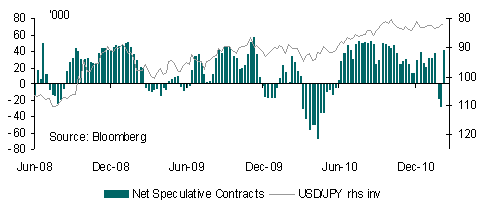
Although the JPY has not been particularly sensitive to risk over recent months shorter-term correlations shows that its sensitivity has increased. Given that Middle-East tensions do not appear to be easing the JPY will remain well supported. Indeed, speculative positioning data reveals the highest JPY net long position since November 2010. As risk appetite improves JPY positioning will be pared back but this is unlikely to be imminent, with USD/JPY set to remain close to support around 81.10.

Egypt Unrest Hits Risk Trades

Recent weeks have seen a real contrast in policy and growth across various economies. A case in point was the surprise drop in UK GDP in Q4 contrasting sharply with the solid (albeit less than forecast) rise in US Q4 2010 GDP. The resilience of the US consumer was particularly evident in the data. The European Central Bank’s (ECB) hawkish slant as reflected in comments from President Trichet compared to the dovish pitch of the Fed FOMC is another clear contrast for markets to ponder.

The ECB’s hawkish tone gave the EUR a lift but expectations of an early Eurozone rate hike looks premature. Although Eurozone inflation data (Monday) will reveal a further rise in CPI above the ECB’s target, to around 2.4% in January, this will not equate to a policy rate hike anytime soon. This message is likely to be echoed at this week’s ECB meeting where policy will be characterised as “appropriate”.

Whilst monetary tightening expectations look overdone in the Eurozone the same can be said for hopes of an expansion in the EU bailout fund (EFSF). Indeed, the fact that EU Commissioner Rehn appeared to pour cold water over an expansion in the size of the fund could hit the EUR and the currency may find itself struggling to extend gains over coming weeks especially if interest rate expectations return to reality too, with a move to EUR/USD 1.4000 looking far harder to achieve than it did only a few days ago.

It’s worth noting that a renewed widening in peripheral debt spreads will also send an ominous signal for the EUR. Against this background the EU Council meeting on February 4 will be in focus but any expectation of a unified policy resolution will be disappointed.

However, markets perhaps should not solely focus on peripheral Europe as the downgrading of Japan’s credit ratings last week highlights. Warnings about US credit ratings also demonstrate that the US authorities will need to get their act together to find a solution to reversing the unsustainable path of the US fiscal deficit, something that was not particularly apparent in last week’s State of the Union Address.

Last week ended with a risk off tone filtering through markets as unrest in Egypt provoked a sell-off in risk assets whilst worries about oil supplies saw oil prices spike. Gold surged on safe haven demand too. This week, markets will focus on events in the Middle East but there will be thinner trading conditions as Chinese New Year holidays result in a shortened trading week in various countries in Asia.

The main release of the week is the US January jobs report at the end of the week. Regional job market indicators and the trend in jobless claims point to a 160k gain in January although the unemployment rate will likely edge higher. Final clues to the payrolls outcome will be deemed from the ISM manufacturing confidence survey and ADP private sector jobs report this week. Whilst the January jobs report is unlikely to alter expectations for Fed policy (given the elevated unemployment rate) the USD may continue to benefit from rising risk aversion.

Interest rate and FX gyrations

Following a brief rally at the start of the year the USD has found itself under growing pressure in the wake of widening interest rate differentials versus many other currencies. In particular, the contrasting stance between the hawkish rhetoric (bias for tighter monetary conditions) from European Central Bank (ECB) President Trichet and the relatively dovish US Federal Reserve stance as highlighted in the 26th January FOMC statement has provided more fuel to the widening in interest rate expectations between the US and eurozone. Since the end of last year interest rate differentials have widened by around 31 basis points in favour of the EUR (second general interest rate futures contract).

The Fed remains committed to carrying out its full $600 billion of asset purchases by end Q2 2011 whilst the ECB appears to be priming the market for a scaling back of its liquidity operations. Whilst there may be more juice in EUR over the short term based on the move in interest rate differentials as well as improved sentiment towards the eurozone periphery the upside potential for EUR/USD is looking increasingly limited. Even European officials are beginning to inject a dose of caution, with the ECB’s Nowotny stating that markets are too euphoric over a potential enlargement of the European Financial Stability Facility (EFSF) bailout fund. Indeed, it is highly likely that the euphoria fades quickly once it becomes apparent that enlarging the bailout fund is by no means a panacea to the region’s ailments.

GBP is another currency that has undergone sharp gyrations over recent days in the wake of a shift in interest rate expectations. A surprise 0.5% quarterly drop in UK Q4 GDP (which could not all be blamed on poor weather) set the cat amongst the pigeons and gave a GBP a thrashing but much of this was reversed following the release of Bank of England Monetary Policy Committee (MPC) minutes which revealed a hawkish shift within the MPC, with two dissenters voting for a rate hike and most members agreeing that the risks to inflation has probably shifted higher.

Does this imply an imminent rate hike? No, a policy rate hike closer to the end of the year appears more likely. BoE Governor King provided support to this view, in a speech that was interpreted as dovish, with the governor once again highlighting the temporary nature of the current rise in inflation pressure. Consequently UK interest rate expectations have shifted back and forth over recent days, but still remain wider relative to the US since the start of the year. GBP/USD has of course benefitted, but given worries about growth and the dovish message from King, it is unlikely that rate differentials will widen much further. Consequently GBP/USD is unlikely to make much if any headway above 1.6000.