Euro unimpressed by Greek confidence vote

News that the Greek government won a confidence vote has left the EUR unimpressed and gains will be limited ahead of the June 28 vote on the country’s 5-year austerity plan. The EUR was in any case rallying ahead of the vote, which the government won by 155-143 votes, and has actually lost a little ground following the vote.

EUR sentiment is likely to remain somewhat fragile given the ongoing uncertainties, but now that the first hurdle has been passed markets there is at least a better prospect of Greece receiving the next EUR 12 billion aid tranche before the July 15 “do or default” deadline. Over the near term EUR/USD upside is likely to remain capped around the 1.4451 resistance level (15 June high).

The next key event for markets is the Fed FOMC meeting outcome and press conference. This is unlikely to bode particularly well for the USD given that the Fed is set to downgrade its growth forecasts, with the comments on the economy likely to sound a little more downbeat given the loss of momentum recently as reflected in a string of disappointing data releases.

Nonetheless, monetary settings are unlikely to be changed, with the Fed committed to ending QE2 by the end of June. I remain positive on the USD’s prospects but its recovery is fragile due to the fact that US bond yields remain at ultra low levels.

Whilst only AUD/USD and USD/JPY have maintained significant correlations with bond yield differentials over the past three months, it will eventually require US bond yields to move higher in relative terms for the USD to find its legs again on a more sustainable basis.

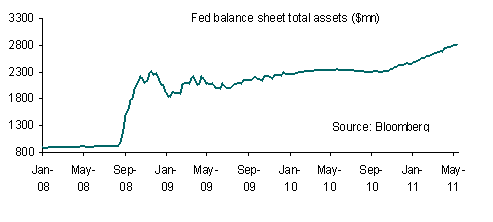
In the meantime the approach of the end of QE2 by the end of June will on balance play positively for the USD as at least the Fed’s balance sheet will no longer be expanding even if the reinvestment of principle from its holdings of US Treasuries suggest that there will not be a quick or immediate reduction in the size of the balance sheet anytime soon.

There is little appetite to intervene to weaken the JPY at present, with the Japanese authorities blaming the strengthening in the JPY versus USD on the latter’s weakness rather than the former’s strength. Until yield differentials widen, USD/JPY will continue to languish at current levels or even lower.

GBP will garner direction from the release of the Bank of England Monetary Policy Committee meeting minutes. Whilst GBP has edged higher against the USD it has remained vulnerable against EUR. A likely dovish set of minutes reflecting some weak activity data, easing core inflation and soft wage growth, suggests little support for GBP over the short term.
US Dollar Finding Support

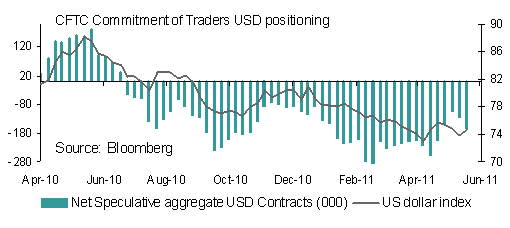
The US dollar is finding growing relief from the fact that the Fed is putting up a high hurdle before more quantitative easing (QE3) is even considered. As highlighted by Federal Reserve Chairman Bernanke last week he is not considering QE3 despite a spate of weak US data. Of course until US bond yields move higher the USD will fail to make much of a recovery and in turn this will need some improvement in US economic data.


The May retail sales release is unlikely to provide this with headline sales likely to undergo an autos related drop while core CPI released on Wednesday is set to remain benign in May. There will be better news on the US manufacturing front, with surveys and hard data likely to bounce back.

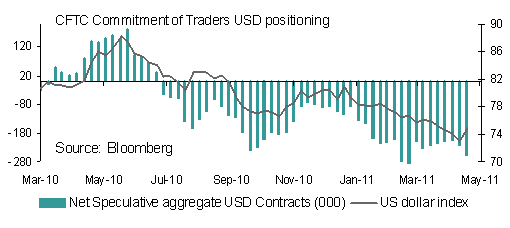
There is still plenty of scope for USD short covering as reflected in the fact that IMM USD positions fell further as of the 7th June, with the market still heavily short USDs. The USD index has likely found a short term bottom, with a break above the 50-day moving average level around 74.6874 in focus.

EUR has lost momentum , with the European Central Bank’s (ECB) confirmation of a July policy rate hike prompting a major sell off in the currency, even with interest rate markets barely flinching. The EUR is susceptible to developments regarding Greece and the news on this front is not good. Divisions between policy makers including the ECB about the extent of private sector involvement in a second bailout package threaten to prolong the pain.

Similarly divisions within the Greek parliament about further austerity measures needed to secure a second bail could also derail the process. Further negotiations this week will be closely scrutinised, likely taking more importance than data releases, with only the final reading of May inflation and industrial production of note this week.

As revealed by the CFTC IMM data, EUR long positions jumped early last week leaving plenty of scope for unwinding, something that is likely to take place this week. Nonetheless, support around the 30 May low of EUR/USD 1.4256 is likely to prove difficult to break on the downside this week.

GBP took a hit in the wake of yet more weak activity data in the form of May industrial and manufacturing production data. The economic news will be no better this week, with retail sales set to drop in May and CPI inflation set to rise further in April. The data will only add further to the confusion about UK monetary policy as the dichotomy between weak data and persistently high inflation continues.

Admittedly the weak data releases can at least partially be explained away by the Royal wedding and Easter holidays but this will provide little solace to GBP bulls. GBP will likely struggle against a firmer USD this week although its worth noting that GBP speculative position has been negative for 3-straight weeks, suggesting that at least there is less room for GBP position unwinding. GBP/USD is likely to hold above support around 1.6055 this week.

EUR Supported, AUD dives, NZD jumps

Today is probably not the best day to sell EUR given that the ECB policy decision looms on the horizon. Whilst there is a risk of a ‘buy on rumour, sell on fact’ impact on the EUR following the European Central Bank (ECB) decision later today the relatively high probability that the ECB flags a rate hike in July will likely give further support to the EUR especially as it is not fully priced in by the market.

Of course should ECB President Trichet fail to mention “strong vigilance” in his press conference the EUR could suffer but this is likely to be a lower probability event. Some justification for higher rates will come from an upward revision in the ECB’s inflation forecasts. Consequently EUR/USD looks well supported around 1.4450.

The Bank of England is unlikely to deliver any surprises today, with an unchanged policy rate outcome and asset purchases target likely. The outcome will keep GBP restrained versus USD but given the likely contrast with the ECB, EUR/GBP could head higher as the currency pair continues to set its sights on the 0.90 level.

Even against the USD, GBP is unlikely to extend its gains, with 1.6474 likely providing a near term technical cap. The dichotomy of weaker activity and higher inflation is clearly causing a problem for policy makers but we still believe a rate hike is likely later in the year. In the meantime GBP remains vulnerable to further data disappointments over coming weeks.

There was more bad news for the AUD today in the form of a weak than forecast May employment report. The data will reinforce expectations that the RBA will not hike interest rates over coming months, with July and August effectively ruled out, though a hike in September remains probable.

The data had major impact on AUD which dropped sharply below the 1.0600 handle versus USD. Clearly the combination of the RBA statement and weak jobs data has resulted in a major headwind against further near term AUD appreciation. AUD will remain under downward pressure in the short-term, with technical support seen at 1.0440.

Unlike the RBA the Reserve Bank of New Zealand (RBNZ) opened the door for higher interest rates following its unchanged policy decision today, with the Bank stating that “a gradual increase in the overnight cash rate over the next two years will be required”. Despite noting some caution about the strength of the NZD and its impact on the economy the Kiwi strengthened versus the USD

Australian dollar hit by weak jobs data

The USD’s bounce since the beginning of the month appears to be gaining more traction, with the USD index up over 3% from its recent lows. I’m still cautious about whether this move can extend much further in the absence of a back up in US bond yields especially given ongoing asset purchases / global USD liquidity injections by the US Federal Reserve at least until the end of June.

Nonetheless, given the magnitude of USD short positioning, which had moved ever close to revisiting record levels, the potential for short-covering was significant. US data today could provide some influence, with attention on April retail sales data, PPI inflation and jobless claims. A relatively positive outcome for retail sales could give the USD further support.

The day has started badly for the AUD, with the currency hit by an awful jobs report, with employment dropping by 22.1k in April compared to consensus expectations of +17k. The details were even more negative than the headline reading, with full time employment dropping by 49.1k and only partially mitigated by a 26.9k rise in part time employment.

The Reserve Bank of Australia will likely pay close attention to the data and it will likely result in any residual expectation of a rate hike by the RBA next month being taken off the table. Already today there has been a sharp rally in bank bill futures as markets pare back interest rate expectations and markets are not even pricing in a further full 25bps rate hike by year end.

The data weighed heavily on the AUD, with AUD/USD hitting a low below 1.06. AUD is likely to trade with a heavy tone over coming sessions, with the currency already under pressure from a generally firmer USD. Moreover, the rally in Australian bank bill futures will add further pressure to the currency as Australia’s favourable rate differential narrows further with the US.

Taken together with the fact that AUD positioning is close to its all time highs and that even compared to interest rate differentials its gains look overdone, it suggests more downside risks over the short-term, with AUD/USD 1.0537 seen as a near term technical support level.

In contrast GBP benefitted from a back up in UK bond yields in reaction to the Bank of England’s Quarterly Inflation Report. Inflation forecasts were revised higher but growth forecasts were revised lower as expected. The In truth, the reaction looked overdone but GBP has gained some momentum versus EUR and looks set to extend its gains, with focus on the 200 day moving average level of 0.8558.

Position Unwinding Boosts USD

The USD’s multi-month fall has come to an abrupt halt, with the currency registering gains in reaction to what appears to be a major position unwinding across asset markets, led by a drop in commodity prices.

Will it continue? Whilst I am amongst the more bullish forecasters on the USD over the medium term, the current rally could prove to be short-lived in the absence of a shift in Federal Reserve rhetoric or end to quantitative easing (QE2). Nonetheless, the market had got itself very short USDs (as reflected in the CFTC IMM data as of early last week which showed an increase in net short positions) and the rally in the USD last week was likely spurred by major short-covering which could extend further into this week.

The move in the USD gained momentum as European Central Bank (ECB) President Trichet proved to be less hawkish than many expected in the press conference following last Thursday’s ECB meeting. Moreover, renewed worries about Greece at the end of last week, with a report in the German Der Spiegel, later denied by Greek officials, that the country was planning to leave the Eurozone dented the EUR,

Taken together with the improving trend in US April non-farm payrolls (April registered +244k increase, with private payrolls 268k), these factors colluded to provide further positive stimulus to the USD and negative fallout on the EUR. The room for EUR downside is evident in the net long EUR speculative position, which rose to its highest since December 2007 as of 3rd May.

This week’s batch of US releases including March trade data, April retail sales and CPI, are unlikely to result in a reversal in last week’s trend though a trend like reading for core CPI, with the annual rate below the Fed’s comfort zone will reinforce expectations of dovish Fed policy being maintained, which could inject a dose of caution into the USD’s rally.

Against the background of a likely widening in the US trade deficit in March there will plenty of attention on the annual strategic and economic dialogue beginning today, with markets interested in discussions on Chinese worries about the gaping US fiscal deficit and US concerns about China’s exchange rate policy.

Greece’s denial of plans to leave the eurozone and discussions over a further adjustment to Greece’s bail out package, may help limit any drop in the EUR this week though it will by no means mark the end of such speculation about the periphery especially with this weeks’ Q1 GDP data releases across the eurozone likely to further highlight the divergence between the core and the periphery even if the headline eurozone reading rebounds strongly as we expect.

In the UK the Bank of England Quarterly Inflation Report will be the main influence on GBP. Downward growth revisions will play into the view that inflation will eventually moderate, capping expectation of higher interest rates over the coming months. However, the likely upward revision to near term inflation forecasts will help limit any damage to GBP.

GBP has lost ground to the USD but it should be noted that it has outperformed the EUR over recent days, reversing some of the recent run up in EUR/GBP. Given that EUR sentiment is likely to remain fragile this week, GBP may continue to capitalise, with a test of EUR/GBP 0.8672 on the cards.