Fed does the Twist, markets do the Shake

Although it was widely expected the Federal Reserve’s decision to implement a fresh version of Operation Twist together with a downbeat assessment of the economy came as a disappointment to equities and risk assets in general. The only surprise was the larger size of the operation at $400 billion.

Moody’s downgrade of three US banks added to the malaise as US equities dropped sharply, commodities slid, longer term Treasuries rallied whilst shorter term bonds dropped. The USD registered broad gains both on the back of the fact that no more quantitative easing was announced and due to a shift away from risk assets. At least there was no more negative news out of the eurozone as talks between the Troika (ECB, IMF, EC) and Greek officials continue on the next tranche of the bailout.

Markets will continue to digest the Fed’s outcome today and the negative tone will likely filter through markets today. There is little on the data front to result in a shift in this tone. In the US data includes weekly jobless claims while in Europe attention will be on manufacturing and service sector confidence measures.

While the potential for a positive outcome to talks in Greece may provide a short term boost to sentiment the overwhelming tone is likely to remain negative especially as Operation Twist is unlikely to change the dynamic of a weak growth trajectory for the US and developed economies over the coming months. Against this background, selling risk assets on rallies remains the preferred option.

The USD will continue to look firmest against high beta emerging market currencies in the current environment. Currencies in this group are those that have the highest correlations with risk (as m measured by my in house risk barometer) over the past 3 months including CAD, ZAR, TRY, INR, MXN, ARS & RUB. In contrast currencies that also have high correlations but actually strengthen as risk aversion increases are CNY and JPY.
Euro crisis intensifies

The blowout in eurozone non-core debt has intensified and unlike in past months the EUR has been a clear casualty. The lack of a concrete agreement over a solution given divergent views of EU officials, the European Central Bank (ECB) and private sector participants threatens a further ratcheting higher of pressure on markets over coming weeks.

The only real progress overnight as revealed in the Eurogroup statement appeared to be in the renewing the option of buying back Greek debt via the eurozone bailout fund, extending maturities and lowering interest rates on loans. This will be insufficient to stem the pressure on the EUR, with the currency verging on a sharp drop below 1.40.

The USD continues to take advantage of the EUR’s woes and has actually staged a break above its 100-day moving average yesterday after several attempts previously. This sends a bullish signal and the USD is set to remain supported given that there is little in sight of a resolution to the problems festering in the eurozone.

Today’s release of the June 22 Fed FOMC minutes will give some clues to Fed Chairman Bernanke’s testimony to the House of Representatives tomorrow, but as long as the minutes do not indicate a greater willingness to embark on more asset purchases, the USD is set to remain resilient.

GBP has also benefitted from the EUR’s weakness, and unlike the EUR has only drifted rather than dived versus the USD. However, the UK economy is not without its own problems as revealed in a further drop in retail sales overnight, albeit less negative than feared, with the British Retail Consortium (BRC) like for like sales falling 0.6% in June.

A likely increase in June CPI inflation in data today to a 4.8% annual rate will once again highlight the dichotomy between weak growth and high inflation. In turn, such data will only provoke further divisions within the Bank of England MPC. While further gains against the beleaguered EUR are likely, with a test of EUR/GBP 0.8721 on the cards in the short term, GBP will struggle to sustain any gain above 1.6000 versus USD.

Both AUD and NZD are vulnerable against the background of rising risk aversion and a firmer USD in general. However, both currencies are not particularly sensitive to risk aversion. Interestingly the major currency most sensitive to higher risk aversion in the past 3-months is the CAD and in this respect it may be worth considering playing relative CAD underperformance versus other currencies.

As for the AUD it is more sensitive to general USD strength, suggesting that it will be restrained over coming sessions too and given that market positioning is still very long AUD, there is scope for further downside pressure to around 1.0520 versus USD.

US Dollar On The Rise

There are plenty of US releases on tap this week but perhaps the most important for the USD will be the minutes of the April 26-27 Fed FOMC meeting. Taken together with speeches by Fed officials including Bernanke, FX markets will attempt to gauge clues to Fed policy post the end of QE2. The Fed’s stance at this point will be the major determinant of whether the USD can sustain its rally over the medium term. The lack of back up in US bond yields suggests that USD momentum could slow, with markets likely to move into wide ranges over coming weeks.

It is worth considering which currencies will suffer more in the event that the USD extends its gains. The correlation between the USD index and EUR/USD is extremely strong (even accounting for the fact that the EUR is a large part of the USD index) suggesting that the USDs gains are largely a result of the EUR’s woes. Aside from the EUR, GBP, AUD and CAD are the most sensitive major currencies to USD strength whilst many emerging market currencies including ZAR, TRY, SGD, KRW, THB, IDR, BRL and MXN, are all highly susceptible to the impact of a stronger USD.

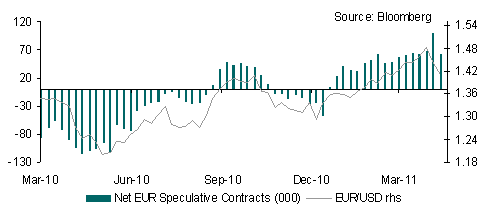
Robust Q1 GDP growth readings in both Germany and France helped to spur gains in the EUR but this proved short-lived. Sentiment for the currency has soured and as reflected in the CFTC IMM data long positions are being scaled back. Nonetheless, there is still plenty of scope for more EUR selling given ongoing worries about the eurozone periphery, which are finally taking their toll on the EUR. A break below EUR/USD 1.4021 would open the door for a test of 1.3980.

The eurogroup and ecofin meetings will be of interest to markets this week but any additional support for Greece is unlikely to be announced at this time. However, likely approval of Portugal’s bailout may alleviate some pressure on the EUR but any positive impetus will be limited. Even on the data front, markets will not be impressed with the German ZEW index of investor confidence likely to register a further decline in May.

Japanese officials have been shying away from further FX intervention by blaming the drop in USD/JPY over recent weeks on general USD weakness despite the move towards 80. However, this view is not really backed up by correlation analysis which shows that there is only a very low sensitivity of USD/JPY to general USD moves over recent months. One explanation for the strength of the JPY is strong flows of portfolio capital into Japan, with both bond and equity markets registering net inflows over the past four straight weeks.

This is not the only explanation, however. One of the main JPY drivers has been a narrowing in yield differentials. This is unlikely to persist with yield differentials set to widen sharply over coming months resulting in a sharply higher USD/JPY. As usual data releases are unlikely to have a big impact on the JPY this week but if anything, a further decline in consumer confidence, and a negative reading for Q1 GDP, will maintain the pressure for a weaker JPY and more aggressive Bank of Japan (BoJ) action although the BoJ is unlikely to shift policy this week.

Another Day, Another Drop In The US Dollar.

The USD index is now close to breaching its November 2009 low around 74.17, with little sign of any turnaround in prospect. A surprise jump in weekly jobless claims to 412k (380k expected) did little to help the USD’s cause whilst higher commodity prices, and in particular energy prices played negatively.

Indeed, many USD crosses have experienced an increase in sensitivity to oil price movements over recent weeks, with the USD on the losing side when oil prices move higher. Commodity currencies including CAD and NOK are the key beneficiaries but EUR/USD is also highly correlated with the price of oil.

Various Fed comments overnight including supportive comments on the USD’s role as a reserve currency have done little to boost USD sentiment despite the generally hawkish slant to comments. A host of US data releases will keep markets busy.

The data are unlikely to deliver any strong surprises but given the growing FX attention on Fed policy, CPI data may take on more importance than usual. Our expectation of a trend like 0.2% increase in core CPI, which is unlikely to cause any consternation within the Fed, suggests that the USD will garner little support.

The ability of the EUR to withstand a torrent of bad news regarding the eurozone periphery is impressive. In particular, peripheral bond yields continue to rise especially Greek yields as expectations of debt restructuring grow. Comments from Germany’s finance minister have added to such expectations. News that the Bank of Spain approved the recapitalisation of 13 bank and that Spanish banks borrowed only EUR 44 billion last month, the lowest since Jan 2008, may have provided some relief.

However, given that markets are already relative hawkish about eurozone interest rates and given growing peripheral worries as well as overly long EUR market positioning, the upside for EUR/USD is looking increasingly restrained, with a break above technical support around 1.4580 likely to be difficult to achieve over the short-term.

AUD and NZD have registered stellar performances over recent weeks as yield attraction has come back to the fore and risk appetite has strengthened. The gains since their post Japan earthquake lows have been in the region of 7.3% and 10.5%, respectively for AUD and NZD.

The additional element of support, especially for AUD has come from central bank diversification, an increasingly important factor for both currencies. The gains in both currencies have been impressive and neither is showing signs of reversing but there are clear risks on the horizon.

One indication of such risks is the fact that market positioning is stretched especially in terms of AUD positioning, with CFTC IMM contracts registering an all time high. The move in AUD especially has been well in excess of what interest rate / yield differentials imply. Whilst I would not suggest entering into short AUD and NZD positions yet, the risks to the downside are clearly intensifying.

FX Winners and Losers

There has been a sense of mean reversion in FX markets so far this year as some of last year’s winners have become losers. Namely NZD, CHF, JPY and AUD have all lost ground whilst EUR and GBP have gained ground. The odd one out is the SEK which has strengthened over 2010 and in 2011 versus USD. I expect this pattern to change and the likely winners over the next 3- months are NZD, AUD and CAD, with CHF and JPY the likely losers.

EUR held up reasonably well in the wake of slightly disappointing growth data, with eurozone GDP rising less than expected in Q4, and a smaller than expected gain in the February German ZEW investor confidence survey (economic sentiment component). My sense is that the net long EUR speculative position has already been pared back somewhat over recent days reducing the potential selling pressure on the currency in the near term.

Given that EUR/USD is one of the only major currency pairs being influenced by interest rate differentials, its direction will hinge more on policy expectations but in the near the announcement by the German Finance Minister this morning of a restructuring plan for WestLB may give the currency some support.

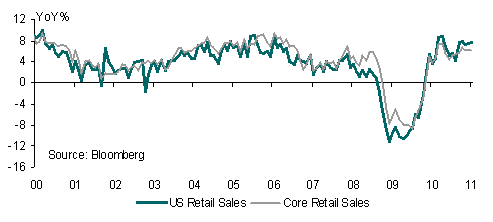
Perhaps one explanation for the stability of EUR/USD around the 1.3500 level is that US data was also disappointing yesterday. January retail sales rose less than forecast whilst revisions to back months suggest less momentum in Q4 consumer spending than previously envisaged. As with the eurozone data weather likely played a role in contributing to the outcome.

The net impact on currencies is that they are largely stuck within tight ranges. Further direction will come from the release of the Fed FOMC minutes for the January 26th meeting. The minutes may undermine the USD if a likely dovish slant continues to be expressed but given that the FOMC decision at that meeting to hold policy setting unchanged had no dissenters this should not come as a surprise.

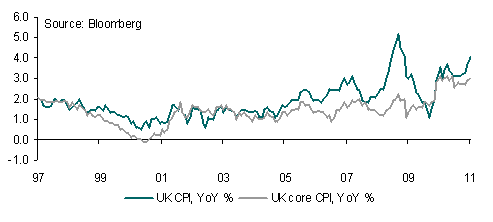
Whilst the battle between the USD and EUR ended in a stalemate GBP outperformed in the wake of the increase in UK January CPI inflation and in particular the letter from the BoE governor to the Chancellor keeping open the door to a rate hike. The Quarterly Inflation Report (QIR) today will be particularly important to determine whether the bounce in GBP is justified.

I remain hesitant to build on long GBP positions given the net long speculative overhang in the currency. The risks following yesterday’s jump in GBP are asymmetric, with a hawkish QIR likely to have less impact on the currency than the negative impact from a more dovish than expected report.

Econometer.org has been nominated in FXstreet.com’s Forex Best Awards 2011 in the “Best Fundamental Analysis” category. The survey is available at http://www.surveymonkey.com/s/fx_awards_2011