Asian currencies vulnerable to equity outflows

Asian currencies are set to continue to trade cautiously. One big headwind to further appreciation is the fact that there has been a substantial outlook of equity capital over recent weeks. Over the last month to date Asian equity markets have registered an outflow of $3.3 billion in outflows. However, whilst Taiwan, South Korea, Thailand and India have seen outflows Indonesia, Philippines, and Vietnam have registered inflows.

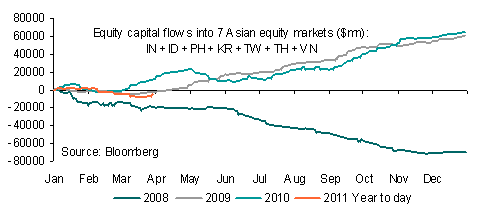
The net result is that equity capital inflows to Asia so far this year are almost flat, a stark contrast from 2009 and 2010 when inflows were much higher at the same point in the year. The odds for further strong inflows do not look good, especially as the Fed ends QE2 by the end of June. While a sharp reversal in capital flows is unlikely, it also seems unlikely that Asia will register anywhere near as strong inflows as the last couple of years.

This will have a significant impact on Asian currencies, whose performance mirrors capital flows into the region. Almost all Asian currencies have dropped against the USD so far this month and could remain vulnerable if outflows continue. Given the relative stability of the USD over recent weeks and imminent end to QE2, the better way to play long Asia FX is very much against the increasingly vulnerable EUR.

The THB has been the worst performing currency this month but its weakness has been attributable to upcoming elections on July 3, which has kept foreign investor sentiment cautious. Thailand has seen an outflow of $812mn from its equity market this month. Polls show the PM Abhisit’s party trailing the opposition and nervousness is likely to persist up to the elections at least. THB weakness is not likely to persist over coming months, with USD/THB forecast at 29.2 by year end.

USD/KRW has been whipsawed over the past week but made up ground despite a continued outflow of equity capital over recent days. KRW has been particularly resilient despite a firmer USD environment and a drop in consumer sentiment in June. Next week the KRW will likely continue to trade positively, helped by a likely firm reading for May industrial production on Thursday. USD/KRW is set to trade in a 1070-1090 range, with direction likely to come from Greece’s parliament vote on its austerity measures.

TWD has traded weaker in June, having been one of the worst performing currencies over the month. USD/TWD does not have a particularly strongly correlation with movements in the USD or risk aversion at present but the currency has suffered from a very sharp outflow of equity capital over recent weeks (biggest outflow out of all Asian countries so far this month). Next week’s interest rate decision on Thursday by the central bank (CBC) will give some direction to the TWD but a 12.5bps increase in policy rates should not come as a big surprise. TWD is likely to trade with a weaker bias but its losses are likely to be capped around the 29.00 level versus USD.
Equity Flow Reversal Supports Asian FX

Asian currencies have rebounded smartly from their post Japan earthquake lows on March 16. The ADXY (Bloomberg-JP Morgan Asia Currency index) is now at its highest level since September 1997 reflecting a sharp rebound in capital inflows to the region. The performance of Asian currencies continues to correspond closely with the movement in capital flows.

Although almost all Asian equity markets have registered outflows so far this year (total equity outflows -$6.2bn), the trend is reversing. Over the past month there has been a major slowing in capital outflows for most countries in Asia whilst India, Thailand and the Philippines have actually registered sizeable inflows. South Korea is notable in that there has been a sharp increase in equity capital inflows over the past week.

Although there has been much focus on a rotation of capital flows out of Asia and into developed economies this year, it is worth noting that the pattern of equity flows in Q1 2011 has not been too different from that witnessed in the past couple of years. In both 2009 and 2010 equity outflows were recorded over the two (2010) or three (2009) months of the year before a reversal took place. This pattern looks like it is repeating itself.

Clearly the environment for Asian equity markets is not as supportive as it was last year given the belated tightening in monetary policies being undertaken by many central banks and prospects of an end to QE2 in the US. Whilst this will result in some reduction in capital flows to the region compared to last year, the overall outlook is positive. Easing risk aversion (our risk aversion barometer has already reversed all of its post Japan earthquake spike and is trending lower), positive growth outlook and maintenance of low US rates point to more inflows.

One currency in particular that will benefit is KRW, with a further drop in USD/KRW likely over coming weeks. KRW has already strengthened by around by around 2.7% since its post Japan earthquake low making it the best performing currency since then. Further gains are likely; a test of USD/KRW 1100 is on the cards in the short-term, with the year end target standing at 1050.

Why buy KRW? 1) Korea has registered the biggest improvement in equity capital flows recently, 2) KRW has been the most sensitive Asian currency to risk over the past month and therefore benefits the most as risk appetite improves, 3) Estimated Price/Earnings ratio for Korean equities looks cheap compared to its historical z-score according to our estimates. As a result our quantitative model on USD/KRW based on commodity prices, risk aversion and equity performance highlights the potential for significantly more KRW strength.

GBP troubles, KRW too weak

The Fed FOMC minutes for the January meeting revealed that behind the unanimous vote to leave policy settings unchanged there was some unease about the completion of QE2. Nonetheless, the USD was left weaker given the Fed’s sanguine view on inflation and worries about unemployment. Inflation data will garner most market attention today but the fact that the core rate of CPI inflation is expected to remain well below the Fed’s preferred level could undermine the USD and add a further barrier to the USD’s recovery so far in February. Jobless claims data will also be of interest given the sharp drop last week. Another firm outcome will help to dispel worries about job market recovery.

As warned in my last post, downside risks to GBP were high given the long GBP speculative positioning overhang and hawkish expectations for the BoE Quarterly Inflation Report. In the event the Report revealed a downward growth forecast revision and an upward inflation forecast revision but importantly showed some reluctance to play into market expectations of an early UK policy rate hike. Following on from a weaker than expected UK January jobs report in which unemployment increased, GBP was hit on both counts. GBP/USD is unlikely to veer far from the 1.6000 level, but with markets reassessing interest rate expectations downside risks are beginning to open up.

News yesterday that Moody’s ratings agency has placed Australia and New Zealand’s major banks on review for possible downgrades went down like a lead balloon but once again AUD and NZD showed their usual resilience and acted as if little has happened. AUD and NZD have weakened since the turn of the year. Weaker data and a paring back in policy tightening expectations have contributed to the weaker performance of the AUD and NZD, but markets have gone too far in scaling back the timing and magnitude of interest rate hikes, suggesting that both currencies may bounce back as interest rate expectations become more hawkish.

Asian currencies continue to register mixed performances largely influenced by capital flows. Most equity markets in the region have registered outflows so far in 2011, with the exception of Taiwan and Vietnam. This has been reflected in Asian FX performance, with the strongest performer being the IDR, but its gains have only been around 0.72% versus USD, coinciding with the fact that it has registered some of the least capital outflows this year. Interestingly the worst performing currency has been the THB, one of last year’s star performers. Korea has also registered strong equity capital outflows but this will not persist and a resumption of inflows taken together with positive fundamentals and higher interest rates will boost the KRW this year.

Asian Currency Differentiation

Asian currencies have started the year in mixed form, but it would be wrong to generalize the performance of Asian currencies as weak. There have been marginal gains recorded year to date vs. USD in the KRW, TWD, MYR and SGD, reflecting strong capital equity inflows. This contrasts with losses in the IDR, INR, PHP and THB versus USD. Compared to the beginning of 2010 equity capital flows have been far weaker overall, with India, Indonesia, Philippines and Thailand, recording outflows, matching the performance of their currencies.

Clearly investors are discriminating more at the turn of 2011. For example Taiwan has recorded solid equity inflows over recent weeks (over $2 billion year-to-date), matching the strength of inflows registered at the beginning of 2010. It appears that Taiwan stocks have started the year as the Asian favorite, helped by growing expectations of further door opening to mainland investment and tourism. Korean equities have also registered inflows helping to support the KRW, which looks to be good buy over the short term above 1120.

This contrast with outflows registered in other Asian equity markets. A major concern responsible for some of the weakness in capital flows to Asia is the threat of inflation. For example, the selling of stocks in India appears to be closely related to inflation concerns and the hawkish rhetoric of the Reserve Bank of India, which is continuing its tightening path this year. Similarly, the PHP may be vulnerable over the short term following a failed T-bill auction on Monday. Inflation worries have clearly led to a push for higher yields but the bids were labeled as “unreasonable” by the government.

Over coming weeks, further EUR strength will likely give Asian currencies more support as the USD succumbs to further pressure. Continued strengthening in the CNY will also support other Asian currencies given that the CNY fixing has reached its highest level since the July 2005 revaluation.

Who’s going to follow in Brazil’s footsteps?

Last week saw a sell off in some emerging market currencies and whilst this may simply have been profit taking attributable to some large hedge funds it did coincide with the imposition of a tax on portfolio inflows in Brazil.  The tax dented sentiment as it quickly fuelled speculation that it would be followed elsewhere, especially in countries that had seen rapid FX appreciation.  

The BRL is one of the best performing currencies this year against the USD whilst the stock market has surged on strong capital inflows.  The huge increase in USD liquidity globally and substantial improvement in risk appetite has fuelled strong capital inflows into Brazil especially as the country has proven to be one of the most resilient during the crisis.

Although on the margin the tax will have a negative impact on speculative flows into Brazil it is unlikely to have a lasting impact.  Previous such measures have done little to prevent further appreciation.  The BRL is clearly overvalued by around 25-30 at present, but the tax in itself will not be sufficient to result in a move back to “fair value”. 

At best it may act a temporary break on currency appreciation and could limit the magnitude of further gains in the real but this could be at the cost of distorting resource allocation and market functioning.   The longer term solution is to enhance productivity but this will not help in the interim. The tax may make investors a little more reluctant to pile into Brazilian assets, which is what the authorities will desire but already the BRL is back on its appreciation path suggesting a short lived reaction. 

Other countries that could follow include South Africa, Turkey or South Korea but South Africa has already denied that it has any plans to move in this direction.  In South Korea’s case the central bank has chosen to intervene in currency markets to prevent the further strengthening in the won but that also has implications for sterilizing such flows limiting the extent that intervention can be carried out.    

The bottom line is that the broad based improvement in risk appetite is proving to be a strong driver of capital flows into emerging markets and the reality is that many emerging economies such as Brazil and many in Asia have been much more resilient than feared. 

Although there is clearly a limit on the extent that these countries want to allow their currencies to strengthen versus USD the upward pressure will continue, leading to more FX intervention and potential imposition of taxes or restrictions such as implemented in Brazil.   Despite this the outlook for most emerging currencies remains positive and the authorities will face an uphill struggle.