China Hikes Rates, More On the Cards

In an otherwise unexciting day China livened things up by raising its 1 year deposit and lending rates by 25 basis points. The hike, the third in the last four months, should not have come as a surprise, given the growing emphasis by China’s central bank PBoC, to dampen inflation pressures. Indeed, more hikes are on the cards, with at least another two more in prospect over H1. The other tool to combat inflation is CNY appreciation further gains in the currency over coming months should be expected to around 6.3 by year-end versus USD.

Global markets largely shrugged of China’s move, with generally positive market sentiment continuing. Even in the eurozone, where there was some disappointment at the surprise drop in German December industrial production, market sentiment continued to improve as Egypt and local debt worries eased further. EUR was particularly resilient despite calls from a Belgian think tank that Greece needs to restructure its debt to avoid a long and painful path ahead. Commodity currencies also showed impressive resilience to China’s rate hike, with both the AUD and NZD holding up well.

The overall positive risk background is supportive for Asian currencies and other risk trades. Currencies in Asia remain highly correlated with portfolio capital inflows and so far this year the weakness in the INR and THB has matched the strong equity outflows from India and Thailand. However, this appears to be reversing, especially in the case of India registering positive equity flows this month, helping the INR to reverse some of its losses.

In the absence of key data releases markets will turn their attention to the testimony by Fed Chairman Bernanke to the House budget committee where he will give comments on the economy, jobs and the budget. Dallas Fed’s Fisher stated overnight that whilst he expects the Fed to complete QE2 he would not support another round of quantitative easing. Fisher’s comments on QE were similar to Atlanta Fed’s Lockhart who notes there is a “high bar” for more QE. Bernanke is unlikely to deviate from this tone in his speech today whilst also maintaining his view that there should be a long term commitment to fiscal retrenchment.

Against the background of improving risk appetite the USD is likely to stay under mild pressure although it is difficult to see a break of recent ranges for most currency pairs. EUR/USD ought to find strong support around its 100-day moving average 1.3535 whilst USD/JPY will be supported around 81.10. Equity sentiment is being supported by US data which remains encouraging. On cue the NFIB Small Business Optimism index duly rose in January to 94.1 as sentiment in this sector continued its improving trend.

Taken together with firmer equities, encouraging data is taking its toll on US bond markets, resulting in a back up in yields. Bond market sentiment wasn’t helped by a relatively poor 3-year auction. For example, US 2-year bond yields have backed up by over 30bps since 28 January. Bad news for bond is good news for the USD however, as higher relative US bond yields will likely help prevent a deeper USD sell-off, with EUR/USD in particular most reactive to relative eurozone / US bond yield differentials.

Econometer.org has been nominated in FXstreet.com’s Forex Best Awards 2011 in the “Best Fundamental Analysis” category. The survey is available at http://www.surveymonkey.com/s/fx_awards_2011
Currencies At Pivotal Levels

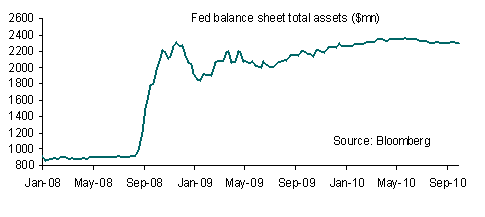
Ahead of today’s highly anticipated Fed FOMC meeting markets are holding their breath to determine exactly what the Fed will deliver. The consensus view is for the Fed to announce a programme of $500 billion in asset purchases spread over a period of 6-months. The reaction in currency markets will depend on the risks around this figure. Should the Fed deliver a bigger outcome, say in the region of $1 trillion or above, the US dollar will likely come under renewed pressure. However, a more cautious amount of asset purchases will be US dollar positive.

It has to be noted that the Fed will likely keep its options open and keep the program open ended depending on the evolution of economic data which it will use to calibrate its asset purchases. The USD will likely trade with a soft tone ahead of the Fed outcome, but with so much in the price, it may be wise to be wary of a sell on rumour, buy on fact outcome.

Whatever the outcome many currencies are at pivotal levels against the USD at present, with AUD/USD flirting around parity following yesterday’s surprise Australian rate hike, EUR/USD holding above 1.4000, GBP/USD resuming gains above 1.600 despite a knock back from weaker than forecast construction data, whilst USD/JPY continues to edge towards 80.00. Also, both AUD and CAD are trading close to parity with the USD. The Fed decision will be instrumental in determining whether the USD continues to remain on the weaker side of these important levels.

Going into the FOMC meeting the USD has remained under pressure especially against Asian currencies as noted by the renewed appreciation in the ADXY (a weighted index of Asian currencies) against the USD this week. Although it appears that the central banks in Asia have the green light to intervene at will following the recent G20 meeting the strength of capital inflows into the region is proving to be a growing headache for policy makers. One option is implementing measures to restrict “hot money” inflows but so far no central bank in the region has shown a willingness to implement measures that are deemed as particularly aggressive.

There has been some concern that Asia’s export momentum was beginning to fade as revealed in September exports and purchasing managers index (PMI) data in the region and this in turn could have acted as a disincentive to inflows of capital, resulting in renewed Asian currency weakness. The jury is still out on this front but its worth noting that Korean exports in October reversed a large part of the decline seen over previous months. Moreover, the export orders component of Korea’s PMI remained firm suggesting that exports will resume their recovery.

Nonetheless, manufacturing PMIs have registered some decline in October in much of Asia suggesting some loss of momentum, with weaker US and European growth likely to impact negatively. However, China’s robust PMI, suggests that this source of support for Asian trade will remain solid. Similarly a rise in India’s manufacturing PMI in October driven largely by domestic demand, highlights the resilience of its economy although with inflation peaking its unlikely that the Reserve Bank of India (RBI) will follow its rate hike on Tuesday with further tightening too quickly.

Why Buy Asian FX (Part 1)

Given all the attention on Greece and European fiscal/debt woes over recent weeks it’s been easy to forget about the success story of Asian economies. Of course, there has been a lot of attention on China and the international pressure to revalue its currency. However, the stability and resilience of Asian economies has been impressive throughout the financial crisis and recent Greek saga, helping to boost the attraction of Asian currencies.

Asia has managed to avoid the fiscal/debt problems associated with many developed economies, due to much better fiscal management over recent years. There are a couple of exceptions however, including the Philippines and India, but the fiscal positions in these countries have seen an improvement and are unlikely to lead to anywhere near the same sort of problems associated with Greece and other European countries.

So far this year capital inflows into Asian equity markets have much been stronger than 2009, albeit after a rocky start to the year when flows dried up due to rising risk aversion. Since then inflows have resumed strongly. The comparison to 2008 is even more dramatic as much of Asia registered significant capital outflows that year. South Korea, India and Taiwan, respectively, have led the way in term of inflows into equity markets in 2010, with inflows of $4.3 billion, $3.7 billion and $3.3 billion, respectively.

It is no coincidence that Asian currencies are most sensitive to the performance of Asian equity markets, with strong capital inflows and rising equities leading to stronger currency performance. Asia is set to continue to be a strong destination for equity flows over coming months, which given the high Asian equity correlation with local currencies, will lead to further appreciation in most Asian FX. A likely CNY revaluation in China will also help to fuel further Asian FX upside.

Asian currencies on the up

The third quarter of 2009 has proven to be another negative one for the US dollar.  Over the period the dollar index fell by over 4%.  The only major currency to lose ground against the dollar over this period was the British pound.  Most other currencies, especially the so called “risk currencies” which had come under huge pressure at the height of the financial crisis, registered strong gains led by the New Zealand dollar, Swedish krona and Australian dollar.  Although the euro also strengthened against the dollar it lagged gains in other currencies over the quarter.

Asian currencies also registered gains against the dollar in Q3 but to a lesser extent than G10 currencies.  Asian currency appreciation was led by the Korean won, Indonesian rupiah and Singapore dollar, respectively.  The under performer over Q3 was the Indian rupee which actually depreciated against the US dollar slightly.  The reason for the smaller pace of appreciation for most Asian currencies was due mainly to intervention by Asian central banks to prevent their respective currencies from strengthening too rapidly, rather than due to any inherent weakness in sentiment.

In fact, Asian currencies would likely be much stronger if it wasn’t for such FX interventions.  A good indication of the upward pressure on Asian currencies can be found from looking at the strength of capital inflows into local stock markets over recent months.  South Korea has registered the most equity capital inflows so far this year, with close to $20 billion of flows into Korean equities year to date but in general most Asian stock markets have registered far stronger inflows compared with last year.   

For the most part, balance of payments positions are also strong.  For example, South Korea recorded a current account surplus of $28.15 billion so far this year, compared to a deficit of $12.58bn over the same period last year.  This is echoed across the region.  Although surpluses are expected to narrow over coming months due mainly to a deterioration in the terms of trade, the overall health of external positions across the region will remain strong and supportive of further currency appreciation.  

The outlook for the final quarter of 2009 is therefore likely to be positive for Asian currencies, with the US dollar set to weaken further against most currencies.  Some risk will come from a potential reversal in global equity market sentiment but overall, further improvements in risk appetite will support capital inflows into the region.  Capital will be attracted by the fact that growth in Asia will continue to out perform the rest of the world and yet again only interventions by central banks will prevent a more rapid appreciation of Asian currencies.