Singapore revalues, Asian currencies jump

The positive tone to risk appetite is keeping the USD on the back foot and for once FX attention has turned away from events in Greece. Before elaborating further and staying with Greece, it’s worth highlighting that the outcome of Greece’s note auction was reasonably solid, with more debt than anticipated being sold. However, the cost of borrowing for Greece rose compared to the previous auction in January, which means that the Greece will still suffer higher funding costs to roll over debt.

The positive reception to the debt offering was not particularly surprising given that it followed so closely after the EU/IMF loan package announcement but it is difficult to see sentiment for Greece and the EUR for that matter, getting much of a lift. The main positive for the EUR is the fact that market positioning remains very short but EUR/USD is likely to struggle to make much headway above technical resistance around 1.3653.

More interestingly Asian central banks are continuing on the track towards fighting rising inflation pressure and Asian currencies, in particular the SGD, were boosted by the Monetary Authority of Singapore (MAS) decision to revalue its currency. Singapore has moved back to a policy of a “modest and gradual appreciation” of the SGD from a policy of zero appreciation, which obviously implies openness to further FX appreciation in the weeks and months ahead.
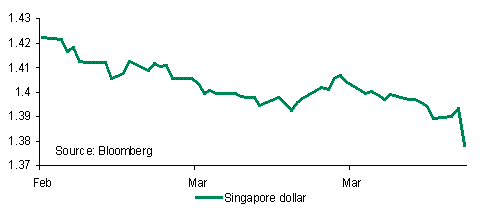
The rationale for the decision was clear and as revealed in the strong first quarter Singapore GDP data which revealed a 13.1% annual rise. Stronger growth is fuelling growing inflationary concern and to combat this Singapore’s MAS will allow greater SGD appreciation. The reaction in other Asian currencies was also positive, with markets (quite rightly in my view) that other Asian central banks will be more tolerant of currency strength in their respective currencies.

Moreover, Singapore’s move was pre-emptive, perhaps with one eye on an imminent revaluation in China. The recent easing in tensions between the US and China has if anything increased the likelihood that China revalues its currency, the CNY, sooner rather than later, and most likely before the end of Q2 2010. Whatever the rationale, strengthening inflation pressure across the region, will mean a less FX interventionist stance in Asia, and likely stronger currencies over coming months.

US/China Tensions Ratchet Higher

FX policy tension is a theme that looks to be making a come back. The potential for CNY revaluation continues to be hotly debated, with international pressure on China intensifying. For its part China continues to resist such calls, but growing speculation that the US will label China a “currency manipulator” in the semi-annual US Treasury report on 15 April suggests that the issue will remain very much on the radar screen.

Tensions have ratcheted higher in the wake of a proposed bill by US senators targeting countries with “fundamentally misaligned currencies” and those needing “priority action”. Any country that is targeted would then have a year to correct its currency or face a case at the World Trade Organisation. If China is labelled as a currency manipulator it could also result in anti dumping regulations.

Much of the increase in tension may be attributable to politicking ahead of the November mid-term Congressional elections but it is clear that the issue is not going away quickly. Chinese Premier Wen’s strong comments over the past weekend denying any need for revaluation of the CNY suggests that the stakes will get even higher over coming months.

It is looking increasingly difficult for the US administration to ignore Congress’ calls for stronger action on FX. Moreover, US President Obama’s pledge to double US exports within 5-years will require some USD weakness, but the USD will need to weaken against Asian currencies led by China and not just against the usual culprits such as the EUR.

There is little sign of this happening anytime soon as Asian central banks continue to intervene to prevent their currencies from strengthening. Nonetheless despite China’s insistence that it does not believe the CNY is undervalued China is likely to be edging closer to an eventual revaluation in the CNY sometime in Q2 2010 as it combined a stronger currency with higher interest rates and tighter lending to curb inflation. A stronger CNY will also spur other Asian central banks to allow stronger currencies.

A deterioration in the China/US relationship could have potentially significant FX implications. The latest US Treasury TIC report this week showed that China reduced its holdings of US Treasuries for the third straight month in January. Should China feel that it needs to retaliate against a more aggressive US trade or FX stance it could reduce its holdings of US Treasuries further.

Dollar on top as central banks deliberate

There has been a veritable feast of central bank activity and decisions with most attention having been on the Fed’s decision.  In the event the FOMC meeting delivered no surprises in its decision and statement.  Basically the Fed acknowledged the recent improvement in economic activity but continued to see inflation as subdued and maintained that policy rates will remain low for an “extended period”.  The Fed also noted that most liquidity facilities were on track to expire on 1 February suggesting that they remain on track to withdraw liquidity.  

There was similarly no surprise in the Riksbank’s decision in Sweden to leave interest rates unchanged, with the Bank reiterating that it would maintain this stance through the autumn of 2010.  The SEK has been stung by outflows due to annual payments of premiums to mutual funds by the Pension Authority but the impact of this has now largely ended leaving the currency in better position.  Norway’s Norges Bank unexpectedly raised interest rates, for a second time, increasing its deposit rate by 25bps to 1.75%, with the surprise evident in the rally in NOK following the decision.   The other central bank to surprise but in the opposite direction was the Czech central bank which cut interest rates by 25bps.  

In contrast to the Norges Bank’s hawkish surprise the RBA has helped to toned down expectations for further rate hikes in Australia, with Deputy Governor Battellino suggesting that monetary policy was back in a “normal range” in contrast to the perception that policy was still very accommodative.   Weaker than expected Q3 GDP (0.2% QoQ versus forecasts of a 0.4% QoQ rise) data fed into the dovish tone of interest rate markets fuelling a further scaling back of rate hike expectations, casting doubt on a move at the February 2010 RBA meeting and pushing the AUD lower in the process.  Against this background AUD continues to look vulnerable in the short term, especially under the weight of year end profit taking and the resurgent USD.  

There was also some surprise in the amount of lending by the ECB, with the Bank lending EUR 96.9 bn in third and final tender of 1-year cash despite the cost of the loan being indexed to the refi rate over the term of the loan rather than being fixed at 1%.  There was also a sharp decline in the number of banks bidding compared to earlier 1-year auctions but at a much higher average bid.  This implies that some banks in Europe remain highly dependent on ECB funding despite the improvement in market conditions.   The EUR continues to struggle and its precipitous drop has shown little sign of reversing, with the currency set for a soft end to the year.  A break below technical support around 1.4407 opens the door to a fall to around 1.4290.   

The USD is set to retain its firmer tone in the near term though we would caution at reading its recent rally as marking a broader shift in sentiment.  The move in large part can be attributed to position adjustment into year end and is being particularly felt by those currencies that have gained the most in recent months.  Hence, the softer tone to Asian currencies and commodity currencies which appear to be bearing the brunt of the rebound in the USD.   Going into next year USD pressure is set to resume but for now the USD is set to remain on top, with the USD index on track to break above 78.000.

CNY appreciation speculation hits EUR

The USD index is trading close to a 15-month low and direction remains firmly downwards as risk appetite continues to improve and the USD’s status as a funding currency remains unaltered.   Whether it’s a weak USD driving stocks higher or vice-versa, US stocks are currently trading at 13-month highs, maintaining the negative correlation with the USD index. 

One currency that has failed to take advantage of the weak USD over recent days is EUR/USD and its failure to make a sustainable break above 1.50 highlights that momentum in the currency is fading.  EUR/USD looks vulnerable on the downside in the short term, with resistance seen around 1.5050.  Speculation that China will resume CNY appreciation has taken some of the steam out of the EUR given that it implies less recycling of intervention flows into the currency.  

The speculation that China will allow a stronger CNY follows a significant change by China’s central bank, the PBOC to its stated FX policy. The Bank removed the statement  that it will keep the CNY “basically stable” and noted instead that foreign exchange policy would take into account “capital flows and major currency movements”.   

Although this does not mean the CNY will immediately strengthen it will add to speculation that China will allow some appreciation next year following a long stretch in which the CNY has effectively been stuck in a very tight range against the USD.   The timing of the change in rhetoric should come as little surprise as it coincides with greater international calls for a stronger CNY to help rebalance the global economy as well as an improvement in economic data domestically.  

Any change in stance on the CNY could be a significant factor in determining the direction for the EUR given that it not only implies less flows into EUR from China but also from other central banks in Asia which may take China’s cue and allow greater strengthening of their currencies versus USD.  Given that central banks in Asia had been intervening to prevent local currency strength and then recycling this USD buying into other currencies, especially EURs, the change in stance could play negatively for the EUR. 

Currencies are also a focus of the APEC meeting of finance ministers, with the draft statement agreeing that flexible exchange rates and interest rates are critical in obtaining balanced and sustainable growth.  This has interesting implications given the FX intervention by Asian central banks to prevent their respective currencies from strengthening and attention will focus squarely on China’s CNY policy.

Who’s going to follow in Brazil’s footsteps?

Last week saw a sell off in some emerging market currencies and whilst this may simply have been profit taking attributable to some large hedge funds it did coincide with the imposition of a tax on portfolio inflows in Brazil.  The tax dented sentiment as it quickly fuelled speculation that it would be followed elsewhere, especially in countries that had seen rapid FX appreciation.  

The BRL is one of the best performing currencies this year against the USD whilst the stock market has surged on strong capital inflows.  The huge increase in USD liquidity globally and substantial improvement in risk appetite has fuelled strong capital inflows into Brazil especially as the country has proven to be one of the most resilient during the crisis.

Although on the margin the tax will have a negative impact on speculative flows into Brazil it is unlikely to have a lasting impact.  Previous such measures have done little to prevent further appreciation.  The BRL is clearly overvalued by around 25-30 at present, but the tax in itself will not be sufficient to result in a move back to “fair value”. 

At best it may act a temporary break on currency appreciation and could limit the magnitude of further gains in the real but this could be at the cost of distorting resource allocation and market functioning.   The longer term solution is to enhance productivity but this will not help in the interim. The tax may make investors a little more reluctant to pile into Brazilian assets, which is what the authorities will desire but already the BRL is back on its appreciation path suggesting a short lived reaction. 

Other countries that could follow include South Africa, Turkey or South Korea but South Africa has already denied that it has any plans to move in this direction.  In South Korea’s case the central bank has chosen to intervene in currency markets to prevent the further strengthening in the won but that also has implications for sterilizing such flows limiting the extent that intervention can be carried out.    

The bottom line is that the broad based improvement in risk appetite is proving to be a strong driver of capital flows into emerging markets and the reality is that many emerging economies such as Brazil and many in Asia have been much more resilient than feared. 

Although there is clearly a limit on the extent that these countries want to allow their currencies to strengthen versus USD the upward pressure will continue, leading to more FX intervention and potential imposition of taxes or restrictions such as implemented in Brazil.   Despite this the outlook for most emerging currencies remains positive and the authorities will face an uphill struggle.