Risk Appetite Puts Dollar On The Back Foot

Markets look somewhat calmer going into this week helped by comments by Fed members who noted that the discount rate hike did not signal a shift in monetary policy, something which is likely to be repeated by Fed Chairman Bernanke in his testimony to Congress on Wednesday and Thursday.  A tame US January CPI report last Friday helped too, giving further support to the view that the Fed will not hike the Fed Funds rate for some time yet; a rate hike this year seems highly unlikely in my view.  

Data this week will be conducive to a further improvement in risk appetite and despite the lingering concerns about Greece the EUR may find itself in a position to extend gains.  In Europe all eyes will be on the February German IFO survey and eurozone sentiment indicators, which following the surprising strength in the manufacturing Purchasing Managers Indices (PMIs), are likely to reveal solid gains. 

The main highlights in Japan this week includes January trade data and industrial production. The trade numbers will be particularly important to determine whether the rebound in exports due in large part to robust Asian demand, has continued whilst the bounce back in exports will be a key factor in fuelling a further gain in industrial output. 

In the US aside from the testimonies by Fed Chairman Bernanke there are plenty of releases on tap including consumer confidence, new and existing home sales, durable goods orders and a likely upward revision to Q4 GDP.  For the most part the data will show improvement and play for a further improvement in risk appetite. 

FX direction will depend on whether markets focus on the potentially positive USD impact of a reduction in USD liquidity or on the likely firmer tone to risk appetite this week.  Given expectations of firmer data and the soothing tone of the Fed, risk currencies will likely perform better, with crosses such as AUD/JPY favoured.  The USD will likely be placed on the back foot, especially given the very long market positioning in the currency.

The EUR will be helped by the fact that speculative market, according to the CFTC IMM data, holds record short positions in the EUR (as of the week ended 16 February) giving plenty of potential for short-covering.   The more timely Tokyo Financial Exchange (TFX) data also reveals that positioning in EUR/JPY has continued to be scaled back.  

CFTC Commitment of Traders (IMM) data – Net EUR speculative positioning
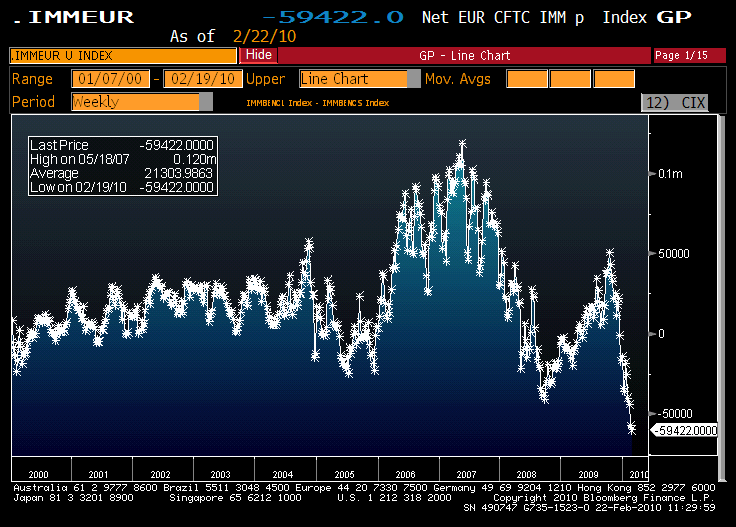
EUR/USD bounced smartly from its lows around 1.3444 on Friday, partly reflecting some short covering and the drop in FX volatility suggests the market is more comfortable with EUR/USD around these levels.  A positive IFO survey and improved risk appetite could see EUR/USD test resistance around 1.3774, its 20 day moving average, over coming days.  Ongoing Greek concerns suggest that any EUR bounce will be limited, however. 

USD/JPY looks well supported and although data this week will suggest that exports are improving despite JPY strength, the relatively more aggressive stance of the Fed compared to the BoJ, long JPY positioning, and improved risk appetite, give plenty of scope for the JPY to extend losses, with technical USD/JPY support seen around 91.28.

Tarnishing The Euro

I am just finishing up a client trip in Japan and waiting to take a flight back to Hong Kong. The time ahead of the flight has allowed some reflection on my meetings here. One thing that has been particularly evident is the strong interest in all events European. Some I have spoken to have wondered out loud whether this the beginning of the end of the European project.  At the least it is evident that fiscal/debt problems in Greece and elsewhere in Europe have tarnished the image of the EUR.

Markets continue to gyrate on any news about Greece and the potential for support from the Europe Union and/or IMF. The divergent views between European countries about how to deal with the problem has intensified, suggesting that reaching an agreement will not be easy. Some countries including the UK and Sweden have suggested enrolling the help of the IMF but this has been resisted by other European countries. Germany and France are trying to rally support ahead of today’s crucial meeting of European officials.

The EUR reacted positively to news that some form of support package is being considered but nothing concrete has appeared yet, leaving markets on edge. The EUR has been heavily sold over recent weeks; speculative market positioning reached a record low in the latest week’s CFTC Commitment of Traders’ IMM report. The fact that EUR positioning has become so negative suggests that the EUR could rebound sharply in the event that some support package for Greece is announced.

Any package will not come without strings attached, however, as European officials will want to avoid any moral hazard. A couple of options hinted at by German officials include fresh loans or some form of plan to purchase Greek debt. Either way, any solution to Greece’s problems will not be quick and will likely result in a sharp contraction in economic activity as the government cuts spending especially as Greece does not have the option of the old remedy of devaluing its currency. Meanwhile, strikes and social tensions in the country could escalate further. A solution for Greece will only constitutes around 2.5% of eurozone GDP will also not prevent focus from continuing to shift to Portugal, Spain and other countries with fiscal problems despite comments by Moody’s ratings agency to differentiate between the countries.

Even if the EUR rebounds on any positive news about support for Greece any relief is likely to prove temporary and will provide better levels to sell into to play for a medium term decline in the currency. Ongoing fiscal concerns, a likely slower pace of economic recovery, divergencies in views of European officials, and the fact that the EUR is still overvalued suggests that the currency will depreciate over much of 2010, with a move to around EUR/USD 1.30 or below in prospect over coming months.

Central banks in the spotlight

The market mood continues to be weighed down by a combination of worries including monetary tightening in China and Greece’s debt woes. Consequently, risk aversion has taken a turn for the worse over the last couple of weeks. Measures of currency and equity market volatility have also spiked. Meanwhile, risk currencies have remained under pressure, especially those that are most sensitive to risk aversion including AUD, NZD, CAD, and a long list of emerging market currencies.

Greece’s problems remain a major drag on the EUR, with speculative sentiment for the currency dropping close to the all time low recorded in September 2008, according to the CFTC IMM data. Further developments including news that the European Commission will officially recommend that Greece should implement more severe cuts on public sector spending are unlikely to help to reverse negative sentiment for the currency. A lack of confidence and scepticism over Greece’s ability to cut its budget deficit suggest little respite for the EUR in the weeks ahead.

Markets will have plenty of other things to focus on this week, with various manufacturing and service sector PMIs, four major central bank decisions, and the January US non-farm payrolls report, due for release. The PMIs are likely to confirm that output in both manufacturing and service industries remains expansionary but only consistent with limited growth rather than the rapid rebound in activity seen following past recessions.

The most interesting central bank decision this week is likely to be that of the Reserve Bank of Australia. Recent data has if anything given more reason for the central bank to raise interest rates, including the latest release which was the TD Securities inflation gauge, which jumped 0.8% in January, the biggest increase in 6-months. Although a hike is now largely discounted, some hawkish rhetoric from the RBA could be sufficient to give the AUD some support.

Although the UK Bank of England is unlikely to shift policy at its meeting on Thursday the statement will be scrutinized for clues as to whether quantitative easing is over. Any indication that there will be no further QE measures will play positively for GBP given that it has been restrained by speculation that the BoE will increase asset purchases. No change is also expected by the ECB but once again Greece will likely dominate the press conference. Meanwhile Norway’s Norges Bank is likely to pause in its policy of gradual tightening.

Clearly the funding currency of choice, the USD, has been one of the main beneficiaries of higher risk aversion and this has been reflected in the latest CFTC Commitment of Traders report, which shows that net short aggregate USD speculative positions have dropped sharply, with USD positioning close to flat again. Similarly, the other beneficiary, namely the JPY, has also seen a significant shift in positioning as shorts have been covered. Expect more to come.

Appetite for carry trades was not be helped by the news that the UK’s Lord Turner has signalled a regulatory crackdown on FX carry trades. The report in the UK press fuelled a sell of in JPY crosses but is unlikely to have more than a short term market impact given the practical difficulties in regulating carry trades. Nonetheless, the fact that speculative positioning is still quite long in the AUD, NZD and CAD suggest scope for more downside in such currencies in the current risk averse environment.

Q4 earnings and Chinese data

Since the start of the year the market has gyrated from “risk on” to “risk off” and back again. On balance the overall tone has been just about positive, with firmer economic data, most notably in China outweighing sovereign debt concerns in Greece and elsewhere. Although debt concerns are unlikely to dissipate quickly, especially given Greece’s inability to convince markets of its plans to cut its burgeoning budget deficit, the “risk on” tone is likely to win.

“Risk off” may be the tone at the start of the week however, as US equities ended the week on a negative note ahead of the Martin Luther King holidays. The holidays will likely keep trading slow. Data wise the main US events housing starts on Wednesday and the Philly Fed on Thursday. Q4 US earnings are likely to take a bigger share of market attention as the earnings season rolls on. Bank earnings will be a key focus, with Citigroup, Morgan Stanley, BoA, Wells Fargo and Goldman Sachs set to report this week.

Given the growing influence of Chinese data on markets the monthly data pack from China will capture more attention than usual on Thursday. In particular, GDP and inflation data will be of most interest. GDP data is likely to reveal an acceleration in growth in Q4 YoY to above 10% but given worries about over heating and following last week’s tightening in China’s monetary policy CPI data will be closely scrutinized. Inflation is likely to pick up further maintaining the pressure for further monetary tightening as well as a stronger CNY.

Elsewhere, in the eurozone the main event is the German ZEW survey tomorrow, which is likely to show further signs of flagging, due to Greek concerns. There is also an interest rate decision to contend with; the Bank of Canada is unlikely to surprise markets as it keeps policy unchanged tomorrow. The UK has a relatively heavier data slate, with CPI tomorrow, Bank of England minutes on Wednesday and retail sales at the end of the week.

The UK data kicked off on a positive note this week, with house prices rising 0.4% MoM in January and 4.1% YoY according to UK property website Rightmove, the biggest annual gain in over a year. Moreover, activity on Rightmove’s website reached a record high in the first full week of the year. The data as well as expectations that Kraft will raise its bid for Cadbury will likely help GBP in addition to other GBP positive M&A news. GBP/USD will look to test resistance around 1.6365 this week.

After a slightly firmer start helped by the weak close to US equity markets on Friday the USD is likely to generally trade on the back foot over the week. Speculative sentiment for the USD has definitely soured into the new-year as reflected in the CFTC IMM data which revealed a big jump in net short positions in the week ending 12 January 2010. Net aggregate USD positions shifted from +1.6k to -51.9k over the week, with the main beneficiaries being the EUR, and risk trades including AUD, NZD and CAD.

“Risk On”- Which Currencies Will Benefit?

It was a “risk on” beginning of the week as equity markets rallied, commodities prices rose, and G10 bonds and USD came under pressure. Stronger manufacturing PMIs helped to boost confidence in the global economic recovery, with solid PMIs revealed in China, and across the rest of Asia, UK, and the US. The US ISM manufacturing which rose to its highest since April 2006 also revealed a rise in the unemployment component, consistent with view of an unchanged reading for December payrolls.

In the Eurozone the PMI matched the flash release and remained in expansion territory though there was some slippage in Germany, Spain, and Italy, underscoring the likely underperformance of the Eurozone economy relative to expectations of faster recovery in the US. Nonetheless, the PMIs continued to show a picture of expansion, with the Eurozone PMI at its highest in 21-months.

The USD lost ground against the background of improved risk appetite and looks set to fall further abruptly ending its short covering rally. The USD appears to be finding little support from interest rate expectations, with the correlation between most currencies and relative interest rate differentials remaining relatively low for the most part (just -0.04 over the past 3-months between the USD index and US rate futures).  The correlation between the USD and US 10-year bond yields looks somewhat stronger however, and could offer some relief to the USD if yields continue to push higher.

Speculative (CFTC Commitment of Traders) data reveals just how massive the shift in USD positioning has been over recent weeks, with net aggregate USD positioning (vs EUR, JPY, GBP, AUD, NZD, CAD, CHF) registering its first net long USD position since May 2008. The swing in positioning has been dramatic, from -167k contracts on 15 September 2009 to +8.7k in the week ending 29th December 2009. The data also reveals the sharp deterioration in sentiment for the EUR to its lowest since September 2008. Likewise net JPY positions have shifted to their biggest net short since August 2008.

What does this imply? The market is very short EUR and JPY but the JPY has much further to go on the downside as it increasingly retakes the mantle of funding currency.  In any case compared to historical positioning JPY shorts are not so big suggesting more room to increase short positions.   

The EUR has moved into a short term uptrend, with the MACD (12,26,9) having crossed its signal line and positioning supports further upside. EUR/USD will need to take out strong resistance at 1.4459 (December 29) before it can embark on a more significant move higher. Asian currencies also look set to take more advantage of a resumption of USD weakness, especially in the wake of strong risk seeking capital flows into the region. KRW, TWD, IDR and PHP look bullish technically.