Risk Appetite Buoyed by Central Banks

Co-ordinated central bank action led by the Federal Reserve to lower the rate on USD liquidity by 50bps was accompanied by a cut in China’s reserve requirements and an easing by Brazil of its benchmark Selic rate. Unsurprisingly risk assets have rallied strongly overnight but once the announcement effect wares off the reality that the underlying tensions in the Eurozone remain in place will see any boost to sentiment wane. The move by the Fed will be a boon to the banking sector but should actually not have been too surprising as this tool was an easy one to use and one that should have been expected given the ample room to cut pricing on USD liquidity swap arrangements.

The other boost to markets overnight was the strong November ADP jobs report, which came in at 206k in November, and will lead to upward revisions to Friday’s payrolls data. Indeed, we now look for a 175k increase in non-farm payrolls from 120k previously. The trend of better than expected US data continued with a stronger than forecast reading for November Chicago PMI at 62.6. We expect this to be echoed by an increase in the ISM manufacturing survey today and the Fed’s Beige Book, all of which will at least allay concerns of a renewed US recession.

What will be important is whether the Fed move will be followed up by other measures from governments and central banks over coming days. Although European Union (EU) leaders have agreed to enhance their bailout fund attention is centred on French and German leaders, with hints that there could be a strong announcement over coming days. At the least, the upcoming EU Summit on 8/9 December will be expected to deliver concrete results otherwise the market rout will continue.

The USD will remain under pressure following the moves by central banks in line with the improvement in risk appetite. High beta risk currencies ie those with the highest correlation to risk over the past 3-months will benefit the most. These include RUB, AUD, TRY, CNH, KRW, GBP and CAD in respective order of correlation. All of these currencies are likely to register gains over the short term, especially given anticipation of further announcements from European officials and a reasonable US jobs report tomorrow.
Asian currencies at multi-year highs

Asian currencies are stronger in the wake of a sharp improvement in risk appetite following the approval of Greece’s austerity measures. The rally in Asian FX is revealed in the ADXY (an index of Asian currencies) index which is approaching a test of its 2nd May high around 119.26 around its highest level since August 1997. Technical indicators have turned more bullish, with the ADXY breaking above its key moving average levels (20, 50 & 100 day) and the 14-day relative strength index also turning higher.

The Asian FX rally has been led by the KRW, the Asian currency that has had the highest correlation with risk over the past few weeks. Given that risk aversion has dropped sharply since mid June it is no surprise that this currency has strengthened the most. USD/KRW is trading around its lowest level since August 2008. Strong equity capital outflows had kept the KRW on the back foot over much of June but there has been a bounce back in flows recently. However, USD/KRW is likely to find it tough to break below 1060 over the short-term, especially given likely resistance from the local authorities.

The THB, the worst performing Asian currency in June, has rapidly reversed some of its losses. The THB looks set to consolidate its gains following a decisive election result which saw the opposition Puea Thai Party gain control of parliament. The biggest relief for markets was the fact that the outcome was relatively clear cut, suggesting a potentially a smooth handover of power. Nonetheless, the currency has already jumped and after having dropped to around 30.40 from a high of around 31.01 USD/THB is likely to trade off gyrations in risk appetite.

The fact that the USD has lost some ground in the wake of firmer risk appetite and better news in Greece has also allowed Asian currencies to strengthen although it’s worth noting that amongst Asian currencies only the MYR has maintained a significant correlation with the USD index over the past 3-months. In other words, although USD weakness has helped to facilitate Asian currency strength, the recent strengthening in Asian FX is more likely to have been due to a rebound in capital inflows to the region.

Further Asian FX gains are likely over the near term especially as China continues to fix the CNY higher versus USD but given the recent rapid gains in some currencies, there is a risk of growing official resistance and intervention to slow or stem Asian FX gains. Moreover, the end of QE2 in the US suggests that the downside risks for the USD in general are not likely to be as prevalent, with a potential recovery in the USD over H2 likely to stand in the way of strong Asian FX gains over coming months.

Asia Helps The Euro Again

Following the pressure on markets over recent days there is some relief filtering through markets today although sentiment remains fickle. Weaker than expected US April durable goods orders data failed to dent confidence with equity markets ending in positive territory overnight even though the data added to a plethora of global data disappointments over recent weeks.

Once again the EUR has been saved by Asian demand, this time not directly for the EUR itself but by reports that China and other Asian investors will purchases EFSF bailout bonds, with China apparently reported to be “clearly interested” in the mid June sales of Portuguese bailout bonds, with Asian investors representing a “strong proportion” of the buyers.

Despite the reassuring news about Asian official interest in eurozone debt, problems in the periphery remain a major drag on the EUR. Developments at the two day G8 heads of governments meeting in Deauville and various speeches by officials from the European Financial Stability Facility (EFSF), European Union (EU) and European Central Bank (ECB) regarding Greece’s travails will be particularly important for EUR direction.

The various speakers are likely to maintain the pressure on peripheral countries to continue their austerity programmes in order to gain external support. Nonetheless, there still appears to be conflicting comments about what Greece will do with regard to its debt burden. Whilst some EU officials have espoused the benefits of extending Greek debt maturities on a voluntary basis, the ECB has steadfastly stood against any form of restructuring.

Other than the events above, in the US the second reading of Q1 GDP will be released. The consensus looks for an upward revision to a 2.1% annual rate from an initial estimate of 1.8% due mainly to an upward revision to inventories. US weekly jobless claims will also be of interest especially as the recent increase in the 4-week average for jobless claims has provoked renewed fears about the jobs market recovery.

Position Unwinding Boosts USD

The USD’s multi-month fall has come to an abrupt halt, with the currency registering gains in reaction to what appears to be a major position unwinding across asset markets, led by a drop in commodity prices.

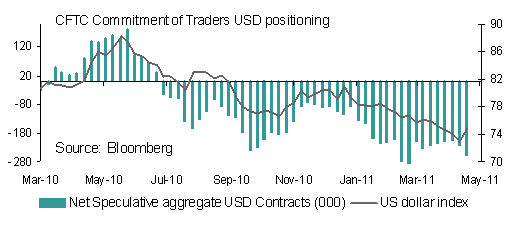
Will it continue? Whilst I am amongst the more bullish forecasters on the USD over the medium term, the current rally could prove to be short-lived in the absence of a shift in Federal Reserve rhetoric or end to quantitative easing (QE2). Nonetheless, the market had got itself very short USDs (as reflected in the CFTC IMM data as of early last week which showed an increase in net short positions) and the rally in the USD last week was likely spurred by major short-covering which could extend further into this week.

The move in the USD gained momentum as European Central Bank (ECB) President Trichet proved to be less hawkish than many expected in the press conference following last Thursday’s ECB meeting. Moreover, renewed worries about Greece at the end of last week, with a report in the German Der Spiegel, later denied by Greek officials, that the country was planning to leave the Eurozone dented the EUR,

Taken together with the improving trend in US April non-farm payrolls (April registered +244k increase, with private payrolls 268k), these factors colluded to provide further positive stimulus to the USD and negative fallout on the EUR. The room for EUR downside is evident in the net long EUR speculative position, which rose to its highest since December 2007 as of 3rd May.

This week’s batch of US releases including March trade data, April retail sales and CPI, are unlikely to result in a reversal in last week’s trend though a trend like reading for core CPI, with the annual rate below the Fed’s comfort zone will reinforce expectations of dovish Fed policy being maintained, which could inject a dose of caution into the USD’s rally.

Against the background of a likely widening in the US trade deficit in March there will plenty of attention on the annual strategic and economic dialogue beginning today, with markets interested in discussions on Chinese worries about the gaping US fiscal deficit and US concerns about China’s exchange rate policy.

Greece’s denial of plans to leave the eurozone and discussions over a further adjustment to Greece’s bail out package, may help limit any drop in the EUR this week though it will by no means mark the end of such speculation about the periphery especially with this weeks’ Q1 GDP data releases across the eurozone likely to further highlight the divergence between the core and the periphery even if the headline eurozone reading rebounds strongly as we expect.

In the UK the Bank of England Quarterly Inflation Report will be the main influence on GBP. Downward growth revisions will play into the view that inflation will eventually moderate, capping expectation of higher interest rates over the coming months. However, the likely upward revision to near term inflation forecasts will help limit any damage to GBP.

GBP has lost ground to the USD but it should be noted that it has outperformed the EUR over recent days, reversing some of the recent run up in EUR/GBP. Given that EUR sentiment is likely to remain fragile this week, GBP may continue to capitalise, with a test of EUR/GBP 0.8672 on the cards.

Financial Times Guest post: Rupee can serve as a reserve currency too

Please see below an excerpt from the Financial Times beyondbrics section in which I wrote a guest post about the Indian rupee.

Amidst the euphoria surrounding the internationalisation of China’s currency, the renminbi, attention on the Indian rupee appears to have fallen into the shadows. Admittedly China has been announcing new measures on the path to internationalisation almost on a weekly basis whilst India appears to have taken a more gradual approach, but it’s not too late for India to regain some of the limelight.

Perhaps it is surprising that the rupee is hardly talked about when discussing reserve currencies. The last BIS Triennial Survey of FX market activity revealed that the rupee accounted for 0.9 per cent (the same as the Russian rouble) of daily foreign exchange market turnover, which may seem small compared to the 84.9 per cent of turnover accounted for by the USD or 39.1 per cent by the EUR but is still ahead of many other developing currencies including China, which accounts for only 0.3 per cent of turnover. Moreover, India’s share of turnover has risen steadily from 0.1 per cent in 1998.

Read the rest at http://blogs.ft.com/beyond-brics/2011/04/14/guest-post-rupee-can-serve-as-a-reserve-currency-too/