Markets in limbo ahead of policy rate decisions

Markets are generally range-bound ahead of tomorrow’s Japan, Eurozone and UK interest rate decisions, as reflected in the flat performance of equity markets overnight. Risk appetite remains positive though still lower than the high levels seen during most of March. China’s interest rate hike did not change the market’s perspective, with markets reacting well.

Overnight the Fed FOMC minutes reflected a range of opinions on the timing of the end of QE2 and the Fed’s exit strategy but the majority view was to end QE2 as planned at the end of June leaving markets, with little new to digest. The USD was a little undermined by a weaker than expected US March ISM non-manufacturing survey but losses are likely to be limited.

Meanwhile there was more negative peripheral news in Europe, with Moody’s cutting Portugal’s sovereign credit ratings by one notch, with Moody’s highlighting the urgent need for financial support from the EU. Portuguese debt took a hit but eurozone markets in general including the EUR continue to take such news in their stride, with EUR/USD holding above 1.4200. Firm readings for the eurozone final services purchasing managers index (PMI) in March helped to support sentiment, outweighing the negative impact of a drop in eurozone retail sales.

GBP was a key outperformer, helped by a much stronger than expected services PMI, which helped GBP/USD breach 1.63 overnight. Today’s industrial and manufacturing production data will likely reveal firm readings too, helping GBP to consolidate its gains but the currency looks rather rich around current levels, with risks skewed to the downside.

JPY was another mover, having breached 85.00 versus the USD, with USD/JPY now some 6 big figures higher from its post earthquake lows. Japanese authorities will undoubtedly see a measure of success from their joint intervention but the reality is that the shift in bond yields (2-year US / Japan yield differentials have widened by close to 30 basis points since mid March, are finally having some impact on USD/JPY as reflected in the strengthening in short-term correlations.

EUR/USD remains resilient to negative peripheral news such as the Portugal credit ratings downgrade, with further direction from tomorrow’s European Central Bank (ECB) meeting and accompanying statement. The risk that the ECB is not as hawkish as the market has priced in holds some downside risks to EUR.

Asian currencies are holding up well though it looks as though the ADXY (Bloomberg-JP Morgan Asian currency index) may have hit a short term barrier. Range trading for EUR/USD suggests little directional influence for Asian currencies in the short-term. Nonetheless, portfolio capital inflows continue to support Asian FX with all Asian equity markets recording foreign inflows so far this month. In particular, KRW continues to outperform. Note that Korea has recorded a whopping inflow of $1.1bn in equity inflows month-to-date.
Risk on, US dollar pressure

FX markets have plenty of different factors to digest these days and after a harrowing couple of weeks markets began this week on a firmer footing. The overall tone into this week is to load up on risk assets. News that the nuclear situation in Japan may closer to stabilising has helped, whilst markets easily shook off another hike in China’s reserve ratio and ongoing conflict in Libya as Allied forces step up their campaign in the face of continuing resistance from Gaddafi’s forces.

Improved risk appetite has helped to keep the JPY on the defensive along with the continued threat of FX intervention, with further official JPY selling likely in the days ahead. Interestingly the intervention last Friday was estimated at only JPY 530 billion ($6.2 billion), much lower than previously thought. USD/JPY 80 remains a major line in the sand and any sign of another breach of this level will likely be met with official JPY selling. I suspect that the Japanese authorities will not be content until USD/JPY is far higher. In this respect its worth noting an official report released earlier in March highlighting that Japanese companies are not profitable at a USD/JPY rate below 86.

The EUR looks overbought around the 1.42 level but seems to be a beneficiary of Japanese FX intervention (perhaps a recycling of USDs into EUR) as well as comments by European Central Bank (ECB) Council members reiterating their intention to hike the refi policy rate, likely at the April ECB meeting. In a similar vein to the recycling of intervention USDs into EUR, Middle East entities may also be recycling petrodollars into EUR whilst news that Russia has permitted one of its oil related funds to buy Spanish debt has given a lift to sentiment for the EUR. Over the near term EUR/USD may struggle to make much headway above 1.42, with further direction coming from the EU leaders meeting on 24/25 March.

GBP is also doing well, having jumped close to the 1.6400 level versus USD, with UK February CPI giving the currency a further lift. The outcome at 4.4% YoY, which was not as bad as rumoured but in any case worse than consensus will give the hawks in the Bank of England MPC further ammunition to push for a policy rate hike. The fact that core inflation also increased suggests that the jump in headline inflation cannot merely be brushed under the table. A BoE rate hike is increasingly looking like a done deal. Renewed inflation worries in the UK and the hawkish rhetoric from ECB officials is sufficient to keep the USD under pressure.

Interest Rate Decisions Galore

The Reserve Bank of New Zealand (RBNZ) decision to cut policy rates by a bigger than expected 50bps does not necessarily mark the onset of a new wave of NZD selling. Indeed, whilst the NZD was hit by the rate cut it recovered quickly.

The NZD was aided by comments from the RBNZ Governor Bollard that short term inflation may spike due to the earthquake but this tempered by another RBNZ official who stated that the central bank may hold rates at 2.5% at least until January 2012. The post meeting statement indicated that the RBNZ will not embark on a series of rate cuts, a fact that will provide some relief to the Kiwi. Moreover, the currency looks increasingly oversold especially relative to the AUD as indicated by relative positioning.

Weaker than expected employment data in Australia will also help to stem AUD strength versus NZD. After many months of positive surprises the labour market is showing signs of cracking. Admittedly full time employment rose but this was outweighed by an even bigger drop in part time employment, resulting in a 10.1k fall in overall employment.

Although the AUD is unlikely to face too much downside markets the data will likely dampen expectations of possible rate hikes in the months ahead. My preferred way of playing possible AUD underperformance is via the NZD. AUD/NZD is likely to face plenty of resistance around the 1.3800 level and eventually as indicated by our quantitative models the currency pair is likely to move lower over coming weeks.

In sharp contrast to the RBNZ, the Bank of Korea hiked interest rates by 25bps in a further move to normalize policy. The decision was not much of a surprise and the statement indicated that more rate hikes should be expected. The KRW remains rangebound but the currency remains on path for further appreciation over coming months. The surprise trade deficit in China has weighed on Asian currencies in general but weakness is likely to be limited.

The Bank of England is the next central bank on tap today but is unlikely to hike rates despite the hawkish shift within the Monetary Policy Committee. A rate hike is moving closer but the Bank will likely wait until at least May before moving. Further details about today’s decision will as usual wait for the minutes in two weeks time. GBP looks vulnerable and whilst a rate move today is not expected the currency may lose ground over coming days against the background of a firmer USD.

China Hikes Rates, More On the Cards

In an otherwise unexciting day China livened things up by raising its 1 year deposit and lending rates by 25 basis points. The hike, the third in the last four months, should not have come as a surprise, given the growing emphasis by China’s central bank PBoC, to dampen inflation pressures. Indeed, more hikes are on the cards, with at least another two more in prospect over H1. The other tool to combat inflation is CNY appreciation further gains in the currency over coming months should be expected to around 6.3 by year-end versus USD.

Global markets largely shrugged of China’s move, with generally positive market sentiment continuing. Even in the eurozone, where there was some disappointment at the surprise drop in German December industrial production, market sentiment continued to improve as Egypt and local debt worries eased further. EUR was particularly resilient despite calls from a Belgian think tank that Greece needs to restructure its debt to avoid a long and painful path ahead. Commodity currencies also showed impressive resilience to China’s rate hike, with both the AUD and NZD holding up well.

The overall positive risk background is supportive for Asian currencies and other risk trades. Currencies in Asia remain highly correlated with portfolio capital inflows and so far this year the weakness in the INR and THB has matched the strong equity outflows from India and Thailand. However, this appears to be reversing, especially in the case of India registering positive equity flows this month, helping the INR to reverse some of its losses.

In the absence of key data releases markets will turn their attention to the testimony by Fed Chairman Bernanke to the House budget committee where he will give comments on the economy, jobs and the budget. Dallas Fed’s Fisher stated overnight that whilst he expects the Fed to complete QE2 he would not support another round of quantitative easing. Fisher’s comments on QE were similar to Atlanta Fed’s Lockhart who notes there is a “high bar” for more QE. Bernanke is unlikely to deviate from this tone in his speech today whilst also maintaining his view that there should be a long term commitment to fiscal retrenchment.

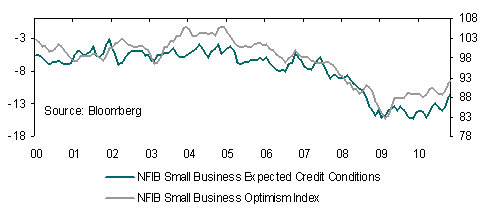
Against the background of improving risk appetite the USD is likely to stay under mild pressure although it is difficult to see a break of recent ranges for most currency pairs. EUR/USD ought to find strong support around its 100-day moving average 1.3535 whilst USD/JPY will be supported around 81.10. Equity sentiment is being supported by US data which remains encouraging. On cue the NFIB Small Business Optimism index duly rose in January to 94.1 as sentiment in this sector continued its improving trend.

Taken together with firmer equities, encouraging data is taking its toll on US bond markets, resulting in a back up in yields. Bond market sentiment wasn’t helped by a relatively poor 3-year auction. For example, US 2-year bond yields have backed up by over 30bps since 28 January. Bad news for bond is good news for the USD however, as higher relative US bond yields will likely help prevent a deeper USD sell-off, with EUR/USD in particular most reactive to relative eurozone / US bond yield differentials.

Econometer.org has been nominated in FXstreet.com’s Forex Best Awards 2011 in the “Best Fundamental Analysis” category. The survey is available at http://www.surveymonkey.com/s/fx_awards_2011

Temporary Euro Relief

Eurozone peripheral country travails continue to garner most market attention. There was at least a semblance of improvement on this front as peripheral bond spreads with German bunds narrowed on Tuesday but this was largely due to European Central Bank (ECB) bond buying than any improvement in sentiment. The fact that German bund yields also rose helped to narrow bund-peripheral spreads further.

A clearer test of sentiment will be today’s debt sales by Portugal followed by actions by Spain and Italy tomorrow. ECB buying of Portuguese bonds has given some relief to other debt, with Spanish and Italian debt spreads narrowing too. Even Greece managed to sell short term debt (EUR 1.95 bn of 26 week T-bills) but at a higher cost than the previous sale.

Perhaps a stronger boost to sentiment will come from the news that European Union (EU) governments are discussing an increase in the EUR 440 billion bailout fund in recognition of the fact that the fund may prove too small to cope if the crisis spreads to Spain. However, don’t expect a decision anytime soon, with next week’s meeting of EU finance ministers unlikely to agree to such a move. Support (or lack) of from Germany may prove to be a sticking point against the background of domestic political pressure.

Other options being considered include the possibility of the EFSF (European Financial Stability Facility) purchasing bonds in the secondary market and lowering interest rates on EFSF bailout loans. News that Japan will buy 20% of EFSF bonds this month as well as recent supportive comments from China suggest that an increase in the size of the EFSF may be easily funded by such investors. The EUR will gain some support against the background of such speculation but its upside may be restrained around its 200-day moving average at EUR/USD 1.3071.

In the US the economic news was not so positive for a change as the National Federation of Independent Business (NFIB) small business optimism survey came in weaker than expected in December, an outcome that will come as a blow given that it suggests some stuttering in the recovery process as well as hiring.

There is only secondary data scheduled today, with most attention on the Fed’s Beige Book later tonight. The survey of Federal Reserve districts will likely reveal a broad based but moderate improvement in economic conditions with the exception of housing activity. A speech by the Fed’s Fisher on Monetary policy will also be in focus. Like the Fed’s Plosser overnight he may highlight some caution about the impact of Fed quantitative easing (QE).

The AUD is increasingly feeling the impact of the flooding in Queensland Australia as the extent of economic damage is revealed. Reserve Bank of Australia (RBA) board member McKibbin estimated that it could knock off at least 1% from economic growth. This may prove too negative and although the flooding will result in a significantly negative impact on growth in Q1 rebuilding and reconstruction will mean that overall growth for 2011 will not be as significantly impacted. Nonetheless, a paring back in RBA policy tightening expectations will see the AUD come under further pressure, with a move down to around AUD/USD 0.9634 on the cards over the short-term.