Dollar, euro and yen view

Pressure on the US dollar was maintained last week but there were definite signs that selling momentum is slowing. The lack of major US data releases meant that the key focus for the USD was events in Europe. This week there will be some return of attention back to the domestic front, with heavyweight releases such January retail sales, manufacturing surveys, industrial production and inflation data.

On balance the data will provide more evidence of US recovery but as we have noted previously this is not necessarily positive for the USD. Firmer US data helps to boost risk appetite, which in turn plays negatively for the USD. This could be counterbalanced if US interest rate expectations turn more hawkish but the Fed has effectively ruled out such a prospect, with its commitment to maintain easy policy.

Europe has some important data releases over coming days including the German February ZEW survey and GDP data across the Eurozone. The data will be less encouraging, especially the Eurozone GDP data, compared to the US and is unlikely to give any support to the EUR. Instead events surrounding Greece will be crucial for EUR sentiment. EUR/USD appeared to lose some traction at the end of the week but the EUR remained firm against other currencies.

Greece’s approval of austerity measures overnight will bode well for markets but the tough stance of EU officials towards Greek austerity implementation means that focus will turn to yet another extraordinary meeting of European officials on Wednesday. Even assuming that some form debt deal and second bailout package is ironed out it is questionable how much the EUR will rally as so much good news is already in the price.

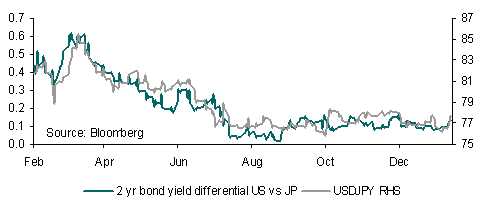
The JPY for a change managed to register relatively big moves, with USD/JPY pushing higher over the past week. The revelation that ‘stealth’ FX intervention was carried out by the authorities in Japan taken together with verbal warnings threatening more intervention helped to exacerbate JPY moves.

Speculation that the Bank of Japan is pondering further easing steps at its policy meeting on Tuesday may also be contributing to the softer tone in the JPY. Such hopes may be disappointed however, as we expect the BoJ to retain its current policy settings. The biggest factor explaining the move in USD/JPY is the fact that US bond yields moved higher relative to Japan, with the yield differential ending the week at its highest so far this year.
Beware of EUR short covering

Europe has plenty of events to focus on over the next couple of days including the European Central Bank (ECB) Council meeting, and debt auctions in Spain and Italy. While I am by no means a EUR bull the risk is skewed towards some short term recovery or at least stabilization around EUR/USD 1.28. The speculative market is extremely short EUR while policy makers, specifically German Chancellor Merkel and French President Sarkozy are making the right noises. it appears to have finally dawned on Eurozone officials that its not just about austerity but also about growth and reform.

News that Fitch ratings is unlikely to downgrade France’s ratings this year has provided a boost to Eurozone confidence. Greece could yet spoil the party given the ongoing discussion with the Troika (Euuropean Commission, International Monetary Fund and ECB) to finalise the second bailout package for the country. Opposition resistance within Greece suggests that more austerity may not be easy to implement. Meanwhile there are ongoing questions about the extent of writedowns that Greek debt will undergo. Despite these issues it appears that markets are becoming somewhat more immune to events in the Eurozone. While still high bond yields for Italy and other debt still point to ongoing trouble, risk appetite has firmed.

One factor that is helping to boost sentiment is the encouraging news out of the US. Although the Q4 earnings season has not began particularly well data releases look somewhat more positive. Not only has positive impact of last week’s US December jobs report continued to filter through the market but so has other news such as a pick up in small business confidence and a rise in consumer credit. These lesser watched data highlight the gradual recovery process underway in the US and the growing divergence with the Eurozone economy and support the view of medium term USD outperformance versus EUR.

Dollar, Euro and Yen Outlook 2012

The USD index is set for another positive year over 2012 but it will not be a star performer. The USD has been a clear beneficiary of the crisis in the eurozone and will continue to find sustenance unless there are signs of a concrete resolution on the horizon. My forecasts still see the USD index rising to 82.5 by the end of 2012. This would be well below the highs reached during the height of the financial crisis in March 2009 around 89.

While economic recovery is expected to continue over 2012 it will be a tepid one, with prominent downside risks. Therefore, one of the factors likely to hold the USD back is the likelihood that the Fed embarks on a fresh round of quantitative easing which I believe will take place sometime in H1 2012, specifically aimed at mortgage backed securities.

I am not bullish on the EUR but it is clear in my view that there is an underlying degree of support for the currency. In 2012 I expect more downward pressure on the currency. News on the economic front will become more negative and the region is set to slip into recession, albeit a mild one (with downside risks). In contrast, the outlook for the US looks somewhat better even if the recovery will look tame compared to past growth.

Relatively weak growth will maintain the pressure on the ECB to ease monetary policy and further interest rate cuts are likely in the months ahead. Easier policy will be another factor that undermines the EUR. Even if the there was some progress on a resolution to the eurozone debt crisis I doubt that the stress on markets would be relieved overnight. While the crisis has and will not deliver a death blow to the EUR it will mean that investors, even official ones, take a much more cautious view on the currency going forward. I look for EUR/USD to fall to around 1.26 by end 2012.

The JPY has been one of the most well behaved currencies over past months, remaining within a relatively tight range. Unfortunately for the Japanese authorities and for the economy the JPY has failed to build on any negative momentum caused by intervention. I expect USD/JPY and EUR/JPY to edge higher over coming months but the upside for both currency pairs is likely to be gradual over 2012.

Much will depend on whether risk appetite improves and more importantly on yield differentials between Japan and other countries. My end 2012 forecast for USD/JPY and EUR/JPY remain at 85 and 107, respectively but its worth noting that I now expect a firmer JPY in March 2012 against both USD and EUR than previously forecast due to the likelihood of prolonged uncertainty and elevated risk aversion over Q1 2012

Eurozone contagion spreading quickly

Contagion from the eurozone debt crisis is spreading quickly, threatening to turn a regional crisis into a global crisis. As highlighted by Fitch ratings further contagion would pose a risk to US banks. Consequently risk assets continue to be sold but interestingly oil prices are climbing. Taken together with comments earlier in the day from the Bank of England that failure to resolve the crisis will lead to “significant adverse effects” on the global economy, it highlights the risks of both economic and financial contagion.

Predominately for some countries this is becoming a crisis of confidence and failure of officials to get to grips with the situation is resulting in an ever worsening spiral of negativity. Although Monti was sworn in as Italian Prime Minister and Papademos won a confidence motion in the Greek parliament the hard work begins now for both leaders in convincing markets of their reform credentials. Given that there is no agreement from eurozone officials forthcoming, sentiment is set to worsen further, with safe haven assets the main beneficiaries.

EUR/USD dropped sharply in yesterday’s session hitting a low around 1.3429. Attempts to rally were sold into, with sellers noted just below 1.3560. Even an intensification of bond purchases by the European Central Bank (ECB) failed to prevent eurozone bond yields moving higher and the EUR from falling.

Against this background and in the absence of key data releases EUR will find direction from the Spanish 10 year bond auction while a French BTAN auction will also be watched carefully given the recent increase in pressure on French bonds. Having broken below 1.3500, EUR/USD will aim for a test of the 10 October low around 1.3346 where some technical support can be expected.

US data releases have been coming in better than expected over recent weeks, acting to dampen expectations of more Fed quantitative easing and in turn helping to remove an impediment to USD appreciation. While the jury is still out on QE, the USD is enjoying some relief from receding expectations that the Fed will forced to purchase more assets. Further USD gains are likely, with data today including October housing starts and the November Philly Fed manufacturing confidence survey unlikely to derail the currency despite a likely drop in starts.

US Dollar Under Broad Based Pressure

ThE USD has registered broad based losses over recent days and the longer the stalemate with regard to extending the US debt ceiling the bigger the problem for the currency. Indeed, it appears that the USD is taking the brunt of the pressure compared to other assets. For example, although US treasury yields have edged higher there is still no sense of panic in US bond markets.

Failure to raise the debt ceiling does not automatically imply a debt default but it will raise the prospect should an agreement not be reached in the weeks after. However, the impact on US bonds maybe countered by the increased potential for QE3 or safe haven flows in the event that no agreement is reached.

The worst case scenario for the USD remains no agreement on the debt ceiling ahead of the August 2 deadline but a short term solution that appears to be favored by some in the US Congress may not be that much better as it would effectively be seen as ‘kicking the can down the road’.

The better than hoped for agreement to help resolve Greece’s debt problems at the end of last week came as a blow to the USD given the almost perfect negative correlation between the USD and EUR over recent months. Moreover, the debt ceiling stalemeate is pouring salt into the wound. However, the situation is highly fluid and should officials pull a rabbit out of the hat and find agreement the USD could rally sharply.

All is not rosy for the EUR either and its gains have largely come by courtesy of a weaker USD rather than positive EUR sentiment. Economic news hardly bodes well for the EUR, with data in the eurozone looking somewhat downbeat. For instance, the Belgian July business confidence indicator dropped to a 9-month low in line with the weaker than expected outcome of the July German IFO survey last week.

Moreover, there are still several questions about last week’s second Greek bailout agreement and contagion containment measures including parliamentary approvals and lack of enlargement of the EFSF which could keep markets nervous until there are clear signs that implementation is taking place successfully.

A clear sign that the EU agreement has failed to inspire as much confidence as officials had hoped for is the lack of traction in terms of narrowing peripheral bond spreads, with the exception of Greece. This partly reflects a renewed ‘risk off’ tone to markets but this is not the sole reason.

EUR/USD has extended gains benefiting from USD weakness rather than any positive sentiment towards EUR, breaking above 1.4446, the strong multi-month corrective channel resistance, signalling a bullish move. The next level of technical resistance is around 1.4568 but direction will continue to come from the debt ceiling talks.