Ratings rampage hits Euro

Both the data flow and market liquidity will be thin over the last couple of weeks of the year. After a bashing over much of H2 2010 it looks as though the USD will end the year in strong form having risen by over 6% since its early November low. In contrast the EUR is struggling having found no support from the meeting of European Union officials at the end of last week in which they agreed to a permanent sovereign debt resolution after 2013 but failed to agree on expanding the size of the bailout fund (EFSF). Similarly there was no traction towards a common euro bond. EUR/USD is now verging on its 200-day moving average around 1.3102, a break of which could see a drop to around 1.2960.

The failure to enlarge the size of the EFSF was disappointing given worries that it is perceived to be insufficient to cope with the bailout of larger eurozone countries if needed. It also highlight that the burden on the European Central Bank (ECB) to prop up eurozone bond markets until confidence improves. The increase in the size of ECB capital from EUR 5.8 billion to EUR 10.8 billion will help in this respect. Such support was clearly needed last week following the rampage across Europe by ratings agencies culminating in Moody’s five notch downgrade of Ireland’s credit ratings, surprising because of its severity rather than the downgrade itself. Ireland’s ratings are now just two notches above junk status and the negative outlook could mean more to come.

It was not just Ireland’s ratings that came under scrutiny. Ireland’s multi notch downgrade followed Moody’s decision to place Greece and Spain on review for a possible downgrade whilst S&P revised Belgium’s outlook to negative. Unsurprisingly peripheral debt markets came under renewed pressure as a result outweighing positive news in the form of strong flash eurozone PMI readings and firm German IFO business confidence survey. EUR did not escape and sentiment for the currency remains weak, with CFTC IMM speculative positioning data revealing a fourth straight week of net EUR short positioning in the week to 14th December.

In contrast, sentiment for the US economy continues to improve. Congress’ swift passage of President Obama’s fiscal plan will help to shore up confidence in US recovery. Data this week will be broadly positive too. On Wednesday, US Q3 GDP data is likely to be upwardly revised to a 2.8% QoQ annualized rate. Durable goods orders excluding transportation are set to increase by a healthy 2.0% (Thu) whilst both existing (Wed) and new (Thu) home sales will reveal rebounds in November following a drop in the previous month.

In the UK the main highlight is the Bank of England (BoE) MPC minutes. Another three way split is expected but this should not cause more than a ripple in FX markets. GBP/USD has slipped over recent days but there appears to be little other than general USD strength responsible for this. The currency pair looks vulnerable to a drop below 1.5500, with 1.5405 seen as the next support level. On balance, the USD will be in good form this week although the drop in US bond yields at the end of last week may take some of the wind out of its sails.
Volatility Within Ranges

Most investors will likely be happy to see the tail end of May given the sharp losses in many asset classes over the month. At least over the last few days there was a sense of some healing, particularly in risk assets though it is questionable how long this can continue given the still many and varied uncertainties afflicting markets. A reminder of this came late on Friday, with Fitch downgrading Spain’s sovereign credit ratings despite the passage of austerity measures.

The Fitch decision highlights that Spain is rapidly becoming the new epicenter of the crisis; focus on the savings banks or Cajas is intensifying ahead of the June 30 deadline for mergers to qualify for government money, the minority government’s popularity is in further decline, whilst unions are threatening more strikes across the country. Unions in Greece and Italy are also pushing for coordinated strikes, highlighting the difficulties in pushing through austerity measures.

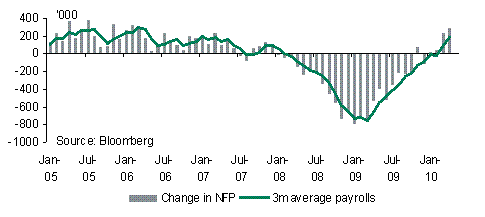
At least economic data is providing some solace to markets. Releases last week in the US highlighted the fact that consensus expectations are underestimating the pace of recovery; consumer confidence, durable goods orders and new home sales all came in above expectations. The same story is likely this week, but there is really only one piece of data that attention will focus on and that’s the May jobs report. The consensus is for a strong 508k increase in non-farm payrolls following a 290k increase in April, though around three-quarters of this will be related to census hiring. The unemployment rate is likely to dip slightly to 9.8%.

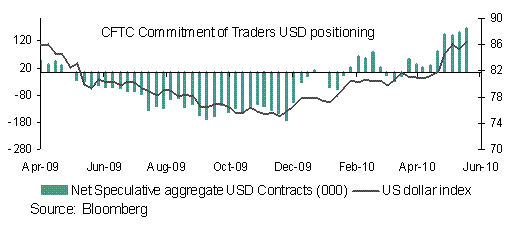
Markets are likely to be in limbo, with volatility in ranges likely this week. USD sentiment remains strong as reflected in the CFTC IMM data where net aggregate positioning is at an all time high, but further USD gains may be harder to come by ahead of the US jobs report and G20 meeting this weekend. Stretched USD positioning has proven no barrier to USD strength over recent weeks but the fact that markets are very long USDs could at the least result in a slower pace of further appreciation.

EUR speculative sentiment remains close to all time lows although there are signs of some relative stability over recent weeks. EUR/USD is likely to range between 1.2134 and 1.2475 this week. There was a sharp drop in net short JPY positions over the week (ie short-covering) though this appears at odds with the fall in the JPY. GBP speculative positions showed little improvement, languishing close to all time lows, whilst net longs in commodity currencies were pared back sharply, especially in AUD where net longs were cut by around half though sharp declines in positioning were also registered for NZD and CAD.

GBP could suffer due to worries about the UK government’s plans to reduce its burgeoning budget deficit following the resignation of Treasury Minister David Laws, following an expense scandal. The resignation hits the coalition just three weeks before the emergency budget and could result in complications on the negotiations between the Liberal Democrats and Conservatives on the substance of the deficit cutting measures. GBP/USD is likely to find support around 1.4260 and resistance around 1.4612 this week.

Contrasting the ECB with the Fed

Whether its year end book closing/profit taking and/or renewed doubts about the shape of recovery, asset markets have turned south recently.  Investor mood appears to be souring as risk aversion creeps back into the market psyche.  A string of disappointing US data releases over the last week including core retail sales, Empire manufacturing, industrial production, and housing starts, contributed to the reduced appetite for risk, resulting in a soft finish to the week for equity markets and a firmer USD.

Things are likely to take a turn for the better this week, however. Data will shed a little more light on the pace and magnitude of economic recovery and could result in some improvement in appetite for risk trades.  Despite an expected downward revision to US Q3 GDP, forward looking data on home sales, durable goods orders and personal income and spending as well as consumer confidence are likely to reveal increases.  In the Eurozone, data economic releases will paint a similar picture, including an expected increase in the closely watched barometer of business confidence, the German IFO survey. 

At the least economic data will remove some, but by no means all doubts about a relapse in the recovery process.  There is no doubting the veracity of the recovery in equity and commodity prices, despite doubts about its sustainability. Central banks may not react uniformly to this and the policy impact could vary significantly.  Already it appears that the ECB is moving more quickly towards an exit strategy compared to the Fed.  Although ECB President Trichet highlighted that the crisis is far from over at the end of last week, the Bank announced tougher standards for asset backed securities used as collateral, indicating that the need to provide emergency support to banks is much lower than it was. 

Clearly the ECB wants to avoid letting the market become over dependent on the central bank and will look to implement measures to this aim.  In contrast, the Fed is showing little sign of beginning this process and at least one member of the FOMC, namely St. Louis Fed President Bullard, was quoted over the weekend advocating that the Fed keep its MBS buying programme beyond its scheduled close in March. Evidence of the contrasting stance is also reflected in the fact that the Fed’s balance sheet is expanding once again whilst the ECB’s is contracting.  As a result of firmer data and comments by Bullard the USD is set to go into the week under renewed pressure, albeit within well defined ranges.