Greek Aid Boosts Euro

Greece is never far from the headlines and the big news over the weekend was once again centred on this small (in terms of economy size) eurozone Country, with the agreement by Eurozone members to provide up to EUR 30 billion in loans to Greece. This will be supplemented by additional contributions from the IMF to the tune of around EUR 15 billion. The rate of around 5% for the three-year fixed loan is well below that yielding on Greek debt but above the International Monetary Fund (IMF) standard lending rate. In other words, the terms of the loan are far more favourable than they would currently face in the market.

After weeks of haggling the decision to detail the amount and terms of a loan for Greece will help reassure markets and likely result in a narrowing in Greek spreads over the near term. Further details will be finalised early in the week including conditions imposed on Greece as well as the exact amount of the IMF contribution but the real test of confidence will be the reception to Greece’s EUR 1.2 billion sale of 3 and 6-month paper at the beginning of the week.

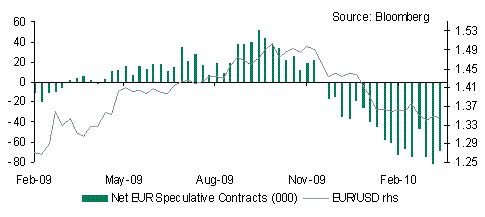
Markets were already embarking on a short covering exercise in EUR/USD early last week according to the latest CFTC IMM report which showed a reduction in net EUR short speculative positions. As a result of the weekend’s agreement the EUR looks set to consolidate its gains into the beginning of this week. Further out, there are still plenty of risks ahead and sellers are likely to emerge around EUR/USD resistance at 1.3696.

Data releases this week will be conducive to maintaining further support for risk appetite whilst shoring up recovery expectations. In particular US March retail sales are set to jump on the back of strong autos spending (consensus 1.2% monthly gain). March industrial production is also likely to record a healthy reading (consensus 0.7% month-on-month), whilst gains in both manufacturing (Empire manufacturing and Philadelphia Fed) and consumer confidence (Michigan confidence) for April are likely.

There will also be plenty of attention on Chinese data this week with a plethora of releases over coming days including FX reserves, GDP, loans data, inflation, retail sales and industrial production. In short, the data will continue to reveal a robust economic performance, which will be good for risk appetite and Asian currencies, but will also add to the pressure to revalue the Chinese currency, CNY, soon.

The USD impact will depend on whether the market reacts to firmer risk appetite or signs of stronger US growth. I suspect the former will apply for now, likely keeping the USD on the back foot early in the week. The main beneficiaries include risk currencies such as AUD, NZD and CAD as well as most Asian currencies. AUD/USD is set to target technical resistance around 0.9407 whilst NZD/USD will set its sights on resistance around 0.7252 over the next few days.

What to watch this week

The 85k drop in US non-farm payrolls in December was obviously disappointing given hopes/expectations/rumours of a positive reading over the month.  There was a small silver lining however, as November payrolls were revised to show a positive reading of +4k, the first monthly gain in jobs since December 2007.  Overall, the US labour market is still gradually improving as the trend in jobless claims and other indicators show. 

The fact that the market took the drop in US payrolls in its stride highlights the fact that recovery is becoming more entrenched despite the occasional set back.  More significantly weaker US jobs disappointment has been countered by strong Chinese trade data, which showed both strong imports and exports growth in December.  Whilst the data, especially the strength in exports, will support calls for a stronger CNY, it also highlights China’s growing influence on world trade and the important role that the country is providing for global economic recovery.

Market resilience in the wake of the drop in US payrolls and positive reaction to Chinese trade data will maintain a “risk on” tone to markets this week.  In particular, the USD is set to start the week on the back foot and despite data last week showing that Eurozone unemployment reached an 11-year high of 10% and growing evidence that the Eurozone economy is falling behind the pace of recovery seen elsewhere, EUR/USD held above technical support (200 day moving average) around 1.4257, and is setting its sights on the 16 December 2009 high of 1.4591 helped by renewed Asian sovereign interest.  

The main event in the Eurozone is the ECB meeting on Thursday no surprises are expected, with the Bank set to keep policy unchanged whilst maintaining current liquidity settings.  The bigger concern for European markets is ongoing fiscal woes in the region, with press reports warning of a ratings downgrade for Portugal and still plenty of attention on Greece and its attempts at deficit reduction.  Fiscal concerns are not going to go away quickly and will clearly act as a restraint on market sentiment for European assets. 

In a holiday shortened week in the US as markets close early on Friday ahead of the 3-day MLK holiday, there are a number of data this week that will shed further light on the shape of US recovery. The main event is the December advance retail sales report on Thursday, which is expected to record a reasonable gain, helped by firm autos sales. 

Preceding this, tomorrow there is expected to be a renewed widening in the US trade deficit in November whilst on Wednesday the Fed’s Beige Book as well as various Fed speakers this week including Bullard, Lockhart, Fisher, Plosser, Evans and Lacker, will give important clues ahead of the January 27 Fed FOMC meeting.  Bullard sounded dovish in his comments in Shanghai, as he highlighted that US interest rates will remain low for some time. 

At the end of the week there will be a heavy slate of releases including December CPI, industrial production, capacity utilization, January Empire manufacturing and Michigan confidence. The outlook for these data is generally positive, with gains expected in both manufacturing and consumer confidence, whilst hard data in the form of industrial production is likely to record a healthy increase and CPI is set to reveal another benign reading.

What’s driving FX – Interest rates or risk?

The November US retail sales report has really set the cat amongst the pigeons. For so long we have become accustomed to judging the move in the USD based on daily gyrations in risk aversion. Well, that may all be about to change. There was an inkling that all did not look right following the release of the November jobs report which unsurprisingly helped to boost risk appetite but surprisingly boosted the USD too.

It was easy to dismiss the USD reaction to year end position adjustment, markets getting caught short USDs etc. What’s more the shift in interest rate expectations following the jobs report in which markets began to price in an earlier rate hike in the US was quickly reversed in the wake of Fed Chairman Bernanke’s speech highlighting risks to the economy and reiterating the Fed’s “extended period” stance.

However, it all has happened again following the release of the November retail sales data, which if you missed it, came in stronger than expected alongside a similarly better than forecast reading for December Michigan confidence. The USD reaction was to register a broad based rally as markets once again moved to believe that the “extended period” may not be so extended after all.

Interest rates will become increasingly important in driving currencies over the course of the next few months but if anyone thinks that the Fed will shift its stance at this week’s FOMC meeting, they are likely to be off the mark. No doubt the Fed will note the recent improvement in economic data but this is highly unlikely to result in a change in the overall stance towards policy.

Further improvements in US data this week including industrial production, housing starts, Philly Fed and Empire manufacturing may lead markets to doubt this but the Fed calls the shots and a potentially dovish statement may act to restrain the USD this week. Also, it’s probably not a good idea to rule out the influence of risk appetite on currencies just yet and with a generally positive slate of data expected, firmer risk appetite will similarly act as a cap on the USD this week.

Other than the US events there is plenty of other potentially market moving data to digest this week. More central banks meet this week including the Riksbank, Norges Bank and Bank of Japan. No change is expected from all three but whilst the Riksbank is set to maintain a dovish stance the Norges Bank meeting is a closer call. So soon after the emergency BoJ meeting, a shift in policy appears unlikely but the pressure to increase Rinban (outright JGB buying) operations could throw up some surprises for markets.

Europe also has its fair share of releases this week including the two biggest data for markets out of the eurozone, namely, the German ZEW and IFO surveys as well as the flash December PMI readings. The biggest risk is for the ZEW survey which could suffer proportionately more in the wake of recent sovereign concerns in the Eurozone. Sovereign names may still lurk to protect the downside on EUR/USD and if the USD finds it tougher going as noted above, the EUR may be able to claw back some of its recent losses.

Contrasting the ECB with the Fed

Whether its year end book closing/profit taking and/or renewed doubts about the shape of recovery, asset markets have turned south recently.  Investor mood appears to be souring as risk aversion creeps back into the market psyche.  A string of disappointing US data releases over the last week including core retail sales, Empire manufacturing, industrial production, and housing starts, contributed to the reduced appetite for risk, resulting in a soft finish to the week for equity markets and a firmer USD.

Things are likely to take a turn for the better this week, however. Data will shed a little more light on the pace and magnitude of economic recovery and could result in some improvement in appetite for risk trades.  Despite an expected downward revision to US Q3 GDP, forward looking data on home sales, durable goods orders and personal income and spending as well as consumer confidence are likely to reveal increases.  In the Eurozone, data economic releases will paint a similar picture, including an expected increase in the closely watched barometer of business confidence, the German IFO survey. 

At the least economic data will remove some, but by no means all doubts about a relapse in the recovery process.  There is no doubting the veracity of the recovery in equity and commodity prices, despite doubts about its sustainability. Central banks may not react uniformly to this and the policy impact could vary significantly.  Already it appears that the ECB is moving more quickly towards an exit strategy compared to the Fed.  Although ECB President Trichet highlighted that the crisis is far from over at the end of last week, the Bank announced tougher standards for asset backed securities used as collateral, indicating that the need to provide emergency support to banks is much lower than it was. 

Clearly the ECB wants to avoid letting the market become over dependent on the central bank and will look to implement measures to this aim.  In contrast, the Fed is showing little sign of beginning this process and at least one member of the FOMC, namely St. Louis Fed President Bullard, was quoted over the weekend advocating that the Fed keep its MBS buying programme beyond its scheduled close in March. Evidence of the contrasting stance is also reflected in the fact that the Fed’s balance sheet is expanding once again whilst the ECB’s is contracting.  As a result of firmer data and comments by Bullard the USD is set to go into the week under renewed pressure, albeit within well defined ranges.

US rates “low for long”

Risk appetite is failing to show much improvement this week and sharply weaker than forecast US housing data dampened sentiment further following other soft data over recent days including the Empire manufacturing survey, industrial production and retail sales less autos. The data will add to concerns about the pace and magnitude of growth in the months ahead.

A sub-par recovery and benign inflation outlook are the two main reasons why the Fed will not hike rates for a long while yet. This was echoed by St. Louis Fed President Bullard – a voting member of the FOMC – who gave a little more colour on the Fed’s “extended period” statement. He highlighted the probability that US interest rates will not be raised until the first half of 2012.

Bullard noted that following the past two recessions the Fed did not raise rates until two and half to three years after recession ended. This is accurate given that in 2001 the Fed did not begin to hike rates until around 2 ½ years after the end of the recession whilst in 1990-91 rates did not go up until close to 3 years after recession ended. This recession just passed was arguably worse than both of the past two, so why should rates rise any earlier?

One factor that could trigger an earlier rate hike is the risks from the massive global liquidity fuelled carry trade fuelled by Fed policy. Bullard highlighted that the risks of creating an asset bubble from keeping rates “too low for too long” may prompt an earlier tightening. What will be important is that the Fed gets the exit strategy right and the risk that delaying any reduction in the Fed’s balance sheet and asset purchases could turn out to be inflationary which in turn would be negative for the USD and hit confidence in US assets.

The Fed is very likely to adjust the level of quantitative easing well before contemplating raising interest rates. The market is pricing in around 50bps of rate hikes in the next 12 months but even this looks to aggressive and as has been the case of recent months the market is likely to push back the timing of expected rate hikes. The consequences for the USD are negative at least until the market becomes more aggressive in pricing in US interest rate hikes or believes the Fed is serious about its exit strategy.