Money Printing

It was a day of surprises on Tuesday as the Bank of Japan (BoJ) not only created a JPY 5 trillion fund to buy domestic assets including JGBs but also cut interest rates to zero. Expect more measures to come in the fight against a stronger JPY and deflation. The Reserve Bank of Australia (RBA) also surprised markets by leaving its policy rate unchanged at 4.5% delaying another rate hike yet again despite expectations by many including ourselves of a 25bps rate hike.

The easier policy stance from the BoJ and RBA taken together with firmer service sector purchasing managers indices – including the September US ISM non-manufacturing survey, which came in at 53.2 from 51.5 – gave risk appetite a solid lift. Even the AUD which dropped sharply following the RBA decision, managed to recoup all of its losses and more overnight.

Japan’s decision could have set the ball rolling for a fresh round of quantitative easing (QE) from central banks as they combat sluggish growth prospects ahead and ongoing deflation risks. The US Fed as has been much speculated on and the Bank of England (BoE) are likely candidates for more QE. Whilst the European Central Bank (ECB) is unlikely to adopt such measures there are reports that board members are split over the timing of exit policy. The BoE decision on Thursday may provoke more interest than usual against this background although the Bank is unlikely to act so quickly. The Fed on the other hand appears to be gearing up for a November move.

Growing prospects of fresh QE looks likely to provide further impetus for risk trades. Notably commodity prices jumped higher, with the CRB commodities index at its highest level since the beginning of the year. Although there is plenty of attention on the gold price which yet a fresh record high above $1340 per troy ounce as well as tin which also hit new highs, the real stars were soft commodities including the likes of sugar, coffee and orange juice up sharply.

The main loser once again is the US dollar and this beleaguered currency appears to be finding no solace, with any rally continuing to be sold into, a pattern that is set to continue. Although arguably a lot is in the price in terms of QE expectations, clearly the fact that the USD continues to drop (alongside US bond yields) highlights that a lot does not mean that all is in the price.

The USD is set to remain under pressure against most currencies ahead of anticipated Fed QE. The fact that the USD has already dropped sharply suggests a less pronounced negative USD reaction once the Fed starts buying assets but the currency is still set to retain a weaker trajectory once the Fed USD printing press kicks into life again as a simple case of growing global USD supply will push the currency weaker.

USD weakness will only spur many central banks including across Asia to intervene more aggressively to prevent their respective currencies from strengthening. A “currency war” looms, a fact that could provoke some strong comments at this weekend’s IMF and World Bank meetings. In the meantime intervention by central banks will imply more reserves recycling, something that will continue to benefit currencies such as EUR and AUD.
Speculators bail out of USDs

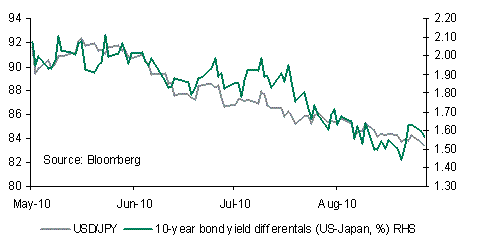
Risk appetite held up reasonably well last week, with markets failing to be derailed by concerns over Ireland’s banking sector and growing opposition to austerity measures across Europe. The main loser remained the USD, with the USD index hitting a low marginally above 78.00 and speculative positioning as reflected in the CFTC IMM data revealing a further sharp drop in sentiment to its lowest since Dec 2007.

This week is an important one for central bank meetings, with four major central banks deliberating on monetary policy including Bank of Japan (BoJ), Reserve Bank of Australia (RBA), European Central Bank (ECB) and Bank of England (BoE). The major event of the week however, is Friday’s release of the September US employment report. The RBA is set to hike its cash rate by 25bps, the BoJ may announced more easing measures whilst in contrast both the ECB and BoE are unlikely to alter their policy settings.

Whilst the BoJ is widely expected to leave its policy rate unchanged at 0.1%, it may announce further measures against the background of persistent JPY strength, a worsening economic outlook as reflected in last week’s Tankan survey and decline in exports. Japanese press indicate that the BoJ may increase lending of fixed rate 3 to 6 month loans to financial institutions as well as buy more short-term government debt.

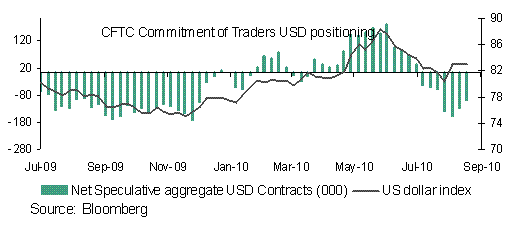
The measures alongside risks of further JPY intervention may prevent USD/JPY slipping further but as reflected in the increase in speculative net long JPY positions last week, the market is increasingly testing the resolve of the Japanese authorities. Strong support is seen around USD/JPY 82.80, with the authorities unlikely to allow a break below this technical level in the short-term.

Although we will only see details of the voting in two weeks in the release of the UK BoE Monetary Policy Commitee (MPC) minutes it is likely that there was a three-way split within the MPC as reflected in recent comments, with MPC member Posen appearing to favour more quantitative easing whilst the MPC’s Sentance is set to retain his preference for higher rates. As has been the case over recent months the majority of the MPC are likely to have opted for the status quo.

GBP was a laggard over September as markets continued to fret over potential QE from the BoE. This uncertainty is unlikely to fade quickly suggesting limited gains against the USD and potentially more downside against the EUR. GBP speculative sentiment has improved but notably positioning remains short. EUR/GBP will likely target resistance around 0.8810.

In contrast to GBP the EUR has taken full advantage of USD weakness and looks set to extend its gains. Although there is a risk that speculative positioning will soon become overly stretched it is worth noting that positioning is well below its past highs according to the IMM data. EUR may have received some support from Chinese Premier Wen’s pledge to support Greece, and a stable EUR. Whilst there continues to be risks to the EUR from ongoing peripheral debt concerns such comments likely to be repeated at the EU-Asia summit today and tomorrow, will keep the EUR underpinned for a test of 1.3840.

Exhausted

No the title is not meant to describe how I felt this morning when I woke up but how I feel the market is looking at present in terms of risk trades. Firmer than feared economic data in the US and China and the agreement in Basel on new bank capital ratios boosted risk appetite but the moves are already beginning to fade. It would be easy to jump on the bandwagon but after the sharp gains registered over recent days I would suggest taking a cautious stance on jumping into risk trades at present.

The EUR has played a degree of catch up to risk currencies, rallying sharply against the USD, helped in part by the European Commission which raised its forecasts for the eurozone economy from 0.9% for 2010 to 1.7%. Although the change in forecasts should come as little surprise give that it is now in line with the European Central Bank’s (ECB) expectations the news bolstered the view of economic resilience in the eurozone. Unfortunately as the ECB noted following its last meeting there are plenty of downside risks to growth next year and upcoming data releases will be viewed to determine how sharply growth momentum will slow into next year.

One currency that strengthened was the JPY and this was mainly due the view that Prime Minister Kan will win the contest for leadership of the governing DPJ party in Japan. The race remains very close, with Prime Minister Kan having a slight lead according to Japanese press. The FX market will pay particular attention to the result given that the other contender Ichiro Ozawa has stated his willingness to drive the JPY lower as well as increase fiscal spending. The results of the election will be known shortly and should Ozawa win USD/JPY will likely find support although the bigger influence is likely to be a shift in relative US/Japan bond yields which due to the sell off in US Treasuries over recent days has become more supportive of a higher USD/JPY.

GBP has lagged the move in many risk currencies, failing to take advantage of the weaker USD. There was some relief overnight from an increase in consumer confidence in August according to the Nationwide index, which rose 5 points to 61, from a 14-month low in July. However, any boost to GBP sentiment will have been outweighed by a fall in UK house prices according to RICS, which revealed the sharpest one-month fall in August since June 2004. The data supports the view that the rally in UK house prices could soon be over. Weaker housing activity will also likely limit any further improvement in consumer confidence. Some of this is already priced into GBP however, and over the short-term EUR/GBP may struggle to breach the 0.8400 level.

Another underperformer overnight was the NZD which was hit by disappointing retail sales data for July, which fell 0.4%. Although the drop followed a strong gain in the previous month the data supports the view that the consumer remains cautious in New Zealand, a factor that will likely play into the view that New Zealand’s central bank, the RBNZ will keep policy on hold when they meet tomorrow. NZD slipped off its highs around 0.7347 overnight and also managed to dampen the upside momentum for AUD/USD which will likely struggle to sustain a break through resistance around 0.9350.

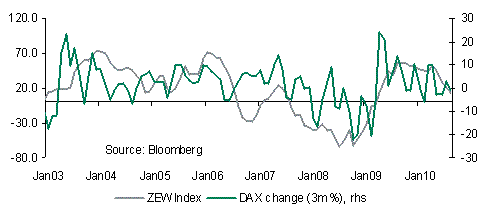
Today’s data will provide further direction for the days ahead, with the September German ZEW survey of investor confidence likely to be closely scrutinized. A drop in the economic sentiment gauge to around 10 is expected from 14 in August, highlighting that eurozone growth momentum is beginning to wane. Hard data in the form of eurozone industrial production will also record a weaker performance, likely to drop 0.3% in July. The data will likely cap the EUR today.

In the US the main release is the August retail sales report for which a 0.3% gain in both headline and ex-autos sales is expected. Sales will have been helped by back to school spending although major discounting will have weighed on retailers’ profits. Nonetheless, any gain even if modest will be a welcome development for Q3 growth in the US.

Bernanke Boost

Last week ended with a downward revision to US Q2 GDP. The data clarified that growth momentum going into Q3 was indeed quite weak though it probably didn’t take the GDP revision to tell us this nugget of information, something that has been evident from the run of weak data over recent months.

Softer growth in Q2 placed particular attention on the Jackson Hole speech by Fed Chairman Bernanke in which he acknowledged the slowing in the pace of growth, but also forecast a moderate economic recovery in H2 2010. Importantly if the Fed is proven wrong he noted the FOMC would undertake unconventional (quantitative easing) QE II measures if needed.

The net impact on Bernanke’s speech and the smaller than expected downward revision to US Q2 GDP was to provide a boost to risk appetite. Sentiment will at least begin this week on a positive note in the knowledge that the Fed stands ready to act although double dip fears are far from over.

One trigger for Fed action will be a further deterioration in job market conditions and markets will pay close attention to the August US jobs report at the end of the week. Bloomberg consensus estimates forecast a 100 drop in payrolls, with private payrolls up 47k and the unemployment rate edging higher to 9.6%. Such an outcome would do little to boost confidence in a jobs market recovery.

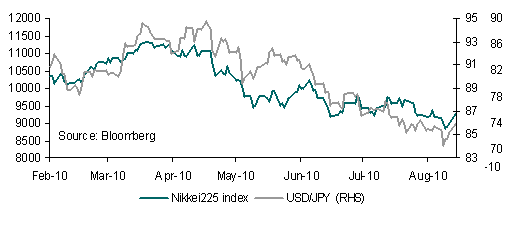
The week begins with all eyes on Japan however, with an emergency Bank of Japan (BoJ) meeting in focus. USD/JPY has already jumped higher on the belief that concrete action will emerge to weaken the JPY. The risk of disappointment is high and at most the BoJ will announce measures to extend loans to banks. A lack of other action especially in the form of FX intervention alongside a likely increase in risk aversion once the Bernanke bounce wares off, will result in a renewed USD/JPY move lower, with a breach of 85.00 likely. As seen in the chart below a decisive turn in the Japanese stocks will be a key factor in helping to eventually drive USD/JPY higher.

Two other central bank meetings of note this week are the European Central Bank (ECB) and Sweden’s Riksbank meetings on Thursday. No change in policy by the ECB will be of little surprise but the release of new staff projections, with growth likely to be revised up in 2010 but left unchanged for 2011, will be of interest. Developments regarding open market operations will also be of attention. In contrast, the Riksbank is widely expected to hike rates by 25bps on the back of a firming economy and house price inflation.

A UK holiday today will likely keep liquidity thin and as noted above risk currencies including AUD, NZD and CAD as well as Asian currencies will start the week firmer but will struggle to hold gains as the week progresses. EUR/USD has benefited little from improved risk appetite and will have a hard time this week making much any headway although potential EUR/CHF buying from the SNB may give some, albeit limited support.

A renewed downside move to support around EUR/USD 1.2455 remains on the cards in the short term. Overall USD sentiment has become less negative as reflected in the CFTC IMM positioning data in contrast to a renewed deterioration in EUR speculative sentiment. We look for more of the same.

ECB, BoE and RBA in the spotlight

Double-dip fears are the pervading influence on market psychology at present even as European sovereign concerns appear to be easing. Friday’s release of the June US jobs report did little to alleviate such concerns but the headline payrolls number was less negative than the indications provided by other jobs data.

Growth fears have in particular been centred on the US in the wake of a run of disappointing data, These new found concerns have somewhat tarnished the USD’s ability to benefit from safe haven buying as risk aversion increases, as reflected in the 4.5% drop in the USD index since its high on 7th June. The prospects for the USD do not look too much better this week, but the drop is more likely a correction rather than a renewed weakening trend.

Having navigated its way through the European Central Bank’s (ECB) 12-month liquidity payback, various debt auctions, and Germany’s presidential election last week the EUR may find itself with less obstruction in its path but will nonetheless, likely struggle to make much headway this week. EUR speculative positioning, as indicated by the CFTC IMM data, reveals that there has been little short covering over the last couple of weeks, suggesting speculative sentiment remains negative.

Nonetheless, the rebound in EUR/USD has been impressive since its low around 1.1876 about a month ago and not just against the USD, with EUR making up ground on various crosses too including CHF and GBP. Easing sovereign concerns will have helped but there are plenty of downside risks ahead as austerity measures begin to bite and growth divergence becomes more apparent.

The ECB council meeting on Thursday is unlikely to give much direction for the EUR, with the meeting likely to pass with an unchanged rate decision and no change in economic assessment. There will be more attention on whether EUR/USD can maintain a toe hold above the psychologically important 1.2500 level, which I suspect may prove tough to hold this week.

The Reserve Bank of Australia (RBA) also announces its rate decision (Tuesday) and will likely pause in tightening cycle. Recent data have remained positive, especially with regard to the labour market. The RBA will wait for the Q2 CPI data on July 28th before deciding on the next policy move, with jobs data on Thursday also likely to provide further clues. AUD/USD may struggle in the current environment where growth worries are prevalent, and the currency is likely to find it tough going over the coming weeks.

Finally, the Bank of England (BoE) meets this week too but like the ECB and RBA no change is likely. Although we will have to wait a couple of weeks for the minutes of the meeting it seems highly unlikely that MPC members will vote for a hike aside from Sentance who has espoused a more hawkish stance. Notably GBP speculative short positions have been scaled back over recent weeks as sentiment for the currency turns less negative but GBP gains against the USD will be more limited this week, with renewed GBP upside against the EUR more likely.