Australian dollar hit by weak jobs data

The USD’s bounce since the beginning of the month appears to be gaining more traction, with the USD index up over 3% from its recent lows. I’m still cautious about whether this move can extend much further in the absence of a back up in US bond yields especially given ongoing asset purchases / global USD liquidity injections by the US Federal Reserve at least until the end of June.

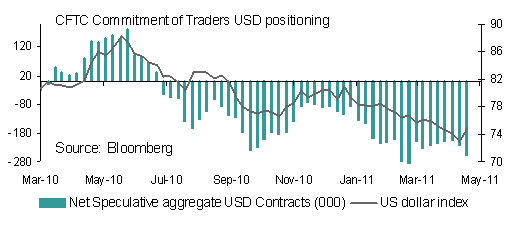
Nonetheless, given the magnitude of USD short positioning, which had moved ever close to revisiting record levels, the potential for short-covering was significant. US data today could provide some influence, with attention on April retail sales data, PPI inflation and jobless claims. A relatively positive outcome for retail sales could give the USD further support.

The day has started badly for the AUD, with the currency hit by an awful jobs report, with employment dropping by 22.1k in April compared to consensus expectations of +17k. The details were even more negative than the headline reading, with full time employment dropping by 49.1k and only partially mitigated by a 26.9k rise in part time employment.

The Reserve Bank of Australia will likely pay close attention to the data and it will likely result in any residual expectation of a rate hike by the RBA next month being taken off the table. Already today there has been a sharp rally in bank bill futures as markets pare back interest rate expectations and markets are not even pricing in a further full 25bps rate hike by year end.

The data weighed heavily on the AUD, with AUD/USD hitting a low below 1.06. AUD is likely to trade with a heavy tone over coming sessions, with the currency already under pressure from a generally firmer USD. Moreover, the rally in Australian bank bill futures will add further pressure to the currency as Australia’s favourable rate differential narrows further with the US.

Taken together with the fact that AUD positioning is close to its all time highs and that even compared to interest rate differentials its gains look overdone, it suggests more downside risks over the short-term, with AUD/USD 1.0537 seen as a near term technical support level.

In contrast GBP benefitted from a back up in UK bond yields in reaction to the Bank of England’s Quarterly Inflation Report. Inflation forecasts were revised higher but growth forecasts were revised lower as expected. The In truth, the reaction looked overdone but GBP has gained some momentum versus EUR and looks set to extend its gains, with focus on the 200 day moving average level of 0.8558.
Position Unwinding Boosts USD

The USD’s multi-month fall has come to an abrupt halt, with the currency registering gains in reaction to what appears to be a major position unwinding across asset markets, led by a drop in commodity prices.

Will it continue? Whilst I am amongst the more bullish forecasters on the USD over the medium term, the current rally could prove to be short-lived in the absence of a shift in Federal Reserve rhetoric or end to quantitative easing (QE2). Nonetheless, the market had got itself very short USDs (as reflected in the CFTC IMM data as of early last week which showed an increase in net short positions) and the rally in the USD last week was likely spurred by major short-covering which could extend further into this week.

The move in the USD gained momentum as European Central Bank (ECB) President Trichet proved to be less hawkish than many expected in the press conference following last Thursday’s ECB meeting. Moreover, renewed worries about Greece at the end of last week, with a report in the German Der Spiegel, later denied by Greek officials, that the country was planning to leave the Eurozone dented the EUR,

Taken together with the improving trend in US April non-farm payrolls (April registered +244k increase, with private payrolls 268k), these factors colluded to provide further positive stimulus to the USD and negative fallout on the EUR. The room for EUR downside is evident in the net long EUR speculative position, which rose to its highest since December 2007 as of 3rd May.

This week’s batch of US releases including March trade data, April retail sales and CPI, are unlikely to result in a reversal in last week’s trend though a trend like reading for core CPI, with the annual rate below the Fed’s comfort zone will reinforce expectations of dovish Fed policy being maintained, which could inject a dose of caution into the USD’s rally.

Against the background of a likely widening in the US trade deficit in March there will plenty of attention on the annual strategic and economic dialogue beginning today, with markets interested in discussions on Chinese worries about the gaping US fiscal deficit and US concerns about China’s exchange rate policy.

Greece’s denial of plans to leave the eurozone and discussions over a further adjustment to Greece’s bail out package, may help limit any drop in the EUR this week though it will by no means mark the end of such speculation about the periphery especially with this weeks’ Q1 GDP data releases across the eurozone likely to further highlight the divergence between the core and the periphery even if the headline eurozone reading rebounds strongly as we expect.

In the UK the Bank of England Quarterly Inflation Report will be the main influence on GBP. Downward growth revisions will play into the view that inflation will eventually moderate, capping expectation of higher interest rates over the coming months. However, the likely upward revision to near term inflation forecasts will help limit any damage to GBP.

GBP has lost ground to the USD but it should be noted that it has outperformed the EUR over recent days, reversing some of the recent run up in EUR/GBP. Given that EUR sentiment is likely to remain fragile this week, GBP may continue to capitalise, with a test of EUR/GBP 0.8672 on the cards.

Risk Aversion Creeps Higher

The USD index has dropped by around 17% since June 2010 high and despite a slight bounce this week it is unlikely to mark the beginning of a sustained turnaround. Nonetheless, I would caution about getting carried away with positioning for USD weakness. Whilst an imminent recovery looks unlikely the risk/reward of shorting the USD is becoming increasingly unfavourable.

Until then Federal Reserve comments will be watched closely for clues on policy and there are plenty of Fed speakers this week including a speech by Boston Fed’s Rosengren today and Fed Chairman Bernanke tomorrow. The USD will also gain some direction from jobs data and markets will be able to gauge more clues for Friday’s non-farm payrolls data , with the release of the April ADP employment report today.

The EUR is one currency that has suffered this week. News that Portugal’s caretaker government has reached an agreement with the European Union / International Monetary Fund on a bailout of as much as EUR 78 billion has so far been greeted with a muted response. EUR attention is still very much focussed on the ECB meeting tomorrow and prospects of a hawkish press statement suggest that EUR/USD downside will be limited, with support seen around 1.4755.

The JPY has strengthened by around 5% versus USD since its 6th April USD/JPY high around 85.53, confounding expectations that Japan’s FX intervention following the county’s devastating earthquake marked a major turning point in the currency. A combination of narrowing interest rate differentials with the US (2 year US/Japan yield differentials have narrowed by around 20bps in the past month), strong capital inflows to Japan (net bond and equity flows in the last four weeks have increased to their highest this year), and rising risk aversion have all played their part in driving the JPY higher.

As a result USD/JPY is fast approaching the psychologically important level of 80, a level that if breached will likely lead to FX intervention. Although Golden Week holidays in Japan this week suggest that JPY liquidity may be quite thin, Japanese authorities are likely to remain resistant to further gains in the JPY, likely using thinning liquidity to their advantage.

Despite the JPY’s recent strength speculative positioning over the past four weeks has remained net short JPY, whilst Japanese margin traders have also increased their long USD/JPY bets, suggesting that these classes of investors are not to blame for the JPY’s appreciation. This suggests that FX intervention may not be as successful given that the market is already short JPY.

Given the risk of intervention on USD/JPY, the CHF appears to be an easier choice for safe haven demand against the background of rising risk aversion. The currency has risen to a record high against the USD, gaining around 8.3% so far this year. Given the hints of higher interest rates by the Swiss National Bank (SNB) and resilience economic performance, downside risks for CHF are limited at present unless risk appetite improves sharply. Further gains are likely with USD/CHF likely to test the 0.8570 support level over the short-term.

Central bank decisions and US payrolls in focus

The USD’s troubles are far from over. Data and events this week will do little to stop the rot. As US Federal Reserve Chairman Bernanke made clear last week the Fed is committed to completing its asset purchase programme by the end of June though there is plenty of debate about what comes after. Reduced growth forecasts and the Fed’s view that price pressures are “transitory” have been sufficient to keep the USD on its knees.

The weaker than expected reading for Q1 US GDP growth at 1.8% QoQ clearly did nothing to alleviate pressure on the USD even though it is widely believed that the soft growth outcome will prove fleeting, with recovery set to pick up pace over the coming months. In truth much will depend on the trajectory for oil prices, especially as petrol prices in the US verge on the psychologically important $4 per gallon mark. Even higher energy prices could dent growth further but lower or stable prices will keep the recovery on track.

The highlight in this holiday shortened week for many countries this week is the US April jobs report at the tail end of the week. Estimates centre on around a 200k gain in payrolls but forecasts will be refined with the release of the ADP private sector jobs report and ISM manufacturing survey earlier in the week. The unemployment rate may prove sticky and will likely remain at 8.8%, a disappointment to those looking for a quicker recovery. The elevated unemployment rate will only reinforce expectations that the Fed will not be quick to reverse policy, with the USD continuing to suffer as a result.

Central bank meetings will be plentiful this week, with the European Central Bank (ECB) and Bank of England (BoE) likely to garner most attention. Recent data in the Eurozone has provided further evidence of growth divergence between North and South, but the EUR has remained resilient to this as well as to increased concerns about the periphery. This make the ECB’s job even tougher than usual when it meets this week and it is unlikely that the Bank will hike rates again so soon, especially given the strength of the EUR. Nonetheless, Trichet will continue to sound hawkish, limiting any damage to the EUR (if any) of no move in policy rates.

Similarly the Bank of England will also remain on the sidelines though this should come as little surprise in the wake of disappointing data recently and a surprise drop in inflation, albeit to still well above the BoE’s target. GBP has made up ground against a generally weak USD but judged against other currencies it has been an underperformer as expectations of monetary tightening have been pared back. Finally, the Reserve Bank of Australia (RBA) is set to remain on hold, but a hike over coming months remains likely even with the AUD at such a high level. Quite frankly although the USD is looking increasingly oversold there is nothing this week that would suggest it will recover quickly.

Markets in limbo ahead of policy rate decisions

Markets are generally range-bound ahead of tomorrow’s Japan, Eurozone and UK interest rate decisions, as reflected in the flat performance of equity markets overnight. Risk appetite remains positive though still lower than the high levels seen during most of March. China’s interest rate hike did not change the market’s perspective, with markets reacting well.

Overnight the Fed FOMC minutes reflected a range of opinions on the timing of the end of QE2 and the Fed’s exit strategy but the majority view was to end QE2 as planned at the end of June leaving markets, with little new to digest. The USD was a little undermined by a weaker than expected US March ISM non-manufacturing survey but losses are likely to be limited.

Meanwhile there was more negative peripheral news in Europe, with Moody’s cutting Portugal’s sovereign credit ratings by one notch, with Moody’s highlighting the urgent need for financial support from the EU. Portuguese debt took a hit but eurozone markets in general including the EUR continue to take such news in their stride, with EUR/USD holding above 1.4200. Firm readings for the eurozone final services purchasing managers index (PMI) in March helped to support sentiment, outweighing the negative impact of a drop in eurozone retail sales.

GBP was a key outperformer, helped by a much stronger than expected services PMI, which helped GBP/USD breach 1.63 overnight. Today’s industrial and manufacturing production data will likely reveal firm readings too, helping GBP to consolidate its gains but the currency looks rather rich around current levels, with risks skewed to the downside.

JPY was another mover, having breached 85.00 versus the USD, with USD/JPY now some 6 big figures higher from its post earthquake lows. Japanese authorities will undoubtedly see a measure of success from their joint intervention but the reality is that the shift in bond yields (2-year US / Japan yield differentials have widened by close to 30 basis points since mid March, are finally having some impact on USD/JPY as reflected in the strengthening in short-term correlations.

EUR/USD remains resilient to negative peripheral news such as the Portugal credit ratings downgrade, with further direction from tomorrow’s European Central Bank (ECB) meeting and accompanying statement. The risk that the ECB is not as hawkish as the market has priced in holds some downside risks to EUR.

Asian currencies are holding up well though it looks as though the ADXY (Bloomberg-JP Morgan Asian currency index) may have hit a short term barrier. Range trading for EUR/USD suggests little directional influence for Asian currencies in the short-term. Nonetheless, portfolio capital inflows continue to support Asian FX with all Asian equity markets recording foreign inflows so far this month. In particular, KRW continues to outperform. Note that Korea has recorded a whopping inflow of $1.1bn in equity inflows month-to-date.