Data releases in focus

For a change the markets may actually concentrate on data releases today rather than political events in the eurozone. The October US retail sales report and November Empire manufacturing survey are likely to paint a less negative economic picture of the US. The data will help to dampen expectations of more quantitative easing in the US but we will be able to hear more on the subject from the Fed’s Bullard and Williams in speeches today.

Overnight the Fed’s Fisher poured more cold water on the prospects of further QE by highlighting that the economy is “poised for growth”. While speculative data in the form of the CTFC IMM data shows a drop in USD sentiment to its lowest in several weeks we do not expect this to persist. The USD will likely benefit from the data today and we see the currency retaining a firmer tone over the short term especially as eurozone concerns creep back in.

The vote by German Chancellor Merkel’s party to approve a measure for a troubled country to leave the EUR opens up a can of worms and will hit EUR sentiment. But rather than politics there are several data releases on tap today that will provide some short term influence on the EUR, including Q3 GDP and the November German ZEW survey. FX markets will likely ignore a positive reading for GDP given that the outlook for Q4 is going to be much worse. The forward looking ZEW survey will record a further drop highlighting the risks to Europe’s biggest economy.

T-bill auctions in Spain and Greece may garner even more attention. Following on from yesterday’s Italian debt sale in which the yield on 5-year bond came in higher than the previous auction but with a stronger bid/cover ratio, markets will look for some encouragement from today’s auctions. Even if the auctions go well, on balance, relatively downbeat data releases will play negatively for the EUR.

When viewing the EUR against what is implied by interest rate differentials it is very evident that the currency is much stronger than it should be at least on this measure. Both short term (interest rate futures) and long term (2 year bond) yield differentials between the eurozone and the US reveal that EUR/USD is destined for a fall.

Europe’s yield advantage has narrowed sharply over recent months yet the EUR has not weakened. Some of this has been due to underlying demand for European portfolio assets and official buying of EUR from central banks but the reality is that the EUR is looking increasingly susceptible to a fall. EUR/USD is poised for a drop below the psychologically important level of 1.35, with support seen around 1.3484 (10 November low).
Eurozone peripheral tensions

The USD index remains under pressure but will likely continue to consolidate. The USD continues to be undermined by adverse interest rate differentials and is gaining little support from rising risk aversion. One factor that will help dictate USD direction over coming months is the prospects for further quantitative easing once QE2 ends.

Fed officials offered varied views on the subject. Dallas Fed President Fisher hinted he would support cutting short asset purchases before the end of June, whilst Atlanta Fed President Lockhart noted he was “very cautious” about further asset purchases. Meanwhile Chicago Fed President Evans noted that he believes the hurdle for altering the asset purchase plan is “pretty high”.

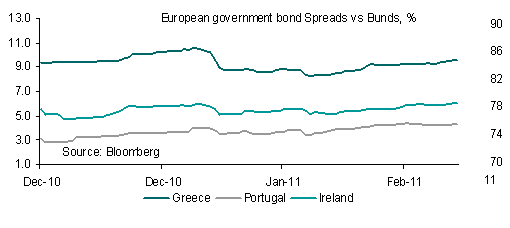
Although there is a lack of first tier data releases in the eurozone this week there is certainly plenty for markets to chew on in terms of peripheral country issues, which may just prevent the EUR from extending its gains. Eurozone peripheral debt spreads have undergone a renewed widening over recent weeks as debt fears have increased and worries that Portugal may follow Ireland and Greece in needing a bailout have risen.

Meanwhile news that Ireland’s incoming government will introduce legislation allowing the restructuring of some senior bank bonds, will add to tensions. Meanwhile, the downgrading of Greece’s government bond ratings to B1 from Ba1 dealt another blow sentiment following hot on the heels of Fitch’s downgrade of Spain’s outlook to negative although the EUR proved resilient to the news. EUR/USD continues to look as though it will consolidate around the 1.4000 level, but worsening sentiment towards the periphery may open up downside as the EUR’s resilience fades.

Upward revisions to eurozone growth and inflation forecasts and of course a hawkish shift in eurozone interest rate expectations may have justified the EUR move higher over recent weeks. However, there does not seem to be much that will provide the stimulus for further gains from current levels.

The market has already priced in an interest hike as early as next month’s European Central Bank (ECB) meeting and further tightening thereafter. The risk now appears asymmetric skewed to the downside especially if tensions between the eurozone core and peripheral countries deepen. How long the EUR can ignore such tensions?

It’s not only the eurozone periphery that should worry about ratings. Japan’s ratings agency R&I has warned that it may be forced to cut Japan’s sovereign ratings before April’s local elections due to current political problems. R&I’s concern revolve around the potential for political problems to delay fiscal reforms. As usual the JPY remains unmoved by political issues and is moving to the stronger side of its recent range against the background of elevated risk aversion.

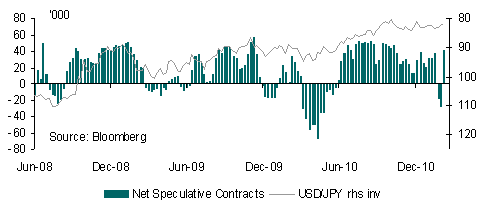
Although the JPY has not been particularly sensitive to risk over recent months shorter-term correlations shows that its sensitivity has increased. Given that Middle-East tensions do not appear to be easing the JPY will remain well supported. Indeed, speculative positioning data reveals the highest JPY net long position since November 2010. As risk appetite improves JPY positioning will be pared back but this is unlikely to be imminent, with USD/JPY set to remain close to support around 81.10.

China Hikes Rates, More On the Cards

In an otherwise unexciting day China livened things up by raising its 1 year deposit and lending rates by 25 basis points. The hike, the third in the last four months, should not have come as a surprise, given the growing emphasis by China’s central bank PBoC, to dampen inflation pressures. Indeed, more hikes are on the cards, with at least another two more in prospect over H1. The other tool to combat inflation is CNY appreciation further gains in the currency over coming months should be expected to around 6.3 by year-end versus USD.

Global markets largely shrugged of China’s move, with generally positive market sentiment continuing. Even in the eurozone, where there was some disappointment at the surprise drop in German December industrial production, market sentiment continued to improve as Egypt and local debt worries eased further. EUR was particularly resilient despite calls from a Belgian think tank that Greece needs to restructure its debt to avoid a long and painful path ahead. Commodity currencies also showed impressive resilience to China’s rate hike, with both the AUD and NZD holding up well.

The overall positive risk background is supportive for Asian currencies and other risk trades. Currencies in Asia remain highly correlated with portfolio capital inflows and so far this year the weakness in the INR and THB has matched the strong equity outflows from India and Thailand. However, this appears to be reversing, especially in the case of India registering positive equity flows this month, helping the INR to reverse some of its losses.

In the absence of key data releases markets will turn their attention to the testimony by Fed Chairman Bernanke to the House budget committee where he will give comments on the economy, jobs and the budget. Dallas Fed’s Fisher stated overnight that whilst he expects the Fed to complete QE2 he would not support another round of quantitative easing. Fisher’s comments on QE were similar to Atlanta Fed’s Lockhart who notes there is a “high bar” for more QE. Bernanke is unlikely to deviate from this tone in his speech today whilst also maintaining his view that there should be a long term commitment to fiscal retrenchment.

Against the background of improving risk appetite the USD is likely to stay under mild pressure although it is difficult to see a break of recent ranges for most currency pairs. EUR/USD ought to find strong support around its 100-day moving average 1.3535 whilst USD/JPY will be supported around 81.10. Equity sentiment is being supported by US data which remains encouraging. On cue the NFIB Small Business Optimism index duly rose in January to 94.1 as sentiment in this sector continued its improving trend.

Taken together with firmer equities, encouraging data is taking its toll on US bond markets, resulting in a back up in yields. Bond market sentiment wasn’t helped by a relatively poor 3-year auction. For example, US 2-year bond yields have backed up by over 30bps since 28 January. Bad news for bond is good news for the USD however, as higher relative US bond yields will likely help prevent a deeper USD sell-off, with EUR/USD in particular most reactive to relative eurozone / US bond yield differentials.

Econometer.org has been nominated in FXstreet.com’s Forex Best Awards 2011 in the “Best Fundamental Analysis” category. The survey is available at http://www.surveymonkey.com/s/fx_awards_2011

What goes down must go up

What goes down must go up! A day that began with a stronger than forecast increase in China’s purchasing managers index (PMI) and firm Australian Q2 GDP continued with a surprise jump in the August ISM manufacturing index. The ISM rose to 56.3 from 55.5 in July an outcome that contradicted most of the regional US manufacturing surveys. It was not all positive in terms of data, yesterday however, with a weaker UK manufacturing PMI and unexpected drop in the August US ADP employment report casting a shadow over markets.

Nonetheless, for a change the market decided to act on the good news, with risk assets surging. Despite the improvement in risk appetite it still feels as though the market is grasping for direction. The jump in equities is unlikely to prove durable in an environment characterized by various uncertainties about growth and policy, especially the US.

The next hurdle for markets is the US payrolls data tomorrow. Although the ADP jobs report revealed a surprise 10k decline the employment component of the ISM manufacturing survey strengthened to 60.4, suggesting an improvement in August manufacturing payrolls. Ahead of the payrolls release the US data slate today largely consists of second tier releases including July pending home sales, August chain store sales, weekly jobless claims, and factory orders. It is worth paying particular interest to jobless claims given that the four week moving average has been edging higher, suggesting renewed job market deterioration. The consensus is for a 475k increase in claims, which will still leave the 4-week average at an elevated level.

Given that one of the biggest debates raging through markets at present is whether the Fed will embark on further quantitative easing comments by Fed officials overnight were closely scrutinized for further clues. In the event, Fed Governor Kohn highlighted that the Fed’s reinvestment of the proceeds from mortgage-backed securities will not automatically lead to further QE, suggesting some hesitancy on his part. Meanwhile, Dallas Fed President Fisher noted his reluctance to expand the Fed’s balance sheet until fiscal and regulatory uncertainties are cleared up.

Both sets of comments highlight the difficulty in gaining a consensus within the FOMC for a further increase in QE, suggesting that the hurdle for further balance sheet expansion will be set quite high. Moreover, such comments put the onus on Congress to move quickly in clearing up fiscal policy uncertainties.

As markets flip from risk on to risk off almost on a daily basis the question for today is how sustainable the rally in risk trades will prove to be against the background of so much policy and growth uncertainty. Unfortunately today’s data will provide few clues and markets will turn their attention to tomorrow’s US non-farm payrolls report for further direction. To an extent this suggests that it may be a case of treading water until then. Nonetheless, I still maintain that risk trades remain a sell on rallies over coming weeks

China tightens policy

Risk appetite has soured due to a combination of the rise in China’s reserve requirements, disappointing earnings including Alcoa and a profit warning by Chevron, setting the scene for a day in the red for Asian markets.  The turn in sentiment has hit commodities and commodity currencies particularly hard whilst the JPY has outperformed.  As would be expected against the background of higher risk aversion the US dollar made up some ground.

All eyes are on China and markets will now look to the implications for CNY policy.  Increasingly it seems that data and policy in China is driving global markets and aside from the hike in reserve requirements this was also evident in the fact that stronger trade data over the weekend helped to counter the impact of the soft US December payrolls report.  Further increases in the reserve ratio are likely over coming months followed by actual hikes in interest rates (likely the 1 year rate).  China’s move to tighten policy further over coming months will likely be accompanied by allowing greater appreciation of the CNY too.

The news worsened overnight as the ABC Consumer Confidence index dropped by 6 points to -47, the biggest one-week drop in the last 25 years.  US trade data also came in worse than expected, with the deficit widening to $36.4bn in November.  There is little on the data front today to keep markets occupied today, suggesting that direction will come from equity markets and with more earnings this week including Intel Corp and JPMorgan Chase & Co. there will be plenty to digest.  In the near term the tone of risk aversion is set to continue to dominate but any pull back in risk currencies is likely to prove short-lived.   

There will be more Fed speakers as well as the Fed’s Beige Book today to provide clues ahead of the January 26-27 FOMC meeting.   Aside from noting some improvements in the economy, weak labour market conditions as well as a lack of inflationary pressures will help support expectations that the Fed will hold off from raising interest rates this year.   Fed speakers include Fisher and Plosser both of whom give speeches on the US economy though neither are current voters on the FOMC.   Plosser’s comments so far have highlighted the need for a timely “exit strategy”.