Euro Sentiment Jumps, USD Sentiment Dives

The bounce in the EUR against a broad range of currencies as well as a shift in speculative positioning highlights a sharp improvement in eurozone sentiment. Indeed, the CFTC IMM data reveals that net speculative positioning has turned positive for the first time since mid-November. A rise in the German IFO business confidence survey last week, reasonable success in peripheral bond auctions (albeit at unsustainable yields), hawkish ECB comments and talk of more German support for eurozone peripheral countries, have helped.
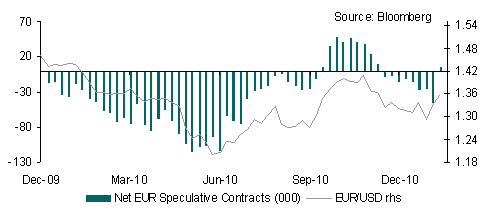
A big driver for EUR at present appears to be interest rate differentials. In the wake of recent commentary from Eurozone Central Bank (ECB) President Trichet following the last ECB meeting there has been a sharp move in interest rate differentials between the US and eurozone. This week’s European data releases are unlikely to reverse this move, with firm readings from the flash eurozone country purchasing managers indices (PMI) today and January eurozone economic sentiment gauges expected.

Two big events will dictate US market activity alongside more Q4 earnings reports. President Obama’s State of The Union address is likely to pay particular attention on the US budget outlook. Although the recent fiscal agreement to extend the Bush era tax cuts is positive for the path of the economy this year the lack of a medium to long term solution to an expanding budget deficit could come back to haunt the USD and US bonds.

The Fed FOMC meeting on Wednesday will likely keep markets treading water over the early part of the week. The Fed will maintain its commitment to its $600 billion asset purchase program. Although there is plenty of debate about the effectiveness of QE2 the program is set to be fully implemented by the end of Q2 2011. The FOMC statement will likely note some improvement in the economy whilst retaining a cautious tone. Markets will also be able to gauge the effects of the rotation of FOMC members, with new member Plosser possibly another dissenter.

These events will likely overshadow US data releases including Q4 real GDP, Jan consumer confidence, new home sales, and durable goods orders. GDP is likely to have accelerated in Q4, confidence is set to have improved, but at a low level, housing market activity will remain burdened by high inventories and durable goods orders will be boosted by transport orders. Overall, the encouraging tone of US data will likely continue but markets will also keep one eye on earnings. Unfortunately for the USD, firm US data are being overshadowed by rising inflation concerns elsewhere.

Against the background of intensifying inflation tensions several rate decisions this week will be of interest including the RBNZ in New Zealand, Norges Bank in Norway and the Bank of Japan. All three are likely to keep policy rates on hold. There will also be plenty of attention on the Bank of England (BoE) MPC minutes to determine their reaction to rising inflation pressures, with a slightly more hawkish voting pattern likely as MPC member Posen could have dropped his call for more quantitative easing (QE). There will also be more clues to RBA policy, with the release of Q4 inflation data tomorrow.

Both the EUR and GBP have benefitted from a widening in interest rate futures differentials. In contrast USD sentiment has clearly deteriorated over recent weeks as highlighted in the shift in IMM positioning, with net short positions increasing sharply. It is difficult to see this trend reversing over the short-term, especially as the Fed will likely maintain its dovish stance at its FOMC meeting this week. This suggests that the USD will remain on the back foot.

Talk but no action

The eurozone periphery remains in the eye of the storm but markets may have to wait before any concrete action is taken. The possibility of increasing the size of the bailout fund (EFSF), preparation of new European bank stress tests and/or allowing the EFSF to purchase eurozone government debt are all on the table but so far agreement has been lacking. Ministers apparently rejected the idea of increasing the size of the fund from EUR 440 billion to EUR 750 billion whilst disagreement over stricter criteria may also be hampering any progress.

Nonetheless, the EUR has found renewed support, helped by the firm German IFO investor confidence survey and news that Russia is looking to buy EFSF bonds. EUR/USD upside may be face a hurdle around 1.3500 over the short term and gains above this level are likely to be difficult to sustain given the ongoing uncertainties about the EFSF none of which are likely to be resolved anytime soon. The bottom line is that talk but not action will not be sufficient to keep the EUR supported.

GBP is also doing well, partly on the coat tails of a firmer EUR but also in the wake of an acceleration in UK CPI inflation which came in at 3.7% YoY a two year high, surpassing the Bank of England’s (BoE) ceiling for the 10th straight month. Inflation is likely to remain elevated pushing closer to 4% due to the VAT hike to 20% which came into effect at the beginning of this year. The data puts the BoE in a difficult situation testing the Monetary Policy Committee (MPC) expectation that the jump in inflation will prove temporary. However, the market is increasing taking the stance that a rate hike is going to take placer sooner rather than later, with a growing probability of a rate hike.

Since the end of last year there has been a 25bps spread widening (between 2nd contract rate futures) as markets have become more hawkish on UK interest rate expectations. This has coincided with an increasing correlation with GBP/USD resulting in the currency pair cracking above the psychologically important 1.60 level. Much will depend on whether the BoE’s predictions come true. If inflation remains sticky on the upside the Bank may be forced into an earlier tightening. Whether this is good news for GBP will depend on the economy. The worst case scenario is premature monetary tightening just as austerity measures start to bite.

What QE2 means for currencies

The sweeping gains for the Republican party in the US mid term elections has sharply changed the political dynamic in the US, with the prospects of further fiscal stimulus looking even slimmer than before although the chances of the Bush tax cuts being extended have likely increased.

The onus is on monetary policy to do the heavy lifting and the Fed delivered on its end of the bargain, with the announcement of $600 billion of purchases of long-term securities over 8-months through June 2011.

Given the likelihood that the economic impact of the asset purchases is likely to be limited and with little help on the fiscal front the Fed has got a major job on its hands and $600 billion may end up being a minimum amount of purchases necessary for the Fed to fulfil its mandate.

The decline in the USD following the Fed decision is unlikely to mark the beginning of a more rapid pace of USD decline though further weakness over coming months remains likely. The USD remains a sell on rallies for now and an overshoot on the downside is highly probable as the Fed begins its asset purchases.

The bottom line is that the Fed’s program of asset purchases implies more USD supply and in simple economic terms more supply without an increase in demand implies a lower price. The USD will remain weak for some months to come and the Fed’s actions will prevent any USD recovery as the USD solidifies its position as the ultimate funding currency.

Nonetheless, with market positioning close to extreme levels, US bond yields unlikely to drop much further, and the USD already having sold off sharply in anticipation of QE2, (USD index has dropped by around 14% since June) those looking for a further sharp drop in the USD to be sustained are likely to be disappointed.

It is difficult however, to fight the likely further weakness in the USD even if turns out not to be a rapid decline. The path of least resistance to some likely USD weakness will be via the likes of the commodity currencies, scandies and emerging market currencies. There will be less marked appreciation in GBP, CHF and JPY against the USD.

The Fed’s actions will continue to fuel a rush of liquidity into emerging markets, particularly into Asia. This means more upward pressure on Asian currencies but will likely prompt a variety of responses including stronger FX intervention as well as measures to restrict and control such flows.

There have been various comments from central banks in the region warning about the Fed’s actions prompting further “hot money” flows into the region and even talk of a coordinated response to combat such flows.

This suggests more tensions ahead of the upcoming G20 meeting in Seoul. Assuming that at least some part of the additional USD liquidity flows into Asia, the implications of potentially greater FX intervention by Asian central banks to prevent Asian currencies from strengthening, will have a significant impact on major currencies.

Already it is apparent that central banks in Asia have been strongly using the accumulated USDs from FX intervention to diversify into EUR and other currencies including AUD and even JPY. Perversely this could end up exacerbating USD weakness against major currencies.

The loss of a great forecaster

Forecasters around the world will mourn the loss of one of their finest following the death of Paul the Octopus at the age of 2 ½ (apparently an average age for Octopi). Although Paul had various threats to his life and insults to his mother’s honour he passed away from natural causes. Many forecasters envious of Paul’s record will look now a successor being groomed to take his place. Markets could do with Paul’s abilities in trying to ascertain the magnitude of Fed quantitative easing (QE) to be announced on 3 November. Conflicting comments from the Fed’s Hoenig (hawkish) and Dudley (dovish) yesterday will keep the market’s guessing.

Interestingly US bond yields are backing up and although yields elsewhere are also rising US yields are beginning to move relatively higher. The FX impact is evident in the growing resilience of the USD. Major Currencies with the highest correlations with bond yield differentials are EUR/USD, AUD/USD, EUR/CAD and USD/CHF although USD/JPY correlations have also been pushing higher. These currencies will ultimately suffer the most if US yields back up further.

Part of the reason for the shift higher in US bond yields is growing speculation that the Fed will take a more measured approach to asset purchases whilst recent data, particularly in the US housing market is showing some stabilisation as revealed in existing home sales data on Monday and a surprise gain in the August US FHFA home price index overnight. September new homes sales will be closely watched today to determine whether this stability is becoming broader based.

US consumer confidence continued this pattern, with the Conference Board index rising to 50.2 in October. Perhaps more interesting was the outcome of the US 5-year TIPS auction at a negative yield (-0.55%). The increased demand for inflation protection hints at QE2 working even before it has been carried out but there is a long way to go on this road and it would be premature to read too much into the auction outcome.

It’s worth noting that UK bond yields bucked the trend versus US bond yields following the release of stronger than expected UK GDP. The data alongside persistently above target inflation will likely dampen expectations that the Bank of England (BoE) will follow the path of the Fed into more QE. Consequently GBP has been a key outperformer. EUR/GBP in particular underwent a sharp reversal and technically the currency pair is showing a negative divergence from the 9-day RSI and the MACD is turning lower from overbought levels. The cross needs to drop below 0.8696 to confirm the technical signals.

Closer to home Australian CPI data this morning played into the hands of those looking for the Reserve Bank of Australia (RBA) to remain on hold next week. Although CPI was slightly softer than expected at 0.6% QoQ in Q3, the AUD took the news badly. The RBA has kept the cash rate on hold at 4.5% since May and at the last meeting there was little indication of an urgency to hike. Nonetheless, recent data plays towards a rate hike next week though the outcome is now a much closer call

Contrasting Stance

Despite some recent Fed speakers putting doubts into the minds of the many now looking for the Fed to embark on QE2 in November, the minutes of the 21 September FOMC meeting gave the green light to the commencement of asset purchases next month. Although there is clearly no unanimity within the FOMC the majority favour further easing. Incremental data dependent asset purchases will be the most likely path.

The minutes leave the USD vulnerable to further declines but extreme short USD positioning suggest that there is plenty of risk of short covering and more likely we are probably set for a period of consolidation over coming weeks before the USD resumes its decline.

Unlike the Fed, BoJ and BoE, which remain in easing mode the ECB is already veering towards an exit strategy, albeit one that is unlikely to take effect for some time. Hawkish comments by the ECB’s Weber overnight managed to give a lift to the EUR in the wake of a further widening in interest rate differentials between the eurozone and US. Indeed, interest rate differentials (2nd contract futures) are at the widest since Feb 2009, a factor that is providing plenty of underlying support for the EUR.

Further out the follow through on the EUR will depend on whether markets believe Weber’s stance is credible. Germany’s economy is doing well but it is highly likely that Southern European officials would oppose any premature tightening in policy given the parlous state of their economies. The stronger EUR will also do some damage to growth, with its recent appreciation acting as a de facto monetary tightening.

Despite the positive influence of Weber’s comments short-term technical indicators show that the trend in EUR is vulnerable, with clear signs of negative divergence as the spot rate is still trending higher whilst the relative strength indices (RSI) are trending lower. Moreover, EUR speculative positioning is at its highest in a year, albeit still well of its all time highs. Speculators may be reluctant to build on longs in the near term. A clean and sustained break above EUR/USD 1.4000 level still looks like a stretch too far though any downside is likely to be limited to strong support around 1.3895.

Unlike the perception that the ECB is highly unlikely to follow the Fed in a path of QE2 the policy stance of the BoE is far more uncertain, a fact that continues to weigh on GBP, especially against the EUR. Recent data in the UK has played into the hands of the doves, with housing market activity and prices coming under renewed pressure, retail sales surveys revealing some deterioration and consumer confidence as revealed in the Nationwide survey overnight, weakening further.

BoE MPC member Miles summarized the situation by highlighting that the UK faces “some big risks” and even hinted that the BoE may “come to use QE”. UK jobs data today is unlikely to give any support to sentiment for GBP although as per its recent trend GBP is likely to remain resilient against the USD whilst remaining under pressure against the EUR, with a move to resistance around EUR/GBP 0.8946 on the cards in the short-term