The Dust Settles

As the dust settles on the massive “shock and awe” package announced over the weekend it is become painfully apparent that markets are not at all convinced that underlying issues surrounding Europe’s woes are on the path to being resolved. Undoubtedly the EUR 750 billion provided by the European Union (EU) and International Monetary Fund (IMF) will go a long way towards fixing the symptoms of the crisis but it will take a lot more action to convince markets that the measures to cut budget deficits, improve productivity and enact structural reforms are being carried out.

As a result of ongoing skepticism EUR/USD dropped to its lowest level since March 2009. The currency pair shows little sign of turning around and over the short-term EUR/USD is likely to test its 2010 low around 1.2510. Market positioning remains heavily short EUR suggesting some scope for short covering but any rebound in EUR/USD is being met with plenty of sellers and the upside is likely to be restricted to around 1.2885.

The size of the EU/IMF package means that financing issues for eurozone peripheral countries will not be a major concern and spreads are likely to continue to narrow against core debt. However, attention has turned to the next step in the process, in particular the path of fiscal consolidation necessary in the months ahead and the negative impact on the economies in Europe that this will entail. As US Fed Chairman Bernanke noted, the package from the EU/IMF is “not a panacea”.

Overall, the measures may have cheapened the long term value of the EUR rather than boost it as it has highlighted the many problems in having a single currency to encompass a wide variety of countries. The stark reality in having differing fiscal policies across the euro region whilst maintaining a single monetary policy has proven to be highly problematic.

At least for now, the economic data in the eurozone is providing some support, though it is questionable how long this will continue. Eurozone GDP grew by 0.2% in the first quarter of 2010 compared to the previous quarter, which was stronger than expected and growth in the second quarter actually looks like it will have picked up from this pace based on the indications from recent monthly data.

Further out, the real damage will begin and in particular economic activity in southern European countries will slow sharply even as the German economy remains resilient due to relatively strong export performance. Deficit cutting measures in Portugal, Spain and Italy will begin to bite into growth later this year and into 2011. The weakness in growth in Europe relative to the US economy, which is likely to perform relaitvely better, will provide further rationale to sell EUR/USD, though at some point markets may just shift their attention back to the burgeoning US fiscal deficit.
Greek Aid Boosts Euro

Greece is never far from the headlines and the big news over the weekend was once again centred on this small (in terms of economy size) eurozone Country, with the agreement by Eurozone members to provide up to EUR 30 billion in loans to Greece. This will be supplemented by additional contributions from the IMF to the tune of around EUR 15 billion. The rate of around 5% for the three-year fixed loan is well below that yielding on Greek debt but above the International Monetary Fund (IMF) standard lending rate. In other words, the terms of the loan are far more favourable than they would currently face in the market.

After weeks of haggling the decision to detail the amount and terms of a loan for Greece will help reassure markets and likely result in a narrowing in Greek spreads over the near term. Further details will be finalised early in the week including conditions imposed on Greece as well as the exact amount of the IMF contribution but the real test of confidence will be the reception to Greece’s EUR 1.2 billion sale of 3 and 6-month paper at the beginning of the week.

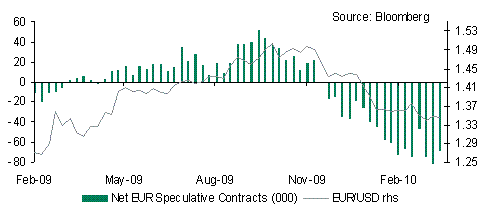
Markets were already embarking on a short covering exercise in EUR/USD early last week according to the latest CFTC IMM report which showed a reduction in net EUR short speculative positions. As a result of the weekend’s agreement the EUR looks set to consolidate its gains into the beginning of this week. Further out, there are still plenty of risks ahead and sellers are likely to emerge around EUR/USD resistance at 1.3696.


Data releases this week will be conducive to maintaining further support for risk appetite whilst shoring up recovery expectations. In particular US March retail sales are set to jump on the back of strong autos spending (consensus 1.2% monthly gain). March industrial production is also likely to record a healthy reading (consensus 0.7% month-on-month), whilst gains in both manufacturing (Empire manufacturing and Philadelphia Fed) and consumer confidence (Michigan confidence) for April are likely.

There will also be plenty of attention on Chinese data this week with a plethora of releases over coming days including FX reserves, GDP, loans data, inflation, retail sales and industrial production. In short, the data will continue to reveal a robust economic performance, which will be good for risk appetite and Asian currencies, but will also add to the pressure to revalue the Chinese currency, CNY, soon.

The USD impact will depend on whether the market reacts to firmer risk appetite or signs of stronger US growth. I suspect the former will apply for now, likely keeping the USD on the back foot early in the week. The main beneficiaries include risk currencies such as AUD, NZD and CAD as well as most Asian currencies. AUD/USD is set to target technical resistance around 0.9407 whilst NZD/USD will set its sights on resistance around 0.7252 over the next few days.

Tarnishing The Euro

I am just finishing up a client trip in Japan and waiting to take a flight back to Hong Kong. The time ahead of the flight has allowed some reflection on my meetings here. One thing that has been particularly evident is the strong interest in all events European. Some I have spoken to have wondered out loud whether this the beginning of the end of the European project.  At the least it is evident that fiscal/debt problems in Greece and elsewhere in Europe have tarnished the image of the EUR.

Markets continue to gyrate on any news about Greece and the potential for support from the Europe Union and/or IMF. The divergent views between European countries about how to deal with the problem has intensified, suggesting that reaching an agreement will not be easy. Some countries including the UK and Sweden have suggested enrolling the help of the IMF but this has been resisted by other European countries. Germany and France are trying to rally support ahead of today’s crucial meeting of European officials.

The EUR reacted positively to news that some form of support package is being considered but nothing concrete has appeared yet, leaving markets on edge. The EUR has been heavily sold over recent weeks; speculative market positioning reached a record low in the latest week’s CFTC Commitment of Traders’ IMM report. The fact that EUR positioning has become so negative suggests that the EUR could rebound sharply in the event that some support package for Greece is announced.

Any package will not come without strings attached, however, as European officials will want to avoid any moral hazard. A couple of options hinted at by German officials include fresh loans or some form of plan to purchase Greek debt. Either way, any solution to Greece’s problems will not be quick and will likely result in a sharp contraction in economic activity as the government cuts spending especially as Greece does not have the option of the old remedy of devaluing its currency. Meanwhile, strikes and social tensions in the country could escalate further. A solution for Greece will only constitutes around 2.5% of eurozone GDP will also not prevent focus from continuing to shift to Portugal, Spain and other countries with fiscal problems despite comments by Moody’s ratings agency to differentiate between the countries.

Even if the EUR rebounds on any positive news about support for Greece any relief is likely to prove temporary and will provide better levels to sell into to play for a medium term decline in the currency. Ongoing fiscal concerns, a likely slower pace of economic recovery, divergencies in views of European officials, and the fact that the EUR is still overvalued suggests that the currency will depreciate over much of 2010, with a move to around EUR/USD 1.30 or below in prospect over coming months.

Optimism dissipates

Markets have been highly fickle so far this year. Optimism about strong recovery led by China – recall the fact that disappointment from the surprisingly weak US non-farm payrolls report in December was outweighed by strong Chinese trade data – has dissipated. Instead of rejoicing at China’s robust GDP report last week, which revealed a 10.7% rise in the fourth quarter of 2009, investors began to fret about whether China would have to move more aggressively to tighten monetary policy. Fuelling these fears was the release of Consumer price data which showed inflation rising above expectations to 1.9% YoY in China.

If such fears were not sufficient to hit risk appetite, US President Obama’s plan to limit the size and trading activities of financial institutions dealt another blow to financial stocks. The plan followed quickly after the Democrats lost the state of Massachusetts to the Republicans and managed to shake confidence in bank stocks whilst fuelling increased risk aversion. Meanwhile, rumblings about Greece continue to weigh on markets and Greek debt spreads continued to widen even as global bond markets rallied.

Following the US administration’s plans to restrict banks’ activities the fact that the rise in risk aversion was US led rather than broad based led to an eventual pull back in the dollar which helped EUR/USD to avoid a break below 1.40. Risk trades including the AUD came under pressure as risk appetite pulled back. A drop in commodity prices did not help. The AUD was also hit by news that Australia’s Henry Tax Review would look to tax miners in the country. As a result AUD/USD dropped below 0.90 though this level is likely to provide good buying levels for those wanted to take medium term AUD long positions. The one currency that did benefit was the JPY which managed to drop below sub 90 levels.

The aftermath of the “Volker Plan” will reverberate around markets this week keeping a lid on equity sentiment. Meanwhile Greece will be in the spotlight especially its bond syndication. A bad outcome could be the trigger for EUR/USD to sustain a move below 1.40 though it looks as though it may find a bottom around current levels, with strong support seen around 1.4029. The German IFO business survey for January will be important to provide some direction for EUR and could be a factor that weighs on the currency if as expected it reveals some loss of momentum in the economy.

Aside from the Fed the other G3 central bank to meet this week is the Bank of Japan but unless the Bank is seen to be serious about fighting deflation, USD/JPY may remain under downward pressure against the background of elevated risk aversion. Below 90.0 there does appear to be plenty of USD/JPY buyers however, suggesting that further upside for the JPY will be limited. USD/JPY will find strong support around 88.84.

Much will depend on the key events in the US this week including the Fed FOMC meeting and the President’s State of the Union speech. USD bulls will look for some indication that the US government is serious about cutting the burgeoning budget deficit. Also watch out for the confirmation vote on the renomination of Bernanke as Fed Chairman which could end up being close. There is a heavy slate of data to contend with including new and existing home sales, consumer confidence, durable goods orders, the first glance at Q4 GDP and Chicago PMI.

Q4 earnings and Chinese data

Since the start of the year the market has gyrated from “risk on” to “risk off” and back again. On balance the overall tone has been just about positive, with firmer economic data, most notably in China outweighing sovereign debt concerns in Greece and elsewhere. Although debt concerns are unlikely to dissipate quickly, especially given Greece’s inability to convince markets of its plans to cut its burgeoning budget deficit, the “risk on” tone is likely to win.

“Risk off” may be the tone at the start of the week however, as US equities ended the week on a negative note ahead of the Martin Luther King holidays. The holidays will likely keep trading slow. Data wise the main US events housing starts on Wednesday and the Philly Fed on Thursday. Q4 US earnings are likely to take a bigger share of market attention as the earnings season rolls on. Bank earnings will be a key focus, with Citigroup, Morgan Stanley, BoA, Wells Fargo and Goldman Sachs set to report this week.

Given the growing influence of Chinese data on markets the monthly data pack from China will capture more attention than usual on Thursday. In particular, GDP and inflation data will be of most interest. GDP data is likely to reveal an acceleration in growth in Q4 YoY to above 10% but given worries about over heating and following last week’s tightening in China’s monetary policy CPI data will be closely scrutinized. Inflation is likely to pick up further maintaining the pressure for further monetary tightening as well as a stronger CNY.

Elsewhere, in the eurozone the main event is the German ZEW survey tomorrow, which is likely to show further signs of flagging, due to Greek concerns. There is also an interest rate decision to contend with; the Bank of Canada is unlikely to surprise markets as it keeps policy unchanged tomorrow. The UK has a relatively heavier data slate, with CPI tomorrow, Bank of England minutes on Wednesday and retail sales at the end of the week.

The UK data kicked off on a positive note this week, with house prices rising 0.4% MoM in January and 4.1% YoY according to UK property website Rightmove, the biggest annual gain in over a year. Moreover, activity on Rightmove’s website reached a record high in the first full week of the year. The data as well as expectations that Kraft will raise its bid for Cadbury will likely help GBP in addition to other GBP positive M&A news. GBP/USD will look to test resistance around 1.6365 this week.

After a slightly firmer start helped by the weak close to US equity markets on Friday the USD is likely to generally trade on the back foot over the week. Speculative sentiment for the USD has definitely soured into the new-year as reflected in the CFTC IMM data which revealed a big jump in net short positions in the week ending 12 January 2010. Net aggregate USD positions shifted from +1.6k to -51.9k over the week, with the main beneficiaries being the EUR, and risk trades including AUD, NZD and CAD.