Payrolls sour mood, Eurozone concerns intensify

The market mood has soured further and risk aversion has increased following disappointing August US jobs report in which the change in payrolls was zero and downward revisions to previous months has reinforced the negative mood on the US and global economy while raising expectations of more Federal Reserve action. Moreover, the report has put additional pressure on US President Obama to deliver fresh jobs measures in his speech on Thursday though Republican opposition may leave Obama with little actual leeway for further stimulus.

There is plenty of event risk over coming days, with a heavy slate central bank meetings including in Europe, UK, Japan, Australia, Canada and Sweden. The European Central Bank will offer no support to a EUR that is coming under growing pressure, with the Bank set to take a more neutral tone to policy compared its previously hawkish stance. In the UK, GBP could also trade cautiously given recent comments by Bank of England Monetary Policy Committee members about potential for more UK quantitative easing.

The EUR has been unable to capitalise on the bad economic news in the US as news there has been even worse. The negative news includes the weekend defeat of German Chancellor Merkel’s centre-right bloc in regional elections, which comes ahead of a vote in Germany’s constitutional court on changes to the EFSF bailout fund.

The withdrawal of the Troika (ECB, IMF and EU) from Greece has also put renewed emphasis on the country at a time when protests are escalating. If all of this is not enough there is growing concern about Italy’s apparent backtracking on austerity measures, with the Italian parliament set to discuss measures this week. Separately Germany, Holland and Finland will hold a meeting tomorrow on the Greek collateral issue. On top of all of this is the growing evidence of deteriorating growth in the euro area.

Data releases are unlikely to garner a great deal of attention amidst the events noted above, with mainly service sector purchasing managers indices on tap and at least threw will look somewhat better than their manufacturing counterparts. In the US the Beige Book and trade data will be in focus but all eyes will be on Obama’s speech later in the week. The USD has maintained a firm tone despite the jobs report but its resilience may be better explained by eurozone negativity rather than US positivity. Even so, the USD is looking less uglier than the EUR in the current environment.
Edging Towards A European Deal For Greece

The momentum towards some form of agreement at the Special EU Summit today is growing, with French and German leaders reaching a “joint position on Greece’s debt situation”. Details of this position are still unknown, however. EUR has found support as expectations of a positive outcome intensify.

However, given that positive news is increasingly being priced in, and the market is becoming increasingly long, upside EUR potential will be limited even in the wake of a comprehensive agreement. A break above EUR/USD resistance around 1.4282 would bring in sight the next key resistance level around 1.4375 but this where the rally in EUR/USD is set to be capped.

Prospects of a major US debt default or at the least a government shutdown appear to be receding as the US administration has indicated some willingness to opt for a short term increase in the US borrowing limit to give more time for a bigger deficit reduction deal to be passed by Congress. Meanwhile, there will be further news on the deficit reduction plans put forward by the “gang of six” US senators, with a press conference scheduled for later today.

Debt ceiling negotiations are likely to be the main focus of market attention, with the Philly Fed manufacturing survey and weekly jobless claims relegated to the background. A speech by Fed Chairman Bernanke is unlikely to deliver anything new today. The USD is likely to be on the back foot given expectations of a deal in Europe and improved risk appetite but we expect losses to be limited.

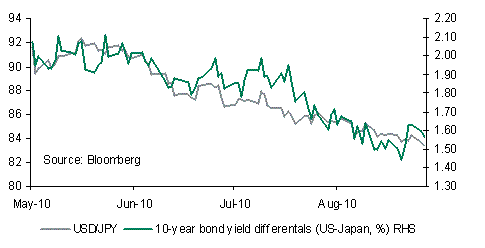
The JPY continues to defy my bearish expectations. Over recent days the US yield advantage over Japan in terms of 2Y bonds dropped to multi-year lows below 20bps. Given the high correlation between USD/JPY and yield differentials, this has corresponded with the fall below 80.00.

Expectations of JPY weakness versus USD is highly dependent on the US – Japan yield gap widening over coming months. For this to happen it will need concerns about the US economy and expectations of more Fed asset purchases to dissipate, something that may not happen quickly given the rash of disappointing US data releases lately.

GBP found itself on the front foot following the release of the Bank of England Monetary Policy Committee minutes, which were less dovish than anticipated. They also revealed that the BoE expects inflation to peak higher and sooner than previously expected. However, the fact that the overall tone was similar to the last set of minutes meant there was little follow through in terms of GBP.

Further direction will come from June retail sales data today and forecasts of a bounce in sales will likely help allay concerns about a downturn in consumer spending. Nonetheless, GBP is still likely to struggle to break through resistance around 1.6230 versus USD.

Exhausted

No the title is not meant to describe how I felt this morning when I woke up but how I feel the market is looking at present in terms of risk trades. Firmer than feared economic data in the US and China and the agreement in Basel on new bank capital ratios boosted risk appetite but the moves are already beginning to fade. It would be easy to jump on the bandwagon but after the sharp gains registered over recent days I would suggest taking a cautious stance on jumping into risk trades at present.

The EUR has played a degree of catch up to risk currencies, rallying sharply against the USD, helped in part by the European Commission which raised its forecasts for the eurozone economy from 0.9% for 2010 to 1.7%. Although the change in forecasts should come as little surprise give that it is now in line with the European Central Bank’s (ECB) expectations the news bolstered the view of economic resilience in the eurozone. Unfortunately as the ECB noted following its last meeting there are plenty of downside risks to growth next year and upcoming data releases will be viewed to determine how sharply growth momentum will slow into next year.

One currency that strengthened was the JPY and this was mainly due the view that Prime Minister Kan will win the contest for leadership of the governing DPJ party in Japan. The race remains very close, with Prime Minister Kan having a slight lead according to Japanese press. The FX market will pay particular attention to the result given that the other contender Ichiro Ozawa has stated his willingness to drive the JPY lower as well as increase fiscal spending. The results of the election will be known shortly and should Ozawa win USD/JPY will likely find support although the bigger influence is likely to be a shift in relative US/Japan bond yields which due to the sell off in US Treasuries over recent days has become more supportive of a higher USD/JPY.

GBP has lagged the move in many risk currencies, failing to take advantage of the weaker USD. There was some relief overnight from an increase in consumer confidence in August according to the Nationwide index, which rose 5 points to 61, from a 14-month low in July. However, any boost to GBP sentiment will have been outweighed by a fall in UK house prices according to RICS, which revealed the sharpest one-month fall in August since June 2004. The data supports the view that the rally in UK house prices could soon be over. Weaker housing activity will also likely limit any further improvement in consumer confidence. Some of this is already priced into GBP however, and over the short-term EUR/GBP may struggle to breach the 0.8400 level.

Another underperformer overnight was the NZD which was hit by disappointing retail sales data for July, which fell 0.4%. Although the drop followed a strong gain in the previous month the data supports the view that the consumer remains cautious in New Zealand, a factor that will likely play into the view that New Zealand’s central bank, the RBNZ will keep policy on hold when they meet tomorrow. NZD slipped off its highs around 0.7347 overnight and also managed to dampen the upside momentum for AUD/USD which will likely struggle to sustain a break through resistance around 0.9350.

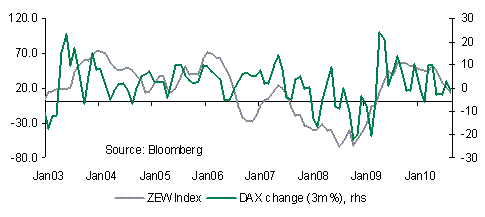
Today’s data will provide further direction for the days ahead, with the September German ZEW survey of investor confidence likely to be closely scrutinized. A drop in the economic sentiment gauge to around 10 is expected from 14 in August, highlighting that eurozone growth momentum is beginning to wane. Hard data in the form of eurozone industrial production will also record a weaker performance, likely to drop 0.3% in July. The data will likely cap the EUR today.

In the US the main release is the August retail sales report for which a 0.3% gain in both headline and ex-autos sales is expected. Sales will have been helped by back to school spending although major discounting will have weighed on retailers’ profits. Nonetheless, any gain even if modest will be a welcome development for Q3 growth in the US.

German Action Backfires

Just as it appeared that a semblance of calm was returning to markets over the last day or so, markets went into a tailspin in reaction to the announcement that the German regulators will temporarily ban naked short-selling of shares in 10 financial institutions, EUR government bonds and credit-default swaps based on these bonds. “Exceptional volatility”, “massive” short-selling and excessive price movements were cited as reasons for the ban. The action was reminiscent of a similar move by the US SEC in September 2008.

The action appears to have backfired, fuelling uncertainty over its impact, potential replication by other European countries, how and to whom it would apply as well as how it will be enforced. Once again a single eurozone country has enforced a unilateral measure in an uncoordinated fashion. It is unclear whether other eurozone countries will follow Germany’s actions but it is clear that the measure has led to a further bailout from European asset markets.

Aside from a reversal in equity markets, risk currencies will remain under pressure, with EUR/USD dropping to a low of 1.2163 following a tentative rally earlier. Options barriers on the way down could prevent a more rapid sell-off, with 1.2033 seen as the next support level. Pressure is likely to continue today and will likely spread through Asian markets and currencies. Clearly confidence is extremely low and unfortunately such measures are doing very little to change the growing negative sentiment towards Europe.

Even at current levels the risk of intervention on EUR/USD remains low. The pace of the move in EUR/USD and its volatility may be more important than even the level of the currency. In any case, at current levels EUR/USD is trading around “fair value” and a weaker EUR will be a boon to the European economy. Implied EUR/USD volatility is also not at a particularly high level, suggesting little concern by European officials about the level of the EUR.