Pressure, panic and carnage

Pressure, panic and carnage doesn’t even begin to describe the volatility and movements in markets last week. If worries about global economic growth and the eurozone debt crisis were not enough to roil markets the downgrade of the US sovereign credit rating after the market close on Friday sets the background for a very shaky coming few days. All of this at a time when many top policy makers are on holiday and market liquidity has thinned over the summer holiday period.

The downgrade of US credit ratings from the top AAA rating should not be entirely surprising. After all, S&P have warned of a possible downgrade for months and the smaller than hoped for $2.1 trillion planned cuts in the US fiscal deficit effectively opened the door for a ratings downgrade. Some solace will come from the fact that the other two main ratings agencies Moody’s and Fitch have so far maintained the top tier rating for the US although Fitch will make it’s decision by the end of the month.

Comparisons to 2008 are being made but there is a clear difference time this time around. While in 2008 policy makers were able to switch on the monetary and fiscal taps the ammunition has all but finished. The room for more government spending in western economies has now been totally used up while interest rates are already at rock bottom. Admittedly the US Federal Reserve could embark on another round of asset purchases but the efficacy of more quantitative easing is arguably very limited.

Confidence is shattered so what can be done to turn things around? European policy makers had hoped that their agreement to provide a second bailout for Greece and beef up the EFSF bailout fund would have stemmed the bleeding but given the failure to prevent the spreading of contagion to Italy and Spain it is difficult to see what else they can do to stem the crisis.

Current attempts can be likened to sticking a plaster on a grevious wound. Although I still do not believe that the eurozone will fall apart (more for political rather than economic reasons) eventually there may have to be sizeable fiscal transfers from the richer countries to the more highly indebted eurozone countries otherwise the whole of the region will be dragged even further down.

Where does this leave FX markets? The USD will probably take a hit on the US credit ratings downgrade but I suspect that risk aversion will play a strong counter-balancing role, limiting any USD fallout. I also don’t believe that there will be a major impact on US Treasury yields which if anything may drop further given growth worries and elevated risk aversion. It is difficult for EUR to take advantage of the USDs woes given that it has its own problems to deal with.

Despite last week’s actions by the Swiss and Japanese authorities to weaken their respective currencies, CHF and JPY will remain in strong demand. Any attempt to weaken these currencies is doomed to failure at a time when risk aversion remains highly elevated, a factor that is highly supportive for such safe haven currencies. From a medium term perspective both currencies are a sell but I wouldn’t initiate short positions just yet.
US Economic Data Disappointments

Risk gyrations continue, with a sharp shift back into risk off mood for markets driven in large part by yet more disappointing US economic data as the May ADP jobs report came in far weaker than expected at 38k whilst the ISM manufacturing index dropped to 53.5 in May, its lowest reading since September 2009. This was echoed globally as manufacturing purchasing managers indices (PMI) softened, raising concerns that the global ‘soft patch’ will extend deeper and longer than predicted.

The market mood was further darkened by news that Moodys downgraded Greece’s sovereign credit ratings to Caa1 from B1, putting the country on par with Cuba and effectively predicting a 50% probability of default.

The resultant jump in risk aversion was pretty extensive, with US Treasury yields dipping further, commodity prices dropping led by soft commodities, and equity volatility spiking although notably implied currency volatility has remained relatively well behaved.

Global growth worries led by the US have now surpassed Greek and eurozone peripheral country concerns as the main driver of risk aversion, especially as it increasingly looks as though agreement on a further bailout package for Greece is moving closer to being achieved. Moreover, it seems as though a ‘Vienna initiative’ type of plan is moving towards fruition involving a voluntary rollover of debt.

The lack of first tier economic data releases today suggests that it will be a case of further digestion or perhaps indigestion of the weak run of US data releases over recent weeks and the implications for policy. For instance, it is no coincidence that QE3 is now being talked about again following the end of QE2 although it still seems very unlikely.

Bonds may see some respite from the recent rally given the lack of data today although this may prove short-lived as expectations for the May US jobs report tomorrow are likely to have been revised sharply lower in the wake of the weak ADP jobs data and ISM survey yesterday, with an outcome sub 100k now likely for May US non-farm payrolls.

Meanwhile, FX markets are caught between the conflicting forces of higher risk aversion and weaker US data, leaving ranges to dominate. On balance, risk currencies will likely remain under pressure today and the USD may get a semblance of support in the current environment.

This may be sufficient to prevent EUR/USD from retesting its 1 June high around 1.4459 as markets wait for further developments on the Greek front. Once again the likes of the CHF and to a lesser extent JPY will do well in a risk off environment whilst the likes of the AUD and NZD will suffer.

ECB In Focus

The highlight today is the European Central Bank (ECB) council meeting. Markets have priced in a hawkish stance from the ECB; Euro rates have edged higher whilst EUR/USD has strengthened. The ECB is likely to highlight worries about price developments today paving way for a hike in H2 2011. Watch for any shift in the balance of risks statement in the press conference and upward revisions to inflation and growth forecasts. In terms of liquidity operations the full allotment procedures at the Main Refinancing Operations (MRO) are likely to be extended for another three months.

EUR risks are asymmetric and whilst the currency remains a buy on dips (with technical indicators pointing to a move to 1.4000) the bigger risk is if the ECB does not live up to the hawkish market expectations which could hit EUR given long positioning overhang. Other than this, risk aversion remains elevated according to my barometer, supporting JPY and CHF. US numbers remain upbeat as seen in the ADP private sector jobs report yesterday, which will likely lead to an upward revision to non-farm payrolls forecasts in February (currency consensus 195k). However, the USD impact of positive data is limited against the background of a relatively dovish Fed stance.

Caught In The Headlights

For a prolonged period of time market attention had firmly focused on the Fed and prospects for quantitative easing (QE2). Now that QE has been delivered with little surprise, as the Federal Reserve arguably did a good job of living up to market expectations, it is Europe that is back in the limelight. Until recently the major surprise about Europe was how well the economy and the EUR were doing and how quickly the European Central Bank (ECB) would diverge from the Fed in its policy path.

This all looks premature and as if to confirm the shift in outlook the slowing in eurozone growth in Q4 (0.4% QoQ) revealed last week is likely to mark the beginning of a sharp and diverging deceleration in growth over coming quarters. The EUR may still have some life left in it given the ongoing purchases via recycled intervention flows from Asian central banks but weaker growth and peripheral worries are undermining this vestige of support.

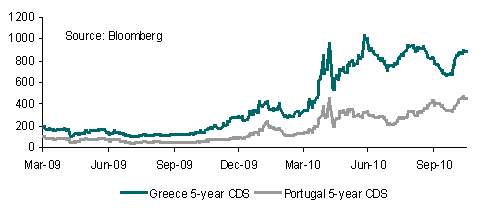
Unfortunately for Europe the region is now not being caste in a good light and the peripheral trio of Ireland, Greece and Portugal are all staring into the headlights with nowhere to run. A crash of sorts seems inevitable but will there be any casualties? Markets are being whipsawed as they determine what will happen next in this slow motion saga.

Irish officials have maintained they do not need any aid package following discussions held over the weekend. Any bailout would likely come from a EUR 60 billion fund from the European Commission meaning a quick distribution but Ireland’s refusal will likely see pressure resume on peripheral debt markets in Europe as well as the EUR.

Portugal is also in the spotlight following comments by its foreign minister that the country may be forced to abandon the EUR if there is a failure to adopt a broad coalition government to deal with the crisis. This sounds like scaremongering but nonetheless highlights the political tensions in the country.

In Greece the second round of regional elections reveals the ruling Pasok party candidates are in the lead, reducing the prospect of early general elections. Nonetheless, this will do little to alleviate pressure as the EU is set to revise higher Greece’s 2009 deficit and debt estimates implying even more difficulty in meeting this year’s targets.

An EU/IMF team will visit Greece to assess progress as well as decide on whether the country should receive its 3rd instalment of a EUR 110 billion loan. Suggestions from PM Papandreou that he does not rule out having to extend the repayment of the loan will not auger well for sentiment. Finally, the government is set to present its 2011 final budget on Thursday, suggesting plenty of event risk this week.

A meeting of EU finance ministers tomorrow and Wednesday will also garner attention. Germany’s stance that investors will only have to take the brunt of losses from debt rescheduling only from 2013 still remains a contentious issue amongst officials even though it is a slightly softer stance than previously stated. Agreement on this as well as pressure on Ireland to accept funding will be key points of discussion.

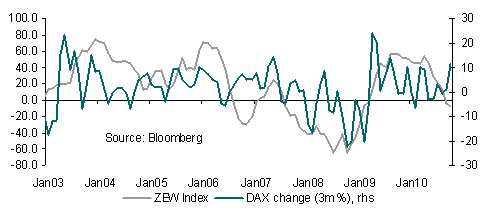
Event wise, an auction of T-bills in Greece tomorrow as well as a Spanish debt auction on Thursday will be watched to determine how far the contagion of Irish woes have spread. The news is unlikely to be good, with higher yields likely. Unfortunately tomorrow’s German November ZEW investor confidence survey will provide further signs of retreating investor sentiment in the wake of renewed peripheral debt concerns.

No Let Up in USD Pressure

At the end of a momentous week for currency markets it’s worth taking stock of how things stand. Much uncertainty remains about the global growth outlook, especially with regard to the US economy, potential for a double-dip and further Fed quantitative easing. Although there is little chance of QE2 being implemented at next week’s Fed FOMC meeting speculation will likely remain rife until there is clearer direction about the path of the US economy.

In Europe, sovereign debt concerns have eased as reflected in the positive reception to debt auctions this week. Nonetheless, after a strong H1 2010 in terms of eurozone economic growth the outlook over the rest of the year is clouded. Such uncertainty means that markets will also find it difficult to find a clear direction leaving asset markets at the whim of day to day data releases and official comments.

The added element of uncertainty has been provided by Japan following its FX intervention this week. Whilst Japanese officials continue to threaten more intervention this will not only keep the JPY on the back foot but will provide a much needed prop for the USD in general. Indeed Japan’s intervention has had the inadvertent effect of slowing but not quite stopping the decline in the USD, at least for the present.

The fact that Japanese officials continue to threaten more intervention suggests that markets will be wary of selling the USD aggressively in the short term. The headwinds on the USD are likely to persist for sometime however, regardless of intervention by Japan and/or other Asian central banks across Asia, until the uncertainty over the economy and QE2 clears.

Japan’s intervention has not gone down well with the US or European authorities judging by comments made by various officials. In particular, the FX intervention comes at a rather sensitive time just as the US is piling on pressure on China to allow its currency the CNY to strengthen further. Although US Treasury Secretary Geithner didn’t go as far as proposing trade and legal measures in his appearance before Congress yesterday there is plenty of pressure from US lawmakers for the administration to take a more aggressive stance, especially ahead of mid-term Congressional elections in November. Ironically, the pressure has intensified just as China has allowed a more rapid pace of CNY nominal appreciation over recent days although it is still weaker against its basket according to our calculations.

Another country that has seen its central bank intervening over many months is Switzerland, with the SNB having been aggressively intervening to prevent the CHF climbing too rapidly. However, in contrast to Japan the SNB is gradually stepping back from its intervention policy stating yesterday that it would only intervene if the risk of deflation increased. Even so, Japan may have lent the Swiss authorities a hand, with EUR/CHF climbing over recent days following Japan’s intervention.

The move in EUR/CHF accelerated following yesterday’s SNB policy meeting in which the Bank cut its inflation forecasts through 2013, whilst stating that the current policy stance in “appropriate”. Moreover, forecasts of “marked” slowdown in growth over the rest of the year highlight the now slim chance of policy rates rising anytime soon. Markets will eye technical resistance around 1.3459 as a near term target but eventually the CHF will likely resume its appreciation trend, with a move back below EUR/CHF 1.3000 on the cards.