World Cup FX Positioning/Data Highlights

The market tone felt decidedly better over the course of the last week although it was difficult to tell if this was due to position squaring ahead of the World Cup football or a genuine improvement in sentiment. There was no particular event or data release that acted as a catalyst either, with the European Central Bank (ECB) and Bank of England (BoE) meetings passing with little fanfare.

US data ended the week mixed, with retail sales disappointing in May but in contrast June consumer confidence beating expectations. Although questions about the pace of recovery remain, other data such as the Fed’s Beige Book suggest that recovery remains on track, sentiment echoed, albeit cautiously by Fed Chairman Bernanke last week.

Attention this week will centre on inflation data. Expected benign CPI readings will support the view that the Fed will take its time to raise interest rates. Speeches by the Fed’s Bullard, Plosser and Bernanke this week will be eyed for further clues on Fed thinking.

Central banks in Brazil and New Zealand hiked rates last week but this is not likely to be echoed this week. No change is likely from both the Bank of Japan and Swiss National Bank although there will be plenty of attention on the SNB’s comments on the CHF following recent data showing a surge in FX reserves due to currency intervention. The BoJ is unlikely to announce anything new but perhaps some further detail on the loan support plan could be forthcoming.

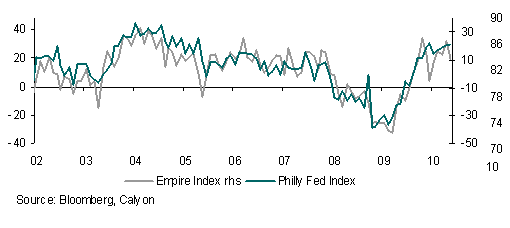
Manufacturing data will also garner some attention, with the US June Empire and Philly Fed surveys and May industrial production on tap. All three reports will confirm the improving trend in manufacturing activity in the US. Housing data will look weaker, with starts set to pull back in starts in May following the expiry of government tax incentive programmes though permits are set to rise.
In Europe, the June German ZEW (econ sentiment) investor sentiment survey will likely slip slightly due to ongoing fiscal/debt worries but this will be countered by stronger domestic data. In any case the index remains at a high level and a slight drop is unlikely to derail markets.

GBP may find some support form upgrade of UK growth forecasts by the CBI to 1.3% for 2010 and relatively hawkish comments from the BoE’s Sentance in the weekend press warning that inflation is higher than expected, indicating that the Bank may need to hike rates sooner than expected.

Further GBP/USD direction will come from CPI and retail sales data this week as well as public borrowing figures and a report by the new Office of Budget Responsibility on the UK’s fiscal position ahead of the June 22 budget. A break above GBP/USD resistance around 1.4760 is unlikely to materialise.

Despite the many data releases this week, the overall tone is likely to be one of consolidation and reduced volatility in the days ahead. This may allow EUR/USD to gain some ground due to short covering, with the CFTC commitment of traders (IMM) report revealing a further increase in net short speculative positions last week, close to the record set a few weeks back, though we suspect that there will be strong resistance around 1.2227.
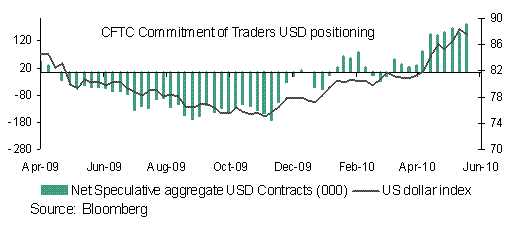
The fact that the IMM data revealed that net aggregate net USD long positions reached an all time high last week, highlights the potential for profit taking this week. USD/JPY will look to take out resistance around 92.55 but this looks unlikely unless the BoJ dishes up anything particularly dovish from its meeting.

What’s driving FX – Interest rates or risk?

The November US retail sales report has really set the cat amongst the pigeons. For so long we have become accustomed to judging the move in the USD based on daily gyrations in risk aversion. Well, that may all be about to change. There was an inkling that all did not look right following the release of the November jobs report which unsurprisingly helped to boost risk appetite but surprisingly boosted the USD too.

It was easy to dismiss the USD reaction to year end position adjustment, markets getting caught short USDs etc. What’s more the shift in interest rate expectations following the jobs report in which markets began to price in an earlier rate hike in the US was quickly reversed in the wake of Fed Chairman Bernanke’s speech highlighting risks to the economy and reiterating the Fed’s “extended period” stance.

However, it all has happened again following the release of the November retail sales data, which if you missed it, came in stronger than expected alongside a similarly better than forecast reading for December Michigan confidence. The USD reaction was to register a broad based rally as markets once again moved to believe that the “extended period” may not be so extended after all.

Interest rates will become increasingly important in driving currencies over the course of the next few months but if anyone thinks that the Fed will shift its stance at this week’s FOMC meeting, they are likely to be off the mark. No doubt the Fed will note the recent improvement in economic data but this is highly unlikely to result in a change in the overall stance towards policy.

Further improvements in US data this week including industrial production, housing starts, Philly Fed and Empire manufacturing may lead markets to doubt this but the Fed calls the shots and a potentially dovish statement may act to restrain the USD this week. Also, it’s probably not a good idea to rule out the influence of risk appetite on currencies just yet and with a generally positive slate of data expected, firmer risk appetite will similarly act as a cap on the USD this week.

Other than the US events there is plenty of other potentially market moving data to digest this week. More central banks meet this week including the Riksbank, Norges Bank and Bank of Japan. No change is expected from all three but whilst the Riksbank is set to maintain a dovish stance the Norges Bank meeting is a closer call. So soon after the emergency BoJ meeting, a shift in policy appears unlikely but the pressure to increase Rinban (outright JGB buying) operations could throw up some surprises for markets.

Europe also has its fair share of releases this week including the two biggest data for markets out of the eurozone, namely, the German ZEW and IFO surveys as well as the flash December PMI readings. The biggest risk is for the ZEW survey which could suffer proportionately more in the wake of recent sovereign concerns in the Eurozone. Sovereign names may still lurk to protect the downside on EUR/USD and if the USD finds it tougher going as noted above, the EUR may be able to claw back some of its recent losses.

Contrasting the ECB with the Fed

Whether its year end book closing/profit taking and/or renewed doubts about the shape of recovery, asset markets have turned south recently.  Investor mood appears to be souring as risk aversion creeps back into the market psyche.  A string of disappointing US data releases over the last week including core retail sales, Empire manufacturing, industrial production, and housing starts, contributed to the reduced appetite for risk, resulting in a soft finish to the week for equity markets and a firmer USD.

Things are likely to take a turn for the better this week, however. Data will shed a little more light on the pace and magnitude of economic recovery and could result in some improvement in appetite for risk trades.  Despite an expected downward revision to US Q3 GDP, forward looking data on home sales, durable goods orders and personal income and spending as well as consumer confidence are likely to reveal increases.  In the Eurozone, data economic releases will paint a similar picture, including an expected increase in the closely watched barometer of business confidence, the German IFO survey. 

At the least economic data will remove some, but by no means all doubts about a relapse in the recovery process.  There is no doubting the veracity of the recovery in equity and commodity prices, despite doubts about its sustainability. Central banks may not react uniformly to this and the policy impact could vary significantly.  Already it appears that the ECB is moving more quickly towards an exit strategy compared to the Fed.  Although ECB President Trichet highlighted that the crisis is far from over at the end of last week, the Bank announced tougher standards for asset backed securities used as collateral, indicating that the need to provide emergency support to banks is much lower than it was. 

Clearly the ECB wants to avoid letting the market become over dependent on the central bank and will look to implement measures to this aim.  In contrast, the Fed is showing little sign of beginning this process and at least one member of the FOMC, namely St. Louis Fed President Bullard, was quoted over the weekend advocating that the Fed keep its MBS buying programme beyond its scheduled close in March. Evidence of the contrasting stance is also reflected in the fact that the Fed’s balance sheet is expanding once again whilst the ECB’s is contracting.  As a result of firmer data and comments by Bullard the USD is set to go into the week under renewed pressure, albeit within well defined ranges.

Chinese stocks enter bear market

Markets can only be described as fickle as they gyrate back and forth depending on the latest news or earnings report and as a result direction is changing not just daily but also intra-day.  Investors in most asset classes will continue to focus on stocks especially the recently underperforming Chinese equity market (Shanghai A share index) which officially moved into bearish territory after falling by over 20% from its early August high. 

Various reasons for the drop can be cited including regulator’s curbs on the stock market, high valuations, absence of new fund launches, limits on institutional buying,  high level of new accounts adding to volatility, tighter regulations on real estate, etc, but whatever the reason the direction has been clearly downwards and the impact is being felt across markets.

The turnaround in equity markets during Wednesday’s sessions was dramatic and was led by the turnaround in Chinese stocks which dragged other Asian bourses down with it.   This outweighed any positive sentiment from Market positives so far this week including a strong reading for the German August ZEW survey which surpassed forecasts by a large margin.  This followed the extension of the TALF by the Fed, and a jump in the US Empire manufacturing survey at the beginning of the week.  

Aside from weaker equities the usual FX beneficiaries including the dollar and yen strengthened on the back of the Chinese stock rout.   S&P’s affirmation of China’s credit ratings and positive comments from China’s stats office about the economic outlook in the months ahead  failed to support sentiment.  This would have been expected to provide a positive backdrop for Asian markets but Chinese stock market jitters provided a strong headwind to local markets. 

Overall most measures of risk have seen a substantial improvement over the past few months but there is no doubt that nerves are creeping back into the market.   This time the nervousness is coming from China and worryingly it is swamping the effect of any good news on the global economy and earnings.   This may prove to be a blip on the long road to recovery in risk appetite but it is difficult to ignore such a sharp fall in Chinese stocks without looking at the potential contagion to other equity markets.  

On the FX front those currencies that are most correlated with risk aversion such as the Australian dollar, New Zealand dollar, South African rand, Indonesian rupiah, Brazilian real and Mexican peso will gyrate in relation to the moves in risk appetite.   These currencies have had the highest correlations with risk aversion over the past month and in the current environment will come under some pressure at least until risk sentiment changes again, which in this market could happen at any moment and without warning.

Risk trades under pressure

Having given presentations in Hong Kong, China and South Korea in the past week and preparing to do the same in Taiwan and Singapore this week it is clear that there is a lot of uncertainty and caution in the air.  

There can be no doubt now that risk aversion has forcibly made its way back into the markets psyche.  Government bonds, the US dollar and the Japanese yen have gained more ground against the background of higher risk aversion. 

Following a tough week in which global equity markets slumped, oil fell below $60 per barrel and risk currencies including many emerging market currencies weakened, the immediate outlook does not look particularly promising.

Data releases are not giving much for markets to be inspired about despite upgrades to economic growth forecasts by the IMF even if their outlook remains cautious.  US trade data revealed a bigger than expected narrowing in the deficit in May whilst US consumer confidence fell more than expected in July as rising unemployment took its toll on sentiment.   There was also some disappointment towards the end of the week as the Bank of England did not announce an increase in its asset purchase facility despite much speculation that it would do so.

Rising risk aversion is manifesting itself in the usual manner in currency markets.  The Japanese yen is grinding higher and having failed to weaken when risk appetite was improving it is exhibiting an asymmetric reaction to risk by strengthening when risk appetite is declining.  Its positive reaction to higher risk aversion should come as no surprise as it has been the most sensitive and positively correlated currency with risk aversion since the crisis began. 

Nonetheless, the Japanese authorities will likely step up their rhetoric attempting to direct the yen lower before it inflicts too much damage on recovery prospects.   The urgency to do so was made clear from another drop in domestic machinery orders last week as well as the poor performance of Japanese equities.  

The US dollar is also benefitting from higher risk aversion and is likely to continue to grind higher in the current environment.  Risk currencies such as the Canadian, Australian and New Zealand dollars, will be most vulnerable to a further sell off but will probably lose most ground against the yen over the coming days.   These currencies are facing a double whammy of pressure from both higher risk aversion and a sharp drop in commodity prices.    Sterling and the euro look less vulnerable but will remain under pressure too.   

There are some data releases that could provide direction this week in the US such as retail sales, housing starts, Empire and Philly Fed manufacturing surveys.  In addition there is an interest rate decision in Japan, and inflation data in various countries. The main direction for currencies will come from equity markets and Q2 earnings reports, however.  

So far the rise in risk aversion has not prompted big breaks out of recent ranges in FX markets.  However, unless earnings reports and perhaps more importantly guidance for the months ahead are very upbeat, there is likely to be more downside for risk currencies against the dollar but in particular against yen crosses where most of the FX action is set to take place.