FX / Economic Preview

The European Union (EU) aid package for Greece and extension of collateral requirements by the European Central Bank (ECB) helped return a semblance of confidence to markets. Although the probability of a Greek default now looks extremely small, further austerity measures, fiscal issues in other EU countries and the negative impact on growth that all of this implies, suggest that Europe will be plagued by various problems for some time yet.

As a result of more favourable market conditions Greece is set to launch a syndicated bond issues today or tomorrow of up EUR 5 billion according to press reports. Attention will also turn to Greek debt rollovers, beginning with EUR 8.2 billion on April 20.

Improving sentiment following the Greece deal has extended to the EUR, with the currency bouncing off its lows around 1.3267. EUR/USD will now look to break through resistance around 1.3446, which would set up a test of 1.3516. There is plenty of scope for short-covering to help the EUR as reflected in the latest IMM Commitment of Traders’ report (a gauge of speculative market positioning) which revealed net EUR positions reaching yet another record low in the week to 23rd March. Whilst sovereign/official buying interest may keep EUR/USD supported this week the currency pair is best played as a sell on rallies.
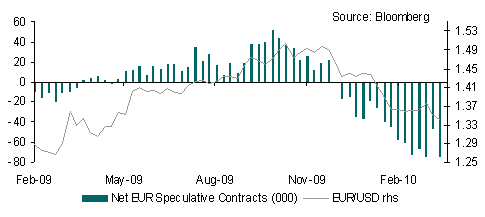
A similar assessment applies for GBP. Speculative sentiment for the currency also hit a record low in the latest week but unlike the Greek deal helping the EUR, last week’s UK budget has done little to boost GBP’s prospects. Moreover, a report in the Financial Times highlighting hedge funds bets against GBP, suggests that there are still plenty of headwinds against the currency.

Volumes are set to thin out this week ahead of upcoming holidays, whilst the US March jobs report at the end of the week will likely prevent moves out of current ranges ahead of its release. The consensus forecast is for a 190k increase in non-farm payrolls though much of this is likely to reflect hiring for the 2010 US consensus and a rebound from adverse weather effects in February.

In Europe March economic confidence surveys will be watched closely to determine how much damage Greece and general fiscal woes are having on sentiment. Some improvement, in line with the Eurozone Purchasing Managers Index (PMI) and the German IFO business confidence survey, is expected, which will help to give further, albeit limited relief to the EUR.

The Japanese data slate kicked off the week in good form, with the release of February retail sales data, revealing its biggest annual increase in 12-years. It is difficult to see the recovery in sales taking much greater hold given persistent deflation pressures however, and part of the gain probably reflects the government’s shopping incentive program.

Aside from industrial production and jobs data in Japan the key release will be the results of the Q1 Tankan survey on Wednesday. The survey of manufacturers’ confidence is set to show further improvement. USD/JPY is likely to remain supported around 91.67 but will need a further widening in US/Japan 10-year bond yield spreads to push higher.
Greek Confusion, India Tightening

It is highly interesting that markets could take fright from a rate hike in India but this appears to be what has happened. India’s surprise 25bps rate hike has provoked another bout of risk aversion whilst the lack of any concrete agreement on a framework for a Greek bail out dealt a further blow to confidence. FX tensions between the US and China have not helped, with China threatening retaliation to any US move to name the country as a currency manipulator in the mid April US Treasury report.

Should we really be worried by a rate hike in India or China? Whilst the India rate move reflects the fact that emerging market central banks are moving far more aggressively to raise rates than their G7 counterparts, global fears that India’s move will dampen recovery prospects are unfounded. Monetary tightening in India and China and other economies is taking place against the backdrop of economic strength not weakness.

As such the global impact on growth should be limited. Rising inflation pressure in Asia is reflection of the much quicker economic recovery, relatively low rates and undervalued currencies in the region. Not only will central banks in Asia have to raise interest rates but will also have to allow further currency appreciation.

There is still plenty of confusion about a bail out for Greece ahead of the 25-26th March EU summit. German Chancellor Merkel dampened expectations of a bailout by stating that it was not even on the agenda for the summit. In contrast, EU President Barroso has pushed EU members to agree on an explicit stand-by aid agreement for Greece as soon as possible.

There is also disagreement about whether there should be any IMF involvement, with Germany favouring some help from the Fund whilst France opposes it. Meanwhile, the Greek Prime Minister has reportedly given an ultimatum that should no aid plan be forthcoming at the EU summit, Greece will turn to the IMF for assistance.

All of this suggests more downside for EUR/USD, with a test of support around 1.3422 looming. In the event that the EU summit offers good news for Greece, EUR/USD sentiment could turn quickly so a degree of caution is warranted. Speculative sentiment for the EUR has improved according to the latest CFTC Commitment of Traders (IMM) data for the week to 16th March, with net short EUR positions at their lowest since the beginning of February. Nonetheless, the short covering seen over the past week could come to an abrupt end should there be no aid package for Greece.

The most volatile currency over the past week was GBP/USD and after hitting a high of around 1.5382 it has slid all the way back to around the 1.5000 level. Much of this was related to the gyrations in EUR/USD but GBP took on a life of its own towards the end of the week and has not been helped by comments by BoE MPC member Sentence who highlighted the risk of a “double-dip” recession in the UK.

GBP is highly undervalued and market positioning is close to a record low but a sustainable recovery looks unachievable at present. Attention this week will centre on the 2010 UK Budget announcement and markets will scrutinise the details of how the government plans to cut the burgeoning budget deficit. Failure to restore some credibility to the government’s plans will dent GBP sentiment further and lead to a sharper decline against both the EUR and USD.

Better Levels To Sell

It is questionable how long the slight improvement in risk appetite at the beginning of this week lasts given the fickle nature of market sentiment at present and propensity for more disappointment. More than likely any relief will be short-lived given 1) there are still major concerns about fiscal/debt problems in Greece, Spain, Portugal, etc 2) the sharp decline in economic activity that various austerity plans will lead to and 3) rising social/labour unrest due to cuts in spending and hikes in taxes that need to be implemented.

Attention remains firmly fixed on Greece’s woes whilst global growth concerns have reappeared following some disappointing data releases in the US last week as well the decline in China’s manufacturing purchasing managers’ index (PMI) in February, released overnight, which although obscured by the timing of Chinese Lunar New Year holidays, suggests that China’s economy is losing some of its recent strong momentum.

Speculation of a rescue plan for Greece will likely give some support to the beleaguered EUR though it may only end up providing better levels to sell the currency. EU Monetary Affairs Commissioner Rehn is scheduled to meet with Greek Prime Minister Papandreou today against the background of talks about the possibility of EUR 25 billion in aid to Greece using state owned lenders to buy Greek debt. Any aid will likely come with demands for more action to reduce Greece’s yawning budget deficit which will fuel further weakness in economic activity.

A key test of sentiment towards Greece’s austerity plans will be the market reception to an upcoming sale of as much as EUR 5 billion in 10-year Greek bonds. Given the reassurances given by the EU the sale of bonds will likely not be too problematic. As an indication, Greek 10-year bond yields dropped sharply on Friday as sentiment improved.

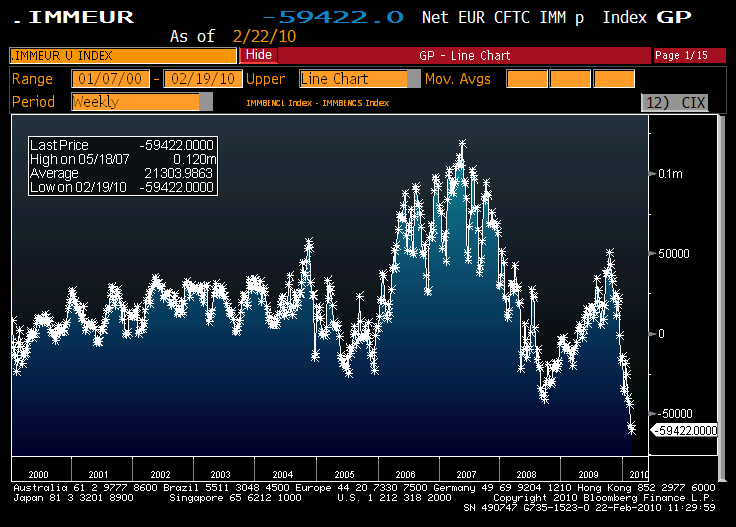
The bounce in Greek debt was accompanied by a firmer EUR/USD which rebounded to a high of around 1.3667 as markets covered short positions. It’s probably way too early to suggest that the EUR has began a sustainable rally however, and more likely it has settled into a new range, with support around the 2010 low of 1.3444. The latest CFTC Commitment of Traders’ (IMM) data revealed a further increase in net short EUR positioning to a new record low in the week to 23rd February. This highlights both the weight of pessimism on the currency as well as significant potential to rebound.

Conversely, the IMM data reveals that net USD positions are at their highest in almost a year and well above their three-month average, suggesting that USD positioning is looking a bit stretched though its worth noting that positioning is still well off its record high. Nonetheless, with a bailout for Greece in the offing, risk appetite could gain a stronger foothold this week, in turn keeping the USD capped.

As for the EUR, although a lot of bad news is in the price, for the currency to rebound on a sustainable basis it will require fiscal/growth worries to recede. Despite talk of Greek aid, there is a long way to go before Europe’s fiscal/debt problems are resolved.

Risk Appetite Puts Dollar On The Back Foot

Markets look somewhat calmer going into this week helped by comments by Fed members who noted that the discount rate hike did not signal a shift in monetary policy, something which is likely to be repeated by Fed Chairman Bernanke in his testimony to Congress on Wednesday and Thursday.  A tame US January CPI report last Friday helped too, giving further support to the view that the Fed will not hike the Fed Funds rate for some time yet; a rate hike this year seems highly unlikely in my view.  

Data this week will be conducive to a further improvement in risk appetite and despite the lingering concerns about Greece the EUR may find itself in a position to extend gains.  In Europe all eyes will be on the February German IFO survey and eurozone sentiment indicators, which following the surprising strength in the manufacturing Purchasing Managers Indices (PMIs), are likely to reveal solid gains. 

The main highlights in Japan this week includes January trade data and industrial production. The trade numbers will be particularly important to determine whether the rebound in exports due in large part to robust Asian demand, has continued whilst the bounce back in exports will be a key factor in fuelling a further gain in industrial output. 

In the US aside from the testimonies by Fed Chairman Bernanke there are plenty of releases on tap including consumer confidence, new and existing home sales, durable goods orders and a likely upward revision to Q4 GDP.  For the most part the data will show improvement and play for a further improvement in risk appetite. 

FX direction will depend on whether markets focus on the potentially positive USD impact of a reduction in USD liquidity or on the likely firmer tone to risk appetite this week.  Given expectations of firmer data and the soothing tone of the Fed, risk currencies will likely perform better, with crosses such as AUD/JPY favoured.  The USD will likely be placed on the back foot, especially given the very long market positioning in the currency.

The EUR will be helped by the fact that speculative market, according to the CFTC IMM data, holds record short positions in the EUR (as of the week ended 16 February) giving plenty of potential for short-covering.   The more timely Tokyo Financial Exchange (TFX) data also reveals that positioning in EUR/JPY has continued to be scaled back.  

CFTC Commitment of Traders (IMM) data – Net EUR speculative positioning

EUR/USD bounced smartly from its lows around 1.3444 on Friday, partly reflecting some short covering and the drop in FX volatility suggests the market is more comfortable with EUR/USD around these levels.  A positive IFO survey and improved risk appetite could see EUR/USD test resistance around 1.3774, its 20 day moving average, over coming days.  Ongoing Greek concerns suggest that any EUR bounce will be limited, however. 

USD/JPY looks well supported and although data this week will suggest that exports are improving despite JPY strength, the relatively more aggressive stance of the Fed compared to the BoJ, long JPY positioning, and improved risk appetite, give plenty of scope for the JPY to extend losses, with technical USD/JPY support seen around 91.28.

Tarnishing The Euro

I am just finishing up a client trip in Japan and waiting to take a flight back to Hong Kong. The time ahead of the flight has allowed some reflection on my meetings here. One thing that has been particularly evident is the strong interest in all events European. Some I have spoken to have wondered out loud whether this the beginning of the end of the European project.  At the least it is evident that fiscal/debt problems in Greece and elsewhere in Europe have tarnished the image of the EUR.

Markets continue to gyrate on any news about Greece and the potential for support from the Europe Union and/or IMF. The divergent views between European countries about how to deal with the problem has intensified, suggesting that reaching an agreement will not be easy. Some countries including the UK and Sweden have suggested enrolling the help of the IMF but this has been resisted by other European countries. Germany and France are trying to rally support ahead of today’s crucial meeting of European officials.

The EUR reacted positively to news that some form of support package is being considered but nothing concrete has appeared yet, leaving markets on edge. The EUR has been heavily sold over recent weeks; speculative market positioning reached a record low in the latest week’s CFTC Commitment of Traders’ IMM report. The fact that EUR positioning has become so negative suggests that the EUR could rebound sharply in the event that some support package for Greece is announced.

Any package will not come without strings attached, however, as European officials will want to avoid any moral hazard. A couple of options hinted at by German officials include fresh loans or some form of plan to purchase Greek debt. Either way, any solution to Greece’s problems will not be quick and will likely result in a sharp contraction in economic activity as the government cuts spending especially as Greece does not have the option of the old remedy of devaluing its currency. Meanwhile, strikes and social tensions in the country could escalate further. A solution for Greece will only constitutes around 2.5% of eurozone GDP will also not prevent focus from continuing to shift to Portugal, Spain and other countries with fiscal problems despite comments by Moody’s ratings agency to differentiate between the countries.

Even if the EUR rebounds on any positive news about support for Greece any relief is likely to prove temporary and will provide better levels to sell into to play for a medium term decline in the currency. Ongoing fiscal concerns, a likely slower pace of economic recovery, divergencies in views of European officials, and the fact that the EUR is still overvalued suggests that the currency will depreciate over much of 2010, with a move to around EUR/USD 1.30 or below in prospect over coming months.