Australian Dollar Looking Stretched

Central bank decisions in Japan, Europe and UK will dictate FX market direction today. No surprises are expected by the Bank of Japan (BoJ) and Bank of England (BoE) leaving the European Central Bank (ECB) decision and press conference to provide the main market impetus. Although a hawkish message from ECB President Trichet is likely the market has already priced in a total of 75 basis points of tightening this year. We retain some caution about whether the EUR will be able to make further headway following the ECB meeting unless the central bank is even more hawkish than already priced in.

EUR/USD easily breached the 1.4250 resistance level and will now eye resistance around 1.4500. News that Portugal formally requested European Union (EU) aid came as no surprise whilst strong German factory orders provided further support to the EUR. The data highlights upside risks to today’s February German industrial production data. The EUR will find further support versus the USD from comments by Atlanta Fed’s Lockhart who noted that he doesn’t expect the Fed to hike interest rates by year end.

USD/JPY is now around 7.5% higher than its post earthquake lows. Japanese authorities will undoubtedly see a measure of success from their joint FX intervention. To a large degree they have been helped by a shift in relative bond yields (2-year US / Japan yield differentials have widened by close to 30 basis points since mid March, and are finally having some impact on USD/JPY as reflected in the strengthening in short-term correlations. Whilst the BoJ is unlikely to alter its policy settings today the fact that it is providing plenty of liquidity to money markets, having injected around JPY 23 trillion or about 5% of nominal GDP since the earthquake, is likely playing a role in dampening JPY demand.

AUD/USD has appreciated by close to 6% since mid March and whilst I would not recommend selling as yet I would be cautious about adding to long positions. My quantitative model based on interest rate / yield differentials, commodity prices and risk aversion reveals a major divergence between AUD/USD and its regression estimate. Clearly the AUD has benefitted from diversification flows as Asian central banks intervene and recycle intervention USDs. However, at current levels I question the value of such diversification into AUD.
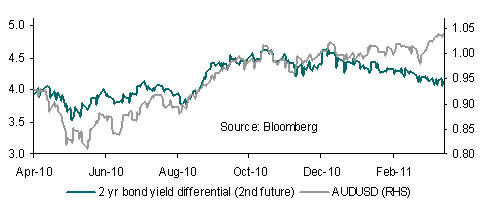
Speculative AUD/USD positioning as indicated by the CFTC IMM data reveals that net long positions are verging on all time highs, suggesting plenty of scope for profit taking / position squaring in the event of a turn in sentiment. Moreover, AUD gains do not match the performance of economic data, which have been coming in worse than expected over recent weeks. Consequently the risks of a correction have increased.
ECB to Hike, BoJ, BoE & RBA on Hold

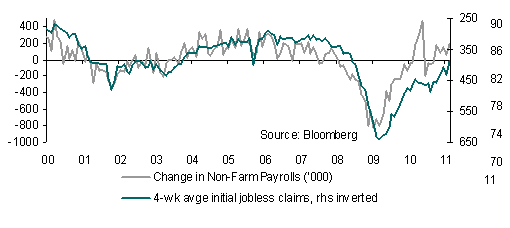
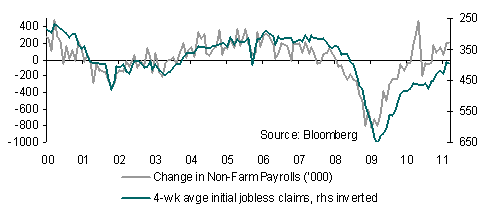
The better than expected March US jobs report will likely help to shift the debate further towards the hawkish camp in the Fed. There is little this week to match the potency of payrolls in terms of market moving data this week. Instead attention will focus on a raft of Fed speakers over coming days as well as the minutes of the March 15 FOMC meeting.

This week’s Fed speakers include Lockhart, Evans, Bernanke, Kocherlakota, Plosser and Lacker. Of these only Lockhart and Lacker are non voters. Given the intense focus on recent Fed comments FX markets will be on the lookout for anything that hints a broader Fed support for a quicker hike to interest rates and/or reduction in the Fed’s balance sheet.

In any case the USD may struggle to make much headway ahead of an anticipated European Central Bank (ECB) rate hike of 25 basis point on Thursday. Much will depend on the press statement, however. If the ECB merely validates market expectations of around 75bps of policy rate hikes this year the EUR will struggle to rally.

It may also be possible that once the ECB meeting is out of the way the EUR may finally be susceptible to pressure related to ongoing peripheral tensions. Last week the outcome of the Irish bank stress tests, and political vacuum in Portugal ahead of elections set for June 5 were well absorbed by the EUR but it is questionable whether the dichotomy between widening peripheral bond spreads and the EUR can continue.

The Tankan survey in Japan released today unsurprisingly revealed a deterioration in sentiment. The survey will provide important clues for the Bank of Japan (BoJ) at its meeting on April 6 & 7th. Although a shift in Japan’s ultra easy monetary policy is unlikely whilst strong liquidity provision is set to continue, pressure to do more will likely grow. This will be accentuated by a likely downward revision in the economic outlook by the BoJ.

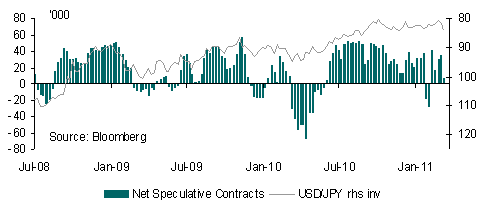
The JPY will not take much direction from this meeting. Nonetheless, its soft tone may continue helped by foreign securities outflows (particularly out of bonds), with USD/JPY eyeing the 16 December high around 84.51. Speculative positioning as reflected in the CFTC IMM data reveals a sharp deterioration in JPY sentiment as the currency evidence that finally the currency maybe regaining its mantle of funding currency.

It is still too early for the Bank of England to hike rates despite elevated inflation readings and MPC members are likely to wait for the May Quarterly Inflation Report before there is decisive shift in favour of raising policy rates. Even then, members will have to grapple with the fact that economic data remains relatively downbeat as reflected in the weaker than expected March manufacturing purchasing managers index (PMI) data.

Today’s PMI construction data will likely paint a similar picture. The fact that a rate hike is not expected by the market will mean GBP should not suffer in the event of a no change decision by the BoE this week but instead will find more direction from a host of data releases including industrial production. GBP has come under growing pressure against the EUR since mid February and a test of the 25 October high of 0.89415 is on the cards this week.

Finally, congratulations to the Indian cricket team who won a well deserved victory in the Cricket World Cup final over the weekend. The celebrations by Indians around the world will go on for a long while yet.

US Dollar On A Slippery Path

The USD has been a on a slippery path over recent weeks, weighed down by adverse interest rate differentials despite improving US economic data. Adding to the run of encouraging US data releases the February jobs report revealed a 192k increase in jobs and a drop in the unemployment rate to 8.9%.

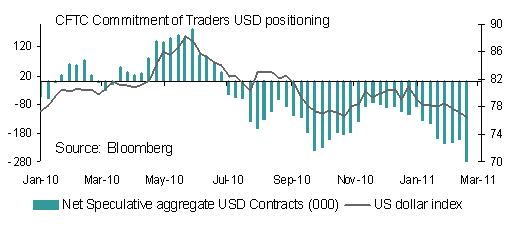
In particular the Fed’s dovish tone highlights that whilst asset purchases under QE2 will stop at the end of June, the failure to hit the Fed’s dual mandate of maximum employment and stable prices, implies that the Fed Funds rate will not be hiked for a long while yet. This dovish slant has undermined the USD to the extent that USD speculative positioning as reflected in the CFTC IMM data dropped to all time low in the week to 1 March. There is certainly plenty of scope for short-covering but the market is no mood to buy the USD yet.

This week’s releases will provide less direction, with a slight widening in the trade deficit likely in January, a healthy gain in February retail sales and a small drop in the preliminary reading of March Michigan sentiment.

In contrast, even the generally hawkish market expectations for the European Central Bank (ECB) proved too timid at last week’s Council meeting as Trichet & Co. strongly implied via “strong vigilance” that the refi rate would be hiked by 25bps in April. EUR/USD lurched higher after the ECB bombshell breaking the psychologically important 1.4000 barrier but appeared to lose some momentum at this level. Should EUR/USD sustain a break of 1.4000, the next level of resistance is at 1.4281 (November high), with support seen around 1.3747.

The lack of major eurozone data releases this week, with only industrial production data in Germany and France of interest, suggests that EUR may consolidate over the short-term with the main interest on the informal Heads of State meeting at the end of the week to determine whether credible plans can be drawn up to restore confidence in the periphery.

This week it is the turn of the Bank of England (BoE) to decide on monetary policy but unlike the ECB we do not expect any surprises with an unchanged decision likely. Further clues will only be available in the Monetary Policy Committee (MPC) minutes on 23 March. However, markets may be nervous given that it could feasibly only take another two voters aside from the three hawkish dissenters last month, to result in a policy rate hike. Notably one possible hawkish dissenter, Charles Bean did not sound overly keen on higher rates in a speech last week, a factor that weighed on GBP alongside some weaker service sector Purchasing Managers Index (PMI) data.

UK manufacturing data will be the main data highlight of the calendar but this will be overshadowed by the BoE meeting. GBP/USD could continue to lag the EUR and given a generally bullish EUR backdrop, our preferred method of playing GBP downside remains via a long EUR/GBP position.

US Dollar Upside, Euro tensions

Following the famine that was last week this week will see a feast of data releases, which hopefully will give some clearer direction to currency markets. The key eurozone data focus for FX markets will be the German February ZEW survey and it should highlight that investor confidence is bouncing back smartly. This will be accompanied by data showing a slight acceleration in GDP in the eurozone in Q4 2010. Good news, but the reality is that the EUR is being driven more by peripheral bond tensions and relative yields.

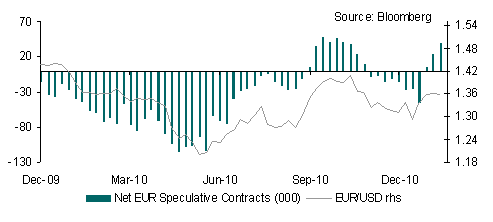
Although the EUR may get a brief lift from the news of the resignation of Egypt’s President Mubarak this will likely prove temporary. Given that tensions are beginning to creep higher EUR/USD may struggle to make any headway this week and will more likely slip below 1.3500 for a test of 1.3440 as sentiment sours. Even the usual sovereign interest may look a little more reluctant to provide support this week. The net long positioning overhang as reflected in the CFTC IMM data suggests some scope for a squaring in long positions, likely accelerating any downside pressure.

As usual data releases are failing to have a major impact on the JPY whilst interest rate / yield differentials suggest the JPY should be much weaker. One explanation for the stubbornly strong JPY is the strength of recent portfolio inflows to Japan, especially into its bond markets. This could reverse quickly and IMM positioning suggests that the potential for a shakeout of long positioning looms large, something that many Japanese margin traders are well positioned for according to TFX data. USD/JPY 84.51 will provide firm resistance to a move higher in the short-term.

GBP will be guided by the Bank of England Quarterly Inflation Report on Wednesday as well as the January CPI and retail sales data. The Report will reveal that inflation moderates over the medium term, even if short-term projections are shifted higher. Consequently, interest rate markets may even pare back overly hawkish expectations for UK rates, leaving GBP vulnerable. Nonetheless, markets maybe somewhat more sceptical or at least nervous in light of a likely increase in UK CPI, albeit mostly due to the increase in value added tax (VAT) at the turn of the year. Moreover, GBP may find some solace from a rebound in retail sales in January.

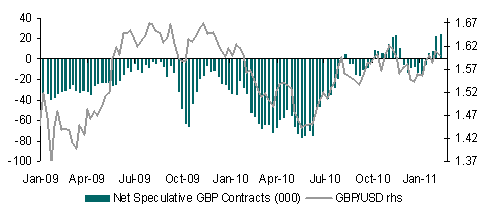
Overall, GBP/USD will take its cue from EUR/USD and the currency is vulnerable to a sustained drop below 1.6000 this week. The fact that GBP/USD IMM positioning is at its highest since September 2008 suggests a lot of scope for a sell-off. EUR/GBP looks like its consolidating in an even narrower range between 0.8400-0.8500.

Another positive slate of US data releases and likely more pressure on US bond markets this week suggest that the USD will find further support, with the USD index likely to take a shot at the 79.00 level. Indeed a further improvement in both the Philly Fed and Empire manufacturing surveys is expected, providing more evidence of strengthening manufacturing momentum, will be borne out in the hard data, with a healthy gain in industrial output expected. Similarly a healthy reading for US retail sales will support the evidence that the US consumer is in full recovery mode.

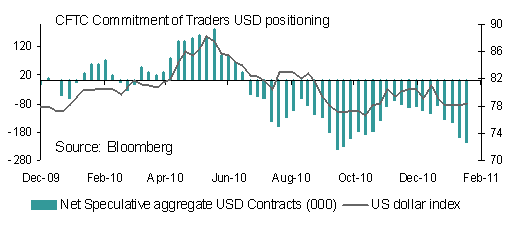
The positive impact on the USD may be dampened however, by benign inflation readings this week, supporting the view that US policy rates will not be raised for a long time yet. This is likely to be echoed in the Fed FOMC minutes this week. Nonetheless, speculative positioning suggests plenty of scope for short USD covering, with the latest CFTC IMM report revealing the biggest net short position since October 2010.

Econometer.org has been nominated in FXstreet.com’s Forex Best Awards 2011 in the “Best Fundamental Analysis” category. The survey is available at http://www.surveymonkey.com/s/fx_awards_2011

Beyond Expectations

Egypt worries continue to reverberate across markets, yet there appears to be growing resilience or at least some perspective being placed on problems there. Encouraging economic data, particularly in the US has helped to shield markets to some extent, with equity market rallying and US bond yields rising last week. The main impact of Egypt and worries about Middle East contagion continues to be felt on oil prices.

Even the mixed US January jobs report has failed to dent market sentiment; the smaller than expected 36k increase in payrolls was largely attributed to severe weather. A further surprising drop in the unemployment rate to 9.0% due mainly to a significant drop in the labor force was also well received by the market.

There will be less market moving releases on tap this week and the data are unlikely to dent recovery hopes. Michigan confidence is set to record an improvement in February whilst the December trade deficit is set to widen to around $41.0 billion. There are also plenty of Federal Reserve speakers this week including a testimony by Chairman Bernanke.

One central bank that has softened its hawkish rhetoric is the European Central Bank (ECB), with President Trichet dampening speculation of an early rate hike last week and alleviating some of the pressure on eurozone interest rate markets. Consequently the EUR fell as the interest rate differential with the USD became somewhat less attractive. The EUR was also undermined by the opposition from some member states to French and German ideas for greater fiscal policy coordination, an aim apparently not shared across euro members.

Data in Europe will be largely second tier. The EUR will look increasingly vulnerable to a further drop this week especially given the increase in net positioning over the past week to (1st February) according to the CFTC IMM data. The potential for position squaring looms large as positioning is now well above the three-month average. Stops are seen just below EUR/USD 1.3540.

In the UK the Bank of England policy meeting will take centre stage but there is unlikely to be any change in policy settings. Clues to policy thinking will be available in the monetary policy committee meeting minutes in two weeks times but it seems unlikely that any more members have joined the two voting for a hike at the last meeting.

Recent data have been a little more encouraging helping to wash off the disappointment of the surprise drop in Q4 GDP. The UK industrial production report is likely to be similarly firm on Thursday, with the annual pace accelerating. GBP/USD may however, struggle to make much headway against the background of a firmer USD and the weigh of long positioning, with GBP/USD 1.6279 seen as strong resistance.

There are plenty of releases in Australia this week to focus including the January employment data, consumer confidence, and a testimony by RBA governor Stevens in front of the House of Representatives on Friday. The data slate started off somewhat poorly this week, with December retail sales coming in softer than expected, up 0.2% MoM. AUD/USD is likely to be another currency that may struggle to sustain gains this week but much will depend on data over coming days. Resistance is seen around 1.0255.

On a final note, the weekend’s sporting events highlight how it’s not just economic data or moves in currencies that don’t always go as expected. After a solid run in the Ashes cricket England slumped to a 6-1 series loss to Australia in the one-day series, putting the Ashes win into distant memory. A similarly solid performance by Man United was dented with their unbeaten record broken by bottom of the table Wolves.

Econometer.org has been nominated in FXstreet.com’s Forex Best Awards 2011 in the “Best Fundamental Analysis” category. The survey is available at http://www.surveymonkey.com/s/fx_awards_2011

Your support in the survey is highly appreciated