EUR boosted, USD under pressure

Market attention remains fully focussed on events in Japan especially related to the country’s nuclear facilities. Risk aversion has spiked higher as a result, with ongoing Middle East tensions adding to the risk off tone. CHF is a key beneficiary of safe haven demand but the picture for JPY is obscured by repatriation expectations on one hand and FX intervention risks/Bank of Japan liquidity injections on the other, keeping USD/JPY clsoe to the 82.00 level. In contrast the AUD is vulnerable to a drop below parity with the USD on Japan worries, especially as Australia is a key destination for Japanese investment and therefore potential for reversal of such flows if Japanese institutions repatriate funds.

The EUR recovered over recent days as worries about the eurozone periphery ease and peripheral bonds spreads narrow. It is only a matter of time before overly long market positioning catches up with the EUR especially as the prospects of further interest rate support to the currency looked limited; markets have already priced in 75bps of policy rate hikes in the eurozone this year, which looks appropriate. It is difficult to see markets pricing in any more tightening than this over coming weeks. Despite its bounce back EUR/USD will struggle to break resistance around 1.4036.

Markets will digest the fallout from the informal EU leaders meeting last Friday which prepared the groundwork for the official meeting on 24/25 March. The initial reaction of the EUR appears to be positive but there is a significant risk of disappointment if the outcome of the meeting on 24/25 March does not live up to expectations. Indeed although Friday’s meeting resulted in an agreement in principle of a new “pact for the Euro” much will depend on the eventual details later this month.

Leaders also agreed on lowering interest rates to Greece by 100bps, and in principle enlarging the scope of the European Financial Stability Facility (EFSF) bailout fund to EUR 440 billion. The main positive surprise was opening the door for the fund to purchase eurozone debt. Data releases will offer little support to the EUR this week, with limited gains in the March German ZEW investor confidence survey today likely to leave markets unperturbed.

The USD’s gains last week proved short-lived and the currency will be tested by another relatively dovish Fed FOMC statement today and a benign reading for core CPI inflation in February. The Fed FOMC meeting is unlikely to deliver any changes to the Fed’s stance and whilst there has recently been some speculation that the Fed will soon remove its “extended period” comment, this is unlikely to happen any time soon. The statement will remind markets that the Fed is in no rush to alter its policy settings, an outcome that may limit the ability of the USD to strengthen this week even if data releases continue to remain on the positive side, including manufacturing survey and industrial production over coming days.
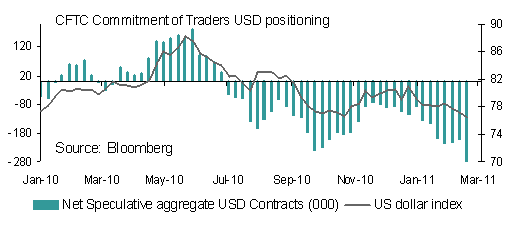
US Dollar On A Slippery Path

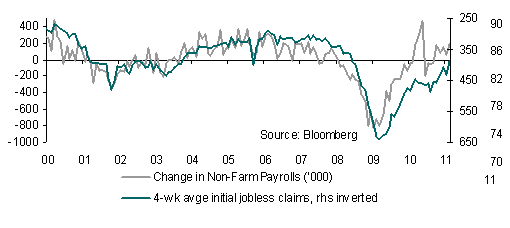
The USD has been a on a slippery path over recent weeks, weighed down by adverse interest rate differentials despite improving US economic data. Adding to the run of encouraging US data releases the February jobs report revealed a 192k increase in jobs and a drop in the unemployment rate to 8.9%.

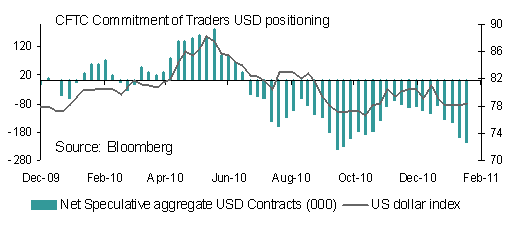
In particular the Fed’s dovish tone highlights that whilst asset purchases under QE2 will stop at the end of June, the failure to hit the Fed’s dual mandate of maximum employment and stable prices, implies that the Fed Funds rate will not be hiked for a long while yet. This dovish slant has undermined the USD to the extent that USD speculative positioning as reflected in the CFTC IMM data dropped to all time low in the week to 1 March. There is certainly plenty of scope for short-covering but the market is no mood to buy the USD yet.

This week’s releases will provide less direction, with a slight widening in the trade deficit likely in January, a healthy gain in February retail sales and a small drop in the preliminary reading of March Michigan sentiment.

In contrast, even the generally hawkish market expectations for the European Central Bank (ECB) proved too timid at last week’s Council meeting as Trichet & Co. strongly implied via “strong vigilance” that the refi rate would be hiked by 25bps in April. EUR/USD lurched higher after the ECB bombshell breaking the psychologically important 1.4000 barrier but appeared to lose some momentum at this level. Should EUR/USD sustain a break of 1.4000, the next level of resistance is at 1.4281 (November high), with support seen around 1.3747.

The lack of major eurozone data releases this week, with only industrial production data in Germany and France of interest, suggests that EUR may consolidate over the short-term with the main interest on the informal Heads of State meeting at the end of the week to determine whether credible plans can be drawn up to restore confidence in the periphery.

This week it is the turn of the Bank of England (BoE) to decide on monetary policy but unlike the ECB we do not expect any surprises with an unchanged decision likely. Further clues will only be available in the Monetary Policy Committee (MPC) minutes on 23 March. However, markets may be nervous given that it could feasibly only take another two voters aside from the three hawkish dissenters last month, to result in a policy rate hike. Notably one possible hawkish dissenter, Charles Bean did not sound overly keen on higher rates in a speech last week, a factor that weighed on GBP alongside some weaker service sector Purchasing Managers Index (PMI) data.

UK manufacturing data will be the main data highlight of the calendar but this will be overshadowed by the BoE meeting. GBP/USD could continue to lag the EUR and given a generally bullish EUR backdrop, our preferred method of playing GBP downside remains via a long EUR/GBP position.

US Dollar Upside, Euro tensions

Following the famine that was last week this week will see a feast of data releases, which hopefully will give some clearer direction to currency markets. The key eurozone data focus for FX markets will be the German February ZEW survey and it should highlight that investor confidence is bouncing back smartly. This will be accompanied by data showing a slight acceleration in GDP in the eurozone in Q4 2010. Good news, but the reality is that the EUR is being driven more by peripheral bond tensions and relative yields.

Although the EUR may get a brief lift from the news of the resignation of Egypt’s President Mubarak this will likely prove temporary. Given that tensions are beginning to creep higher EUR/USD may struggle to make any headway this week and will more likely slip below 1.3500 for a test of 1.3440 as sentiment sours. Even the usual sovereign interest may look a little more reluctant to provide support this week. The net long positioning overhang as reflected in the CFTC IMM data suggests some scope for a squaring in long positions, likely accelerating any downside pressure.

As usual data releases are failing to have a major impact on the JPY whilst interest rate / yield differentials suggest the JPY should be much weaker. One explanation for the stubbornly strong JPY is the strength of recent portfolio inflows to Japan, especially into its bond markets. This could reverse quickly and IMM positioning suggests that the potential for a shakeout of long positioning looms large, something that many Japanese margin traders are well positioned for according to TFX data. USD/JPY 84.51 will provide firm resistance to a move higher in the short-term.

GBP will be guided by the Bank of England Quarterly Inflation Report on Wednesday as well as the January CPI and retail sales data. The Report will reveal that inflation moderates over the medium term, even if short-term projections are shifted higher. Consequently, interest rate markets may even pare back overly hawkish expectations for UK rates, leaving GBP vulnerable. Nonetheless, markets maybe somewhat more sceptical or at least nervous in light of a likely increase in UK CPI, albeit mostly due to the increase in value added tax (VAT) at the turn of the year. Moreover, GBP may find some solace from a rebound in retail sales in January.

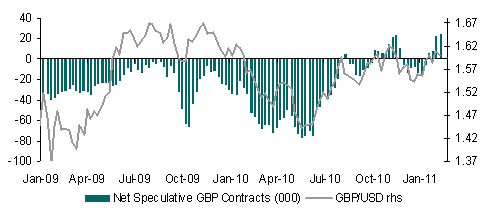
Overall, GBP/USD will take its cue from EUR/USD and the currency is vulnerable to a sustained drop below 1.6000 this week. The fact that GBP/USD IMM positioning is at its highest since September 2008 suggests a lot of scope for a sell-off. EUR/GBP looks like its consolidating in an even narrower range between 0.8400-0.8500.

Another positive slate of US data releases and likely more pressure on US bond markets this week suggest that the USD will find further support, with the USD index likely to take a shot at the 79.00 level. Indeed a further improvement in both the Philly Fed and Empire manufacturing surveys is expected, providing more evidence of strengthening manufacturing momentum, will be borne out in the hard data, with a healthy gain in industrial output expected. Similarly a healthy reading for US retail sales will support the evidence that the US consumer is in full recovery mode.

The positive impact on the USD may be dampened however, by benign inflation readings this week, supporting the view that US policy rates will not be raised for a long time yet. This is likely to be echoed in the Fed FOMC minutes this week. Nonetheless, speculative positioning suggests plenty of scope for short USD covering, with the latest CFTC IMM report revealing the biggest net short position since October 2010.

Econometer.org has been nominated in FXstreet.com’s Forex Best Awards 2011 in the “Best Fundamental Analysis” category. The survey is available at http://www.surveymonkey.com/s/fx_awards_2011

Ready for Fed QE2

The USD was already under pressure ahead of the Fed FOMC decision last night, with the EUR benefiting in particular from successful debt auctions in Ireland and Spain. The Fed statement resulted in a further lurch lower for the USD index as it fell through the 81.00 level on its way to testing the August low of 80.09. EUR/USD broke important technical resistance levels moving above its 200-day moving average (1.3215). In contrast, gold prices continued to surge hitting a new record high whilst 2-year Treasury yields fell to an all-time low.

The US Federal Reserve confirmed that it was ready to ease if needed. Although the decision to leave the Fed funds target rate at 0% to 0.25% unchanged and commitment to maintain exceptionally low levels of the rate for an “extended period” came as no surprise there was a subtle change in the language of the statement regarding further easing. The Fed noted that it was “prepared to provide additional accommodation if needed” a shift from the previous wording that it “will employ its tools as necessary”.

It appears to be a case of not if but when the Fed embarks on further quantitative easing and/or other policy accommodation. Once again the Fed offered no guideposts to determine the timing of easing and the decision will ultimately be data dependent. Nonetheless, the bias has clearly shifted towards more balance sheet expansion.

We expect core inflation to decline further over the coming months although we do not forecast a drop to as low as 0.5%. Nonetheless, declining core CPI could lead to the Fed’s disinflation concerns intensifying. Indeed, providing further rationale for the Fed’s conditional easing bias was the particularly dovish stance on inflation in the FOMC statement.

If it wasn’t obvious before it has become increasingly clear now that the USD will not relinquish its role as the ultimate funding currency for a long time to come. Although interest rate differentials are not yet the main driver for most currency pairs, with risk aversion retaining this role for now, there is a very high correlation between certain high yielding currencies and their respective interest rate differentials against the USD.

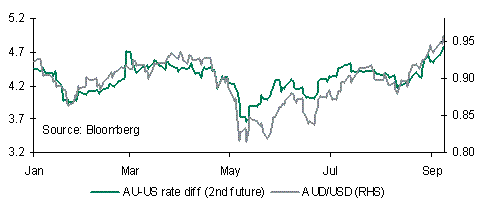
For instance, there is a high and significant correlation between interest rate differentials between Japan, Australia, Canada and the US and their respective currency pairs. AUD/USD is one to watch as the currency hit a fresh 25 month high overnight. Although the AUD looks rich at current levels, the shift in relative yield with the US overnight provides a further underpinning to the currency, with parity being talked about once again.

Even USD/JPY moved lower in the wake of the Fed statement dropping just below 85.00 although the threat of further official Japanese FX intervention will likely prevent a sharp drop in the currency pair. It will be interesting to see how far the market is prepared to go, with further threats of FX intervention by Prime Minister Kan overnight. Despite the threats the narrowing in US / Japan bond yields overnight suggests more downside pressure on USD/JPY and a fresh challenge for the Japanese authorities.

Euro Rally To Fade

It is not an easy time to forecast currencies. Just as many forecasters fought for the accolade of being the most bearish on the EUR and many others were forced to capitulate or risk falling behind the curve, EUR/USD has started to perk up. Similarly, commodity currencies and many emerging market currencies have bounced.

Perhaps the explanation of these moves is merely position adjustments as traders and investors square positions as they keep one eye on the World Cup or maybe its just fatigue after weeks of selling pressure. Either way, the fact that speculative USD market positioning is at a very high level, suggests there is plenty of scope to take profits on long USD positions.

There are various reasons to expect the calm to give way to renewed tensions, however. Public opposition to austerity plans in Europe, added to the prospects for slowing growth as the plans are implemented, in addition to banking sector concerns, suggest that the outlook for the EUR remains downbeat. These factors also point to the prospects of risk aversion rising over the coming weeks, reversing the recent rally in risk currencies.

Further out, the EUR’s travails will not be over quickly and in the wake of the implementation of austerity plans the EUR will struggle from the impact of relatively slower growth in the eurozone compared to the US and other countries. The EUR will continue to remain under pressure even as risk appetite improves and many risk currencies appreciate.

The interruption of risk as an FX determinant is likely to fade towards the end of the year and investors will then go back to differentiating on the basis of relative growth and interest rate dynamics, which will play well for the USD as US growth strengthens.

Relative growth differentials will also bode well for commodity currencies and there will be scope for plenty of upside in the AUD and NZD as growth strengthens. Both countries have benefited from firm demand in Asia and China in particular and this source of support will likely continue to be beneficial.

Funding currencies including JPY and CHF will likely weaken this year against the USD based on the likely improvement in risk appetite later this year. The outlook for the JPY will be particularly interesting in the wake of the change in Prime Minister in Japan, especially given the new PM’s preference for a weaker JPY and reflationary policies. USD/JPY will likely reach 100 by the end of the year.

GBP should not be seen in the same context as the EUR. Although the UK has got its own share of fiscal problems the new government appears to be moving quickly to mollify both investor and ratings agency concerns. The test will come with the reaction of the emergency budget on June 22nd but I suspect that the downside risk to GBP will be limited.

Unlike the EUR which is trading around “fair value”, GBP is highly undervalued. Arguably past GBP weakness puts the UK economy on a stronger recovery footing. Moreover, problems that Europe will face in implementing multi country austerity plans and widening growth divergence, will not be repeated in the UK. Overall, there is likely to be significant outperformance of GBP versus EUR over coming months