Ecofin, ECB, US jobs report in focus

The USD index remains close to its recent highs, maintaining a positive tone amid elevated risk aversion. Data releases have tended to take a back seat to events over recent weeks, but this week the all important US September jobs report may provide the bigger focus for US markets. The consensus expectation is for a 50k increase in payrolls and the unemployment rate remaining at 9.1% an outcome that would do nothing to assuage US growth worries. As usual markets will gauge clues to the jobs data from the ADP jobs data and employment components of the ISM data but an outcome in line with consensus expectations will likely keep risk aversion elevated and the USD supported unless the data is so bad that it results in an increase in expectations for Fed QE3.

There will be plenty of attention on the Ecofin meeting of European finance ministers today especially given that much of the reason for the stability in markets recently is the hope of concrete measures to resolve the crisis in the region. In this respect the scope for disappointment is high, suggesting that the EUR is vulnerable to a further drop if no progress is made at today’s meeting. While the extent of short market positioning has left open some scope for EUR short covering the absence of any good news will mean the impetus for short covering will diminish.

While attention in Europe will predominately remain on finding a resolution to the debt crisis and the saga of Greece’s next loan tranche, the European Central Bank (ECB) meeting will also be in focus this week especially given expectations that the ECB will cut interest rates. While hopes of a 50 basis points rate cut may have taken a knock from the firmer than expected reading for September flash CPI released at the end of last week the EUR could actually react positively to an easing in policy given that it may at least help to allay some of the growing growth concerns about the eurozone economy. However, any EUR will be limited unless officials in the eurozone get their act together and deliver on expectations of some form of resolution to the crisis in the region.

Strong words from Japan’s Finance Minister Azumi failed to have any lasting impact on USD/JPY. Japan will bolster funds to intervene in currency markets by JPY 15 trillion and extend the monitoring of FX positions until the end of December. Japan did not intervene during September but spent around JPY 4.5 trillion in FX intervention in August to little effect. For markets to be convinced about Japan’s conviction to weaken the JPY it will require putting intervention funds to active use, something that doesn’t seem to be forthcoming at present. A factor that may give some potential upside momentum for USD/JPY is the slight widening of US versus Japan bond yield differentials over recent days, which could finally result in a sustained move above 77.00 if it continues into this week.
No QE3 but Bernanke gives some hope

Not only did Federal Reserve Chairman Bernanke not discuss the potential for more quantitatiive easing QE3 but he also did not discuss many other options for Fed policy at Jackson Hole last Friday. The onus has now shifted to the 2-day Fed FOMC meeting on September 21 where markets are looking (hoping) for fresh policy measures. Such hopes helped US equity markets bounce back after initially reacting negatively to Bernanke’s speech.

Bernanke provided some hope to markets that the US economy wasn’t sliding into the abyss while offering the potential for further Fed stimulus even if QE3 wasn’t quite on the cards. This hope was sufficient to spur markets higher. However, importantly Bernanke noted the limitations of monetary policy in stimulating growth over the medium term.

In this respect there will be plenty of attention on President Obama’s speech on September 5 in which markets will be looking for a response from the administration at a time when the economy is becoming an increasingly important issue for the electorate.

In the meantime there are plenty of data releases to contend with this week including the August US jobs report, ISM manufacturing survey, US consumer confidence and various confidence surveys in Europe. Unfortunately the news will not be positive as the data releases are set to reinforce concerns of economic slowdown. The US jobs report is likely to reveal a limited, around 75k increase in non-farm payrolls according to consensus while the ISM manufacturing survey is set to drop into contraction territory.

Consequently markets may start the week in risk on mood but this is unlikely to last given renewed economic worries. Moreover, Eurozone peripheral country travails continue to exasperate markets, with concerns that some members of German Chancellor Merkel’s coalition plan to vote against the revamped EFSF bailout fund and news that two German banks have yet to commit on Greece’s bailout plan. Against this background the EUR continues to defy gravity around the 1.45 level versus USD but may yet come down to earth with a bang.

US dollar on the rise

Risk aversion is on the rise as uncertainties about Greece and worries about weaker economic data weigh on sentiment. A number of key events rather than data will be the main drivers this week. First and foremost amongst these is the vote in the Greek parliament on the country’s budget reform plan, which if passed will pave the way for the way for a disbursement of EUR 12 billion from the European Union / IMF and a new bailout package.

Meanwhile in the US talks on raising the debt ceiling are likely to resume in earnest, with the market likely to become increasingly nervous about the lack of resolution on the issue. Nonetheless, it is Europe that will dominate the headlines and on this front even if the reform plan is passed any market relief is likely to be limited given the ongoing uncertainty about private sector participation in any Greek debt roll over. This suggests that the EUR will remain under pressure over the week despite reassuring comments from Chinese Premier Wen.

Data releases will be relegated to background noise but what there is will not help sentiment. Signs of slowing activity remain evident as revealed in disappointing eurozone manufacturing surveys last week and this will be echoed in the US ISM manufacturing survey at the end of this week. Economic sentiment gauges in Europe are also set to reveal a decline. Given the lack of ammunition and/or unwillingness to risk using further stimulus from the Fed, the sensitivity of markets to weak data will be high, keeping risk aversion elevated.

Indeed, although well flagged the end of the Fed’s QE2 this week will mark a major shift in market dynamics, especially in currency markets where the USD will finally see a massive weight lifted from its shoulders. As indicated by Fed Chairman Bernanke following the FOMC meeting the Fed is not considering a further round of asset purchases, a fact that will help the USD to find firmer support.

Notably the USD index moved has above its 100-day moving average providing a positive technical signal given that it has failed on its last two attempts. The USD index now looks set to break its April high around 76.610.

US Economic Data Disappointments

Risk gyrations continue, with a sharp shift back into risk off mood for markets driven in large part by yet more disappointing US economic data as the May ADP jobs report came in far weaker than expected at 38k whilst the ISM manufacturing index dropped to 53.5 in May, its lowest reading since September 2009. This was echoed globally as manufacturing purchasing managers indices (PMI) softened, raising concerns that the global ‘soft patch’ will extend deeper and longer than predicted.

The market mood was further darkened by news that Moodys downgraded Greece’s sovereign credit ratings to Caa1 from B1, putting the country on par with Cuba and effectively predicting a 50% probability of default.

The resultant jump in risk aversion was pretty extensive, with US Treasury yields dipping further, commodity prices dropping led by soft commodities, and equity volatility spiking although notably implied currency volatility has remained relatively well behaved.

Global growth worries led by the US have now surpassed Greek and eurozone peripheral country concerns as the main driver of risk aversion, especially as it increasingly looks as though agreement on a further bailout package for Greece is moving closer to being achieved. Moreover, it seems as though a ‘Vienna initiative’ type of plan is moving towards fruition involving a voluntary rollover of debt.

The lack of first tier economic data releases today suggests that it will be a case of further digestion or perhaps indigestion of the weak run of US data releases over recent weeks and the implications for policy. For instance, it is no coincidence that QE3 is now being talked about again following the end of QE2 although it still seems very unlikely.

Bonds may see some respite from the recent rally given the lack of data today although this may prove short-lived as expectations for the May US jobs report tomorrow are likely to have been revised sharply lower in the wake of the weak ADP jobs data and ISM survey yesterday, with an outcome sub 100k now likely for May US non-farm payrolls.

Meanwhile, FX markets are caught between the conflicting forces of higher risk aversion and weaker US data, leaving ranges to dominate. On balance, risk currencies will likely remain under pressure today and the USD may get a semblance of support in the current environment.

This may be sufficient to prevent EUR/USD from retesting its 1 June high around 1.4459 as markets wait for further developments on the Greek front. Once again the likes of the CHF and to a lesser extent JPY will do well in a risk off environment whilst the likes of the AUD and NZD will suffer.

RBA on hold, RBI hikes rates

News of the death of Osama Bin Laden gave the USD a lift and its gains have extended for a second day. Extreme short market positioning as well as increasing risk aversion (perhaps due to worries about retaliation following Bin Laden’s death) have helped the USD.

However, the boost to the USD could be short-lived in the current environment in which it remains the preferred global funding currency. Indeed, the fact that US bond yields have dropped sharply over recent weeks continues to undermine the USD against various currencies.

The USD firmed despite the US ISM manufacturing index dropping slightly, albeit from a high level. The survey provided some useful clues to Friday’s US jobs report, with the slight decline in the employment component of the ISM survey to 62.7 consistent with a 200k forecast for April payrolls.

Ahead of the European Central Bank (ECB) meeting on Thursday hawkish rhetoric from new Council member and Bundesbank chief Weidmann (replacing Weber) and more reassurances from Greek and EU officials that there will be no debt restructuring or haircut on the country’s debt has helped the EUR although it is notable that it could not sustain a foot hold above 1.49. Eurozone bond yields have risen by around 20bps compared to US yields over the past month, a fact that suggests that the EUR may not fall far in the short-term.

USD/JPY is trading dangerously close to levels that may provoke FX intervention by the Japanese authorities. General USD weakness fuelled a drop in USD/JPY which has been exacerbated by a rise in risk aversion over recent days (higher risk aversion usually plays in favour of a stronger JPY). The biggest determinant of the drop in USD/JPY appears to a narrowing in bond yields (2-year bond yields have narrowed by around 20bps over the past month) largely due to a rally in US bonds.

Unsurprisingly the Reserve Bank of Australia (RBA) left its cash rate on hold at 4.75%. The accompanying statement showed little inclination to hike rates anytime soon, with credit growth noted as modest, pressure from a stronger exchange rate on the traded sector and temporary prices shocks which are expected to dissipate. The only indication that rates will eventually increase is the view that longer term inflation is expected to move higher.

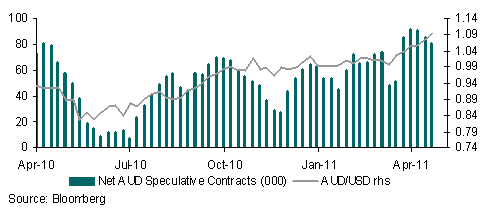
I look for further rate hikes over coming months even with the AUD at such a high level. AUD has lost a bit of ground after hitting a high just above 1.10 against the USD and on the margin the statement is slightly negative for AUD. A slightly firmer USD overall and stretched speculative positioning, with IMM AUD positions close to their all time high, points to some downside risks in the short-term.

In contrast India’s central bank the RBI hiked interest rates by more than many expected. Both the repo and reverse repo rates were raised by 50bps, with the central bank governor highlighting renewed inflation risks in his statement. The decision reveals a shift in RBI rhetoric to an even more hawkish bias in the wake of rising inflation pressures, which should be beneficial to the rupee.