Payrolls sour mood, Eurozone concerns intensify

The market mood has soured further and risk aversion has increased following disappointing August US jobs report in which the change in payrolls was zero and downward revisions to previous months has reinforced the negative mood on the US and global economy while raising expectations of more Federal Reserve action. Moreover, the report has put additional pressure on US President Obama to deliver fresh jobs measures in his speech on Thursday though Republican opposition may leave Obama with little actual leeway for further stimulus.

There is plenty of event risk over coming days, with a heavy slate central bank meetings including in Europe, UK, Japan, Australia, Canada and Sweden. The European Central Bank will offer no support to a EUR that is coming under growing pressure, with the Bank set to take a more neutral tone to policy compared its previously hawkish stance. In the UK, GBP could also trade cautiously given recent comments by Bank of England Monetary Policy Committee members about potential for more UK quantitative easing.

The EUR has been unable to capitalise on the bad economic news in the US as news there has been even worse. The negative news includes the weekend defeat of German Chancellor Merkel’s centre-right bloc in regional elections, which comes ahead of a vote in Germany’s constitutional court on changes to the EFSF bailout fund.

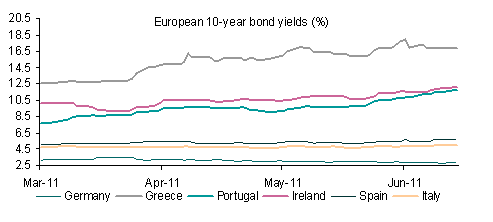
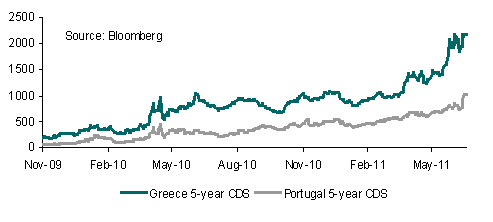
The withdrawal of the Troika (ECB, IMF and EU) from Greece has also put renewed emphasis on the country at a time when protests are escalating. If all of this is not enough there is growing concern about Italy’s apparent backtracking on austerity measures, with the Italian parliament set to discuss measures this week. Separately Germany, Holland and Finland will hold a meeting tomorrow on the Greek collateral issue. On top of all of this is the growing evidence of deteriorating growth in the euro area.

Data releases are unlikely to garner a great deal of attention amidst the events noted above, with mainly service sector purchasing managers indices on tap and at least threw will look somewhat better than their manufacturing counterparts. In the US the Beige Book and trade data will be in focus but all eyes will be on Obama’s speech later in the week. The USD has maintained a firm tone despite the jobs report but its resilience may be better explained by eurozone negativity rather than US positivity. Even so, the USD is looking less uglier than the EUR in the current environment.
Japan FX Measures Underwhelm

Currencies continue to show remarkable stability in the face of elevated risk aversion which has prompted huge volatility in other asset markets. Although FX volatility has risen over recent weeks its rise is nothing compared to the jump in the VIX ‘fear gauge’ equity volatility measure. FX markets are in some form of limbo where there are conflicting forces at play and where there is no obvious currency to play. The lack of clarity in markets suggests that this situation will not change quickly.

The USD (index) is trading at the lower end of its recent ranges and verging on a retest of its July 27 low around 73.421, with the currency perhaps suffering from expectations that Fed Chairman Bernanke will announce a desire to embark on more quantitative easing at Friday’s Jackson Hole symposium. Its losses could quickly reverse as such expectations are quickly dashed.

Indeed, while Bernanke will likely keep all options open any hint at QE3 is unlikely as the Fed maintains a high hurdle before any prospect of further quantitative easing is entertained. One option on the table is ‘sterilised’ large scale asset purchases which would not result in an increase in the size of the Fed’s balance sheet. This would be far less negative for the USD than a fresh round of QE and may even prompt a rally in the currency as markets shift away from the idea of QE3.

The USD will benefit from high risk aversion except against safe havens such as the CHF and JPY. In this respect the USD remains a better bet than the EUR which has failed to garner much benefit from renewed ECB peripheral bond buying. Nonetheless, data yesterday failed to feed into negative EUR sentiment despite mixed manufacturing surveys and a sharp drop in the German ZEW investor confidence survey. EUR/USD remains trapped in a broad 1.42-1.45 range.

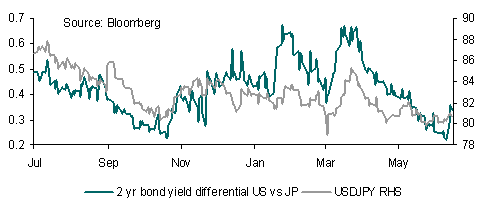
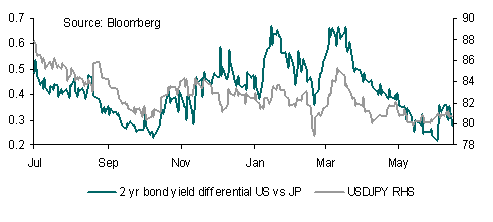
News that Moody’s ratings agency has downgraded Japan’s sovereign ratings by one notch to Aa3 is unlikely to have much impact on the JPY. Moody’s left the outlook stable while unlike the US and Europe around 95% of Japanese debt is held domestically, suggesting little FX and JGB impact. USD/JPY continues to garner some influence from yield differentials and given that the US bond yield advantage versus Japan has continued to narrow, USD/JPY continues to face downward pressure.

Japan announced measures to deal with JPY strength including the creation of a $100 billion emergency credit facility. However, the main impact on the JPY could come from increased monitoring of FX transactions with firms having to report on FX positions held by dealers. The statement made no comment on FX intervention and this is where there will be most disappointment for JPY bears. Overall, the actions are somewhat underwhelming and are unlikely to have much impact on the JPY. If anything, the JPY may actually strengthen given the lack of comment on FX intervention. USD/JPY downside could face strong technical support around 75.93, however.

Edging Towards A European Deal For Greece

The momentum towards some form of agreement at the Special EU Summit today is growing, with French and German leaders reaching a “joint position on Greece’s debt situation”. Details of this position are still unknown, however. EUR has found support as expectations of a positive outcome intensify.

However, given that positive news is increasingly being priced in, and the market is becoming increasingly long, upside EUR potential will be limited even in the wake of a comprehensive agreement. A break above EUR/USD resistance around 1.4282 would bring in sight the next key resistance level around 1.4375 but this where the rally in EUR/USD is set to be capped.

Prospects of a major US debt default or at the least a government shutdown appear to be receding as the US administration has indicated some willingness to opt for a short term increase in the US borrowing limit to give more time for a bigger deficit reduction deal to be passed by Congress. Meanwhile, there will be further news on the deficit reduction plans put forward by the “gang of six” US senators, with a press conference scheduled for later today.

Debt ceiling negotiations are likely to be the main focus of market attention, with the Philly Fed manufacturing survey and weekly jobless claims relegated to the background. A speech by Fed Chairman Bernanke is unlikely to deliver anything new today. The USD is likely to be on the back foot given expectations of a deal in Europe and improved risk appetite but we expect losses to be limited.

The JPY continues to defy my bearish expectations. Over recent days the US yield advantage over Japan in terms of 2Y bonds dropped to multi-year lows below 20bps. Given the high correlation between USD/JPY and yield differentials, this has corresponded with the fall below 80.00.

Expectations of JPY weakness versus USD is highly dependent on the US – Japan yield gap widening over coming months. For this to happen it will need concerns about the US economy and expectations of more Fed asset purchases to dissipate, something that may not happen quickly given the rash of disappointing US data releases lately.

GBP found itself on the front foot following the release of the Bank of England Monetary Policy Committee minutes, which were less dovish than anticipated. They also revealed that the BoE expects inflation to peak higher and sooner than previously expected. However, the fact that the overall tone was similar to the last set of minutes meant there was little follow through in terms of GBP.

Further direction will come from June retail sales data today and forecasts of a bounce in sales will likely help allay concerns about a downturn in consumer spending. Nonetheless, GBP is still likely to struggle to break through resistance around 1.6230 versus USD.

Which is the ugliest currency?

The contest of the uglies has once again been set in motion in FX markets as last Friday’s weak US jobs report, which revealed a paltry 18k increase in June payrolls, downward revisions to past months and a rise in the unemployment rate, actually left the USD unperturbed. Europe’s problems outweighed the negative impact of more signs of a weak US economy, leaving the EUR as a bigger loser.

The USD’s resilience was even more impressive considering the drop in US bond yields in the wake of the data. However, news over the weekend that talks over the US budget deficit and debt ceiling broke down as Republicans pulled out of discussions, will leave USD bulls with a sour taste in their mouth.

Should weak jobs recovery dent enthusiasm for the USD? To the extent that it may raise expectations of the need for more Fed asset purchases, it may prove to be an obstacle for the USD. However, there is sufficient reason to look for a rebound in growth in H2 2011 while in any case the Fed has set the hurdle at a high level for more quantitative easing (QE).

Fed Chairman Bernanke’s reaction and outlook will be gleaned from his semi-annual testimony before the House (Wed) although he will likely stick to the script in terms of US recovery hopes for H2. This ought to leave the USD with little to worry about. There will be plenty of other data releases this week to chew on including trade data, retail sales, CPI and PPI inflation and consumer confidence as well as the kick off to the Q2 earnings season.

Fresh concerns in Europe, this time with contagion spreading to Italy left the EUR in bad shape and unable to capitalise on the soft US jobs report. In Italy high debt levels, weak growth, political friction and banking concerns are acting in unison. The fact that there is unlikely to be a final agreement on second Greek bailout package at today’s Eurogroup meeting will act as a further weight on the EUR.

Discussions over debt roll over plans, the role of the private sector and the stance of ratings agencies will likely drag on, suggesting that the EUR will not find any support over coming days and will more likely lose more ground as the week progresses. If these issues were not sufficiently worrisome, the release of EU wide bank stress tests on Friday will fuel more nervousness. Against this background EUR/USD looks vulnerable to a drop to technical support around 1.4102.

The Bank of Japan is the only major central bank to decide on interest rates this week but an expected unchanged policy decision tomorrow is unlikely to lead to any JPY reaction. In fact there appears to be little to move the JPY out of its current tight range at present. USD/JPY continues to be the most correlated currency pair with 2-year bond yield differentials and the fact that the US yield advantage has dropped relative to Japan has led to USD/JPY once again losing the 81.0 handle.

However, as reflected in the CFTC IMM data the speculative market is still holding a sizeable long position in JPY, which could result in a sharp drop in the currency should US yields shift relatively higher, as we expect over coming months. In the short-term USD/JPY is likely to be well supported around 80.01.

EUR higher but resistance looms

EUR and risk currencies in general were buoyed by the passage of the austerity bill in the Greek parliament. The implementation bill is also likely to be passed later today opening the door for the disbursement of EUR 12 billion from the European Union / IMF from the EUR 110 bailout agreed for the country. Combined with news that German banks are progressing towards agreeing on a mechanism to roll over Greek debt alongside French banks as well as likelihood of an European Central Bank (ECB) rate hike next week, the EUR is set to remain supported over the short term.

Nonetheless, it once again looks as though a lot of good news is priced in and it would be surprising if EUR/USD could extend to above strong resistance around 1.4557 given the many uncertainties ahead, not the least of which includes the stance of ratings agencies on any Greek debt rollover.

USD/JPY is the only major currency pair that is correlated with bond yield differentials at present (2-year yields) and therefore it should not come as a surprise that USD/JPY has moved higher as the yield differential between the US and Japan has widened by around 10bps over the past week. Indeed, yesterday’s move above 81.00 was spurred by the move in yield differentials although once again the currency pair failed to build sufficient momentum to close above this level.

Further gains will require US bond yields to move even higher relative to Japan but perhaps the end of QE2 today may mark a turning point for US bond markets and currencies. The end of QE2 taken together with a jump in bond supply over coming months, will see US Treasury yields will move sharply higher, implying much more upside for USD/JPY.

AUD has bounced back smartly over recent days, with the currency eyeing resistance around 1.0775 versus USD. A general improvement in risk appetite has given the currency some support but markets will be unwilling to push the currency much higher ahead of the Reserve Bank of Australia (RBA) meeting next week. On the plus side, there are no rate hikes priced in for Australia over the remainder of the year, suggesting an asymmetric risk to next week’s meeting.

In other words, unless the RBA openly discusses rate cuts in the statement, the AUD will likely remain supported. Conversely any indication that a rate hike may be in prospect will be AUD supportive. In any case we continue to believe the AUD offers better value especially relative to NZD and maintain our trade idea to buy AUD/NZD.