Risk on, US dollar pressure

FX markets have plenty of different factors to digest these days and after a harrowing couple of weeks markets began this week on a firmer footing. The overall tone into this week is to load up on risk assets. News that the nuclear situation in Japan may closer to stabilising has helped, whilst markets easily shook off another hike in China’s reserve ratio and ongoing conflict in Libya as Allied forces step up their campaign in the face of continuing resistance from Gaddafi’s forces.

Improved risk appetite has helped to keep the JPY on the defensive along with the continued threat of FX intervention, with further official JPY selling likely in the days ahead. Interestingly the intervention last Friday was estimated at only JPY 530 billion ($6.2 billion), much lower than previously thought. USD/JPY 80 remains a major line in the sand and any sign of another breach of this level will likely be met with official JPY selling. I suspect that the Japanese authorities will not be content until USD/JPY is far higher. In this respect its worth noting an official report released earlier in March highlighting that Japanese companies are not profitable at a USD/JPY rate below 86.

The EUR looks overbought around the 1.42 level but seems to be a beneficiary of Japanese FX intervention (perhaps a recycling of USDs into EUR) as well as comments by European Central Bank (ECB) Council members reiterating their intention to hike the refi policy rate, likely at the April ECB meeting. In a similar vein to the recycling of intervention USDs into EUR, Middle East entities may also be recycling petrodollars into EUR whilst news that Russia has permitted one of its oil related funds to buy Spanish debt has given a lift to sentiment for the EUR. Over the near term EUR/USD may struggle to make much headway above 1.42, with further direction coming from the EU leaders meeting on 24/25 March.

GBP is also doing well, having jumped close to the 1.6400 level versus USD, with UK February CPI giving the currency a further lift. The outcome at 4.4% YoY, which was not as bad as rumoured but in any case worse than consensus will give the hawks in the Bank of England MPC further ammunition to push for a policy rate hike. The fact that core inflation also increased suggests that the jump in headline inflation cannot merely be brushed under the table. A BoE rate hike is increasingly looking like a done deal. Renewed inflation worries in the UK and the hawkish rhetoric from ECB officials is sufficient to keep the USD under pressure.
Losing Your Addiction

An interesting thing happened to me last week. On a business trip to Europe my blackberry broke and failed to work for the rest of the week. I felt like an addict coming off an addiction. The first couple of days were very tough; my usual instinct to constantly check for messages resulted in constant fidgeting and major withdrawal symptoms.

Once this had worn off I must admit I felt liberated. My addiction gone, it felt great to be weaned off my crackberry. The message here is that life goes on without access to mail. It’s an experience I would recommend to all users of such devices.

Back to reality and my view from Hong Kong this week is as follows. The risk-off tone as reflected in related to the turmoil in Libya and the increase in oil prices (as supply concerns intensify), may help to limit the pressure on the USD this week, but the overall tone is set to remain weak.

Much will depend on this week’s key US data releases and a testimony by Fed Chairman Bernanke to the US Senate, to determine whether the USD will find a more stable footing. Clearly the more hawkish tone of the European Central Bank (ECB) and Bank of England (BoE) in contrast to the lack of inclination by the Fed towards a tighter monetary policy stance could undermine the USD.

In this respect, it is doubtful that Bernanke will change his stance of the Fed failing to meet its dual mandate due to too low inflation. The main event is the February US jobs report at the tail end of the week. The consensus expectation of a 190k increase in payrolls will be finalised after gaining more clues from the US February ISM surveys and ADP jobs report earlier in the week. The week’s releases will likely reveal further improvements in US economic data, but given that this will do little to budge the Fed’s stance, the USD may be left somewhat underwhelmed.

The intensification in risk aversion over recent days has also been felt in the Eurozone periphery where bond market pressures have resumed. Nonetheless, the fallout on the EUR has been limited by hawkish ECB jawboning. Thursday’s ECB meeting will surely maintain this stance, and following the release of data on Tuesday likely to show a further increase in inflation in February, upside inflation risks are likely to be highlighted by ECB President Trichet in the press conference.

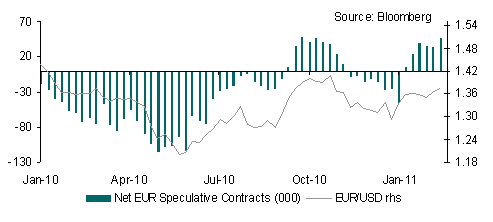
A likely pre-emptive strike from the ECB cannot be ruled out. Two rate hikes in H2 2011 are now likely even as the Bank maintains liquidity support for weaker peripherals. No change in policy but a hawkish press statement on Thursday will on the face of it play for a firmer EUR but i) the fact that the market has already discounted the possibility of early rate hikes and ii) the proximity of the US payrolls data on Friday and iii) uncertainty over the impact of the Irish election outcome in which the Fine Gael party won a clear victory, suggest that EUR risks are asymmetric. The net long positioning overhang also points to some downside risks to EUR.

There are plenty of other events and data on the calendar this week including Japan’s slate of month end releases, interest rate decisions by the Reserve Bank of Australia and Bank of Canada, UK PMI manufacturing survey data and Swedish Q4 GDP data.

The bottom line is that currencies will be driven by the conflicting influences of improving economic data on the one hand and elevated risk aversion on the other. The main beneficiaries of higher risk aversion will be the CHF and JPY though both have risen far whilst the USD will be restrained by a dovish Fed.

In contrast the EUR and GBP may yet extend gains but in both cases, markets have already shifted policy tightening expectations sharply over recent weeks and we suspect EUR/USD will be capped at resistance around 1.3860, whilst GBP/USD will similarly struggle to break its year high around 1.6279.