USD Pressured As Yields Dip

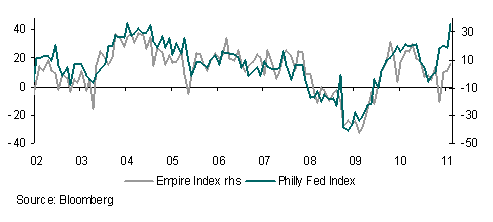
The USD came under pressure despite a higher than forecast reading for January US CPI and a strong jump in the February Philly Fed manufacturing survey. On the flip side, an increase in weekly jobless claims dented sentiment. The overnight rally in US Treasury yields was a factor likely weighing on the USD. The US calendar is light today leaving markets to focus on the G20 meeting and to ponder next week’s releases including durable goods orders, existing and new home sales.
The jump in the European Central Bank (ECB) marginal facility borrowing to EUR 15 billion, its highest since June 2009, provoked some jitters about potential problems in one or more eurozone banks. At a time when there are already plenty of nerves surrounding the fate of WestLB and news that Moody’s is reviewing another German bank for possible downgrade, this adds to an already nervous environment for the EUR.

Nonetheless, EUR/USD appears to be fighting off such concerns, with strong buying interest on dips around 1.3550. The G20 meeting under France’s presidency is unlikely to have any direct impact on the EUR or other currencies for that matter, with a G20 source stating that the usual statement about “excess volatility and disorderly movements in FX” will be omitted.

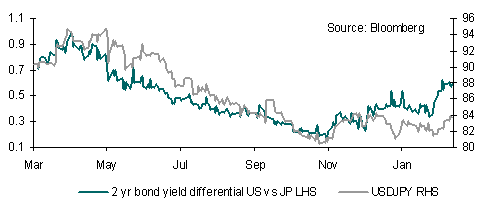
Although USD/JPY has been a highly sensitive currency pair to differentials between 2-year US and Japanese bonds (JGBs), this sensitivity has all but collapsed over recent weeks. USD/JPY failed to break the 84.00 level, coming close this week. There appears to be little scope to break the current range ahead of next week’s trade data and CPI.
Given the recent loss in momentum of Japan’s exports the data will be instructive on how damaging the strength of the JPY on the economy. In the near term, escalating tensions in the Middle East will likely keep the JPY supported, with support around USD/JPY 83.09 on the cards.

It seems that the jump in UK CPI this week (to 4.0%) provoked even more hawkish comments than usual from the Bank of England BoE’s Sentance, with the MPC member stating that the Quarterly Inflation Report understates the upside risks to inflation indicating that interest rates need to rise more quickly and by more than expected. Specifically on GBP he warned that the Bank should not be relaxed about its value.

Although these comments should not be particularly surprising from a known hawk, they may just help to underpin GBP ahead of the January retail sales report. Expectations for a rebound in sales following a weather related drop in the previous month will likely help prop up GBP, with GBP/USD resistance seen around 1.6279.

Interest rate and FX gyrations

Following a brief rally at the start of the year the USD has found itself under growing pressure in the wake of widening interest rate differentials versus many other currencies. In particular, the contrasting stance between the hawkish rhetoric (bias for tighter monetary conditions) from European Central Bank (ECB) President Trichet and the relatively dovish US Federal Reserve stance as highlighted in the 26th January FOMC statement has provided more fuel to the widening in interest rate expectations between the US and eurozone. Since the end of last year interest rate differentials have widened by around 31 basis points in favour of the EUR (second general interest rate futures contract).

The Fed remains committed to carrying out its full $600 billion of asset purchases by end Q2 2011 whilst the ECB appears to be priming the market for a scaling back of its liquidity operations. Whilst there may be more juice in EUR over the short term based on the move in interest rate differentials as well as improved sentiment towards the eurozone periphery the upside potential for EUR/USD is looking increasingly limited. Even European officials are beginning to inject a dose of caution, with the ECB’s Nowotny stating that markets are too euphoric over a potential enlargement of the European Financial Stability Facility (EFSF) bailout fund. Indeed, it is highly likely that the euphoria fades quickly once it becomes apparent that enlarging the bailout fund is by no means a panacea to the region’s ailments.

GBP is another currency that has undergone sharp gyrations over recent days in the wake of a shift in interest rate expectations. A surprise 0.5% quarterly drop in UK Q4 GDP (which could not all be blamed on poor weather) set the cat amongst the pigeons and gave a GBP a thrashing but much of this was reversed following the release of Bank of England Monetary Policy Committee (MPC) minutes which revealed a hawkish shift within the MPC, with two dissenters voting for a rate hike and most members agreeing that the risks to inflation has probably shifted higher.

Does this imply an imminent rate hike? No, a policy rate hike closer to the end of the year appears more likely. BoE Governor King provided support to this view, in a speech that was interpreted as dovish, with the governor once again highlighting the temporary nature of the current rise in inflation pressure. Consequently UK interest rate expectations have shifted back and forth over recent days, but still remain wider relative to the US since the start of the year. GBP/USD has of course benefitted, but given worries about growth and the dovish message from King, it is unlikely that rate differentials will widen much further. Consequently GBP/USD is unlikely to make much if any headway above 1.6000.

Talk but no action

The eurozone periphery remains in the eye of the storm but markets may have to wait before any concrete action is taken. The possibility of increasing the size of the bailout fund (EFSF), preparation of new European bank stress tests and/or allowing the EFSF to purchase eurozone government debt are all on the table but so far agreement has been lacking. Ministers apparently rejected the idea of increasing the size of the fund from EUR 440 billion to EUR 750 billion whilst disagreement over stricter criteria may also be hampering any progress.

Nonetheless, the EUR has found renewed support, helped by the firm German IFO investor confidence survey and news that Russia is looking to buy EFSF bonds. EUR/USD upside may be face a hurdle around 1.3500 over the short term and gains above this level are likely to be difficult to sustain given the ongoing uncertainties about the EFSF none of which are likely to be resolved anytime soon. The bottom line is that talk but not action will not be sufficient to keep the EUR supported.

GBP is also doing well, partly on the coat tails of a firmer EUR but also in the wake of an acceleration in UK CPI inflation which came in at 3.7% YoY a two year high, surpassing the Bank of England’s (BoE) ceiling for the 10th straight month. Inflation is likely to remain elevated pushing closer to 4% due to the VAT hike to 20% which came into effect at the beginning of this year. The data puts the BoE in a difficult situation testing the Monetary Policy Committee (MPC) expectation that the jump in inflation will prove temporary. However, the market is increasing taking the stance that a rate hike is going to take placer sooner rather than later, with a growing probability of a rate hike.

Since the end of last year there has been a 25bps spread widening (between 2nd contract rate futures) as markets have become more hawkish on UK interest rate expectations. This has coincided with an increasing correlation with GBP/USD resulting in the currency pair cracking above the psychologically important 1.60 level. Much will depend on whether the BoE’s predictions come true. If inflation remains sticky on the upside the Bank may be forced into an earlier tightening. Whether this is good news for GBP will depend on the economy. The worst case scenario is premature monetary tightening just as austerity measures start to bite.

Ratings rampage hits Euro

Both the data flow and market liquidity will be thin over the last couple of weeks of the year. After a bashing over much of H2 2010 it looks as though the USD will end the year in strong form having risen by over 6% since its early November low. In contrast the EUR is struggling having found no support from the meeting of European Union officials at the end of last week in which they agreed to a permanent sovereign debt resolution after 2013 but failed to agree on expanding the size of the bailout fund (EFSF). Similarly there was no traction towards a common euro bond. EUR/USD is now verging on its 200-day moving average around 1.3102, a break of which could see a drop to around 1.2960.

The failure to enlarge the size of the EFSF was disappointing given worries that it is perceived to be insufficient to cope with the bailout of larger eurozone countries if needed. It also highlight that the burden on the European Central Bank (ECB) to prop up eurozone bond markets until confidence improves. The increase in the size of ECB capital from EUR 5.8 billion to EUR 10.8 billion will help in this respect. Such support was clearly needed last week following the rampage across Europe by ratings agencies culminating in Moody’s five notch downgrade of Ireland’s credit ratings, surprising because of its severity rather than the downgrade itself. Ireland’s ratings are now just two notches above junk status and the negative outlook could mean more to come.

It was not just Ireland’s ratings that came under scrutiny. Ireland’s multi notch downgrade followed Moody’s decision to place Greece and Spain on review for a possible downgrade whilst S&P revised Belgium’s outlook to negative. Unsurprisingly peripheral debt markets came under renewed pressure as a result outweighing positive news in the form of strong flash eurozone PMI readings and firm German IFO business confidence survey. EUR did not escape and sentiment for the currency remains weak, with CFTC IMM speculative positioning data revealing a fourth straight week of net EUR short positioning in the week to 14th December.

In contrast, sentiment for the US economy continues to improve. Congress’ swift passage of President Obama’s fiscal plan will help to shore up confidence in US recovery. Data this week will be broadly positive too. On Wednesday, US Q3 GDP data is likely to be upwardly revised to a 2.8% QoQ annualized rate. Durable goods orders excluding transportation are set to increase by a healthy 2.0% (Thu) whilst both existing (Wed) and new (Thu) home sales will reveal rebounds in November following a drop in the previous month.

In the UK the main highlight is the Bank of England (BoE) MPC minutes. Another three way split is expected but this should not cause more than a ripple in FX markets. GBP/USD has slipped over recent days but there appears to be little other than general USD strength responsible for this. The currency pair looks vulnerable to a drop below 1.5500, with 1.5405 seen as the next support level. On balance, the USD will be in good form this week although the drop in US bond yields at the end of last week may take some of the wind out of its sails.

Contrasting Stance

Despite some recent Fed speakers putting doubts into the minds of the many now looking for the Fed to embark on QE2 in November, the minutes of the 21 September FOMC meeting gave the green light to the commencement of asset purchases next month. Although there is clearly no unanimity within the FOMC the majority favour further easing. Incremental data dependent asset purchases will be the most likely path.

The minutes leave the USD vulnerable to further declines but extreme short USD positioning suggest that there is plenty of risk of short covering and more likely we are probably set for a period of consolidation over coming weeks before the USD resumes its decline.

Unlike the Fed, BoJ and BoE, which remain in easing mode the ECB is already veering towards an exit strategy, albeit one that is unlikely to take effect for some time. Hawkish comments by the ECB’s Weber overnight managed to give a lift to the EUR in the wake of a further widening in interest rate differentials between the eurozone and US. Indeed, interest rate differentials (2nd contract futures) are at the widest since Feb 2009, a factor that is providing plenty of underlying support for the EUR.

Further out the follow through on the EUR will depend on whether markets believe Weber’s stance is credible. Germany’s economy is doing well but it is highly likely that Southern European officials would oppose any premature tightening in policy given the parlous state of their economies. The stronger EUR will also do some damage to growth, with its recent appreciation acting as a de facto monetary tightening.

Despite the positive influence of Weber’s comments short-term technical indicators show that the trend in EUR is vulnerable, with clear signs of negative divergence as the spot rate is still trending higher whilst the relative strength indices (RSI) are trending lower. Moreover, EUR speculative positioning is at its highest in a year, albeit still well of its all time highs. Speculators may be reluctant to build on longs in the near term. A clean and sustained break above EUR/USD 1.4000 level still looks like a stretch too far though any downside is likely to be limited to strong support around 1.3895.

Unlike the perception that the ECB is highly unlikely to follow the Fed in a path of QE2 the policy stance of the BoE is far more uncertain, a fact that continues to weigh on GBP, especially against the EUR. Recent data in the UK has played into the hands of the doves, with housing market activity and prices coming under renewed pressure, retail sales surveys revealing some deterioration and consumer confidence as revealed in the Nationwide survey overnight, weakening further.

BoE MPC member Miles summarized the situation by highlighting that the UK faces “some big risks” and even hinted that the BoE may “come to use QE”. UK jobs data today is unlikely to give any support to sentiment for GBP although as per its recent trend GBP is likely to remain resilient against the USD whilst remaining under pressure against the EUR, with a move to resistance around EUR/GBP 0.8946 on the cards in the short-term