EUR boosted, USD under pressure

Market attention remains fully focussed on events in Japan especially related to the country’s nuclear facilities. Risk aversion has spiked higher as a result, with ongoing Middle East tensions adding to the risk off tone. CHF is a key beneficiary of safe haven demand but the picture for JPY is obscured by repatriation expectations on one hand and FX intervention risks/Bank of Japan liquidity injections on the other, keeping USD/JPY clsoe to the 82.00 level. In contrast the AUD is vulnerable to a drop below parity with the USD on Japan worries, especially as Australia is a key destination for Japanese investment and therefore potential for reversal of such flows if Japanese institutions repatriate funds.

The EUR recovered over recent days as worries about the eurozone periphery ease and peripheral bonds spreads narrow. It is only a matter of time before overly long market positioning catches up with the EUR especially as the prospects of further interest rate support to the currency looked limited; markets have already priced in 75bps of policy rate hikes in the eurozone this year, which looks appropriate. It is difficult to see markets pricing in any more tightening than this over coming weeks. Despite its bounce back EUR/USD will struggle to break resistance around 1.4036.

Markets will digest the fallout from the informal EU leaders meeting last Friday which prepared the groundwork for the official meeting on 24/25 March. The initial reaction of the EUR appears to be positive but there is a significant risk of disappointment if the outcome of the meeting on 24/25 March does not live up to expectations. Indeed although Friday’s meeting resulted in an agreement in principle of a new “pact for the Euro” much will depend on the eventual details later this month.

Leaders also agreed on lowering interest rates to Greece by 100bps, and in principle enlarging the scope of the European Financial Stability Facility (EFSF) bailout fund to EUR 440 billion. The main positive surprise was opening the door for the fund to purchase eurozone debt. Data releases will offer little support to the EUR this week, with limited gains in the March German ZEW investor confidence survey today likely to leave markets unperturbed.

The USD’s gains last week proved short-lived and the currency will be tested by another relatively dovish Fed FOMC statement today and a benign reading for core CPI inflation in February. The Fed FOMC meeting is unlikely to deliver any changes to the Fed’s stance and whilst there has recently been some speculation that the Fed will soon remove its “extended period” comment, this is unlikely to happen any time soon. The statement will remind markets that the Fed is in no rush to alter its policy settings, an outcome that may limit the ability of the USD to strengthen this week even if data releases continue to remain on the positive side, including manufacturing survey and industrial production over coming days.
Talk but no action

The eurozone periphery remains in the eye of the storm but markets may have to wait before any concrete action is taken. The possibility of increasing the size of the bailout fund (EFSF), preparation of new European bank stress tests and/or allowing the EFSF to purchase eurozone government debt are all on the table but so far agreement has been lacking. Ministers apparently rejected the idea of increasing the size of the fund from EUR 440 billion to EUR 750 billion whilst disagreement over stricter criteria may also be hampering any progress.

Nonetheless, the EUR has found renewed support, helped by the firm German IFO investor confidence survey and news that Russia is looking to buy EFSF bonds. EUR/USD upside may be face a hurdle around 1.3500 over the short term and gains above this level are likely to be difficult to sustain given the ongoing uncertainties about the EFSF none of which are likely to be resolved anytime soon. The bottom line is that talk but not action will not be sufficient to keep the EUR supported.

GBP is also doing well, partly on the coat tails of a firmer EUR but also in the wake of an acceleration in UK CPI inflation which came in at 3.7% YoY a two year high, surpassing the Bank of England’s (BoE) ceiling for the 10th straight month. Inflation is likely to remain elevated pushing closer to 4% due to the VAT hike to 20% which came into effect at the beginning of this year. The data puts the BoE in a difficult situation testing the Monetary Policy Committee (MPC) expectation that the jump in inflation will prove temporary. However, the market is increasing taking the stance that a rate hike is going to take placer sooner rather than later, with a growing probability of a rate hike.

Since the end of last year there has been a 25bps spread widening (between 2nd contract rate futures) as markets have become more hawkish on UK interest rate expectations. This has coincided with an increasing correlation with GBP/USD resulting in the currency pair cracking above the psychologically important 1.60 level. Much will depend on whether the BoE’s predictions come true. If inflation remains sticky on the upside the Bank may be forced into an earlier tightening. Whether this is good news for GBP will depend on the economy. The worst case scenario is premature monetary tightening just as austerity measures start to bite.

Data and earnings focus

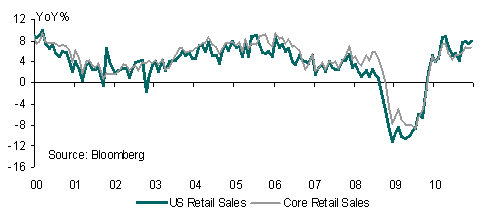
Friday’s round of US data were generally upbeat, highlighting that consumer spending is coming back to life. Inflation pressures however, remain benign at least on the core reading highlighting the Fed’s concern that inflation is running below the level consistent with its mandate. In other words it will be a long time, probably late into 2012 before policy rates increase.

While the Fed is no hurry to raise rates despite a few hawkish rumblings within the FOMC the European Central Bank (ECB) in contrast appears to have become more eager to pull the trigger for higher rates. ECB President Trichet’s hawkish press conference last week set the cat amongst the pigeons and marked a clear shift in ECB rhetoric towards a more hawkish stance.

A very big problem for the ECB is that the eurozone economy is not performing along the lines that its hawkish rhetoric would suggest, especially in the periphery. Growth momentum in the core in contrast, as likely reflected in the January ZEW investor confidence and IFO business confidence survey data this week in Germany, remains positive. Both surveys are likely to stabilize at healthy levels but how long can the likes of Germany drag along the eurozone periphery?

There will be relatively more attention on the meeting of Eurogroup/Ecofin officials, with focus on issues such as enlarging the size of the European Financial Stability Facility (EFSF) bailout fund and development of a “comprehensive plan” to contain the eurozone crisis. Don’t look for any conclusive agreements as this may have to wait until the European Union (EU) Council meeting on 4 February assuming (optimistically given ongoing German resistance) some agreement can even be reached.

Following the success (albeit at relatively high yields) of the eurozone debt auctions last week, sentiment for peripheral debt will face further tests this week in the form of debt sales in Spain, Belgium and Portugal.

The US Martin Luther King Jr. holiday will result in a quiet start to the week for markets but there will be plenty to chew on. This week’s key earnings reports include several banks scheduled to release Q4 earnings. Financials are a leading sector in the rally in equities at present and these earnings will be critical to determine whether the rally has legs.

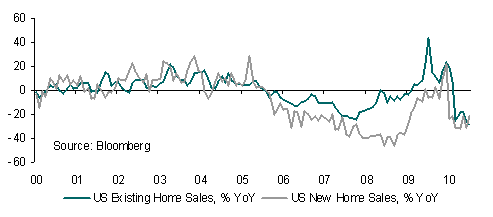
The US data slate includes January manufacturing surveys in the form of the Empire and Philly Fed, both of which are likely to post healthy gains whilst existing home sales are also likely to rise. This will not change the generally weak picture of the US housing market, with high inventories and elevated foreclosures characterizing conditions. As if to prove this, housing starts are set to drop in December. On the rates front, the Bank of Canada is likely to keep its policy rates on hold this week.

After coming under pressure last week much for the USD will depend on the eurozone’s travails to determine further direction. Concrete evidence of progress at the Ecofin may bolster the EUR further, with resistance seen around 1.3500 but don’t bank on it. The ability of eurozone officials to let down often lofty expectations should not be ignored. In any case following sharp gains last week progress over coming days for the EUR will be harder to achieve.

Edging Towards A Bailout

A confluence of factors have come together to sour market sentiment although there appeared to be some relief, with a soft US inflation reading (core CPI now at 0.6% YoY) and plunge in US October housing starts reinforcing the view that the Fed will remain committed to carry out its full QE2 program, if not more.

However any market relief looks tenuous. Commodity prices remain weak, with the CRB commodities index down 7.4% in just over a week whilst the Baltic Dry Index (a pretty good forward indicator of activity and sentiment) continues to drop, down around 21% since its recent high on 27 October. Moreover, oil prices are also sharply lower. Increasingly the drop in risk assets is taking on the form of a rout and many who were looking for the rally to be sustained into year end are getting their fingers burnt.

Worries about eurozone peripheral countries debt problems remains the main cause of market angst, with plenty of attention on whether Ireland accepts a bailout rumoured to be up EUR 100 billion. Unfortunately Ireland’s reluctance to accept assistance has turned into a wider problem across the eurozone with debt in Portugal, Greece and also Spain suffering. An Irish bailout increasingly has the sense of inevitability about it. When it happens it may offer some short term relief to eurozone markets but Ireland will hardly be inspired by the fact that Greece’s bailout has had little sustainable impact on its debt markets.

Ireland remains the primary focus with discussions being enlarged to include the IMF a well as ECB and EU. What appears to be becoming clearer is that any agreement is likely to involve some form of bank restructuring, with the IMF likely to go over bank’s books during its visit. Irish banks have increasingly relied on ECB funding and a bailout would help reduce this reliance. Notably the UK which didn’t contribute to Greece’s aid package has said that it will back support for Ireland, a likely reaction to potential spillover to UK banks should the Irish situation spiral out of control. Any bailout will likely arrive quite quickly once agreed.

Although accepting a bailout may give Ireland some breathing room its and other peripheral county problems will be far from over. Uncertainties about the cost of recapitalising Ireland’s bank will remain whilst there remains no guarantee that the country’s budget on December 7 (or earlier if speculation proves correct) will be passed. Should Ireland agree to a bailout if may provide the EUR will some temporary relief but FX markets are likely to battle between attention on Fed QE2 and renewed concerns about the eurozone periphery, suggesting some volatile price action in the days and weeks ahead.

Reports of food price controls of and other measures to limit hot money inflows into China as well as prospects for further Chinese monetary tightening, are attacking sentiment from another angle. China’s markets have been hit hard over against the background of such worries, with the Shanghai Composite down around 10% over the past week whilst the impact is also being felt in many China sensitive markets across Asia as well as Australia. For instance the Hang Seng index is down around 7% since its 8 November high.