FX sensitivities to yield differentials

A lot has been made about the hawkish language from a few Federal Reserve FOMC members over recent days and growing speculation about whether quantitative easing (QE2) will end earlier than initially planned. In turn, this has been noted as a positive factor for the USD. Undoubtedly there are a few in the Fed who are becoming more nervous about current policy settings but it is highly unlikely that the Fed will not complete its $600 billion in planned asset purchases by the end of June.

The biggest imponderable is how and when the Fed begins its exit policy and how effectively/efficiently it can be done. Whilst it is likely to be over a year before the Fed Funds rate is hiked, the USD will be sensitive to balance sheet reduction. Moreover, the way in which the Fed reduces the size of the balance will also be important given the likely active approach to liquidity withdrawal required.

For the present, it should be noted that even with the hawkish Fed rhetoric and increase in US bond yields (2 year yields have risen by close to 25bps over the last couple of weeks) the USD is actually lower versus EUR than where it was two weeks ago. The reality is that German bund yields have risen by even more than US yields ahead of the anticipated European Central Bank (ECB) rate hike on 7 April (the case for which appears to have been sealed by the above consensus 2.6% YoY reading for March eurozone CPI).

However, I would be cautious about ascribing general FX moves at present to yield / interest rate differentials given that it is only EUR crosses (including EUR/JPY, EUR/GBP, EUR/CAD, and EUR/USD) that hold a statistically significant relationship with yields. All of this implies EUR crosses look supported ahead of the upcoming ECB meeting, with EUR/USD unlikely to sustain a drop below 1.4000 ahead of the rate decision. What happens after depends on the press conference. Bearing in mind that markets have already priced in 75bps of rate hikes by the ECB it would take an even stronger tone from the ECB to push the EUR higher, something that looks unlikely
Equity Flow Reversal Supports Asian FX

Asian currencies have rebounded smartly from their post Japan earthquake lows on March 16. The ADXY (Bloomberg-JP Morgan Asia Currency index) is now at its highest level since September 1997 reflecting a sharp rebound in capital inflows to the region. The performance of Asian currencies continues to correspond closely with the movement in capital flows.

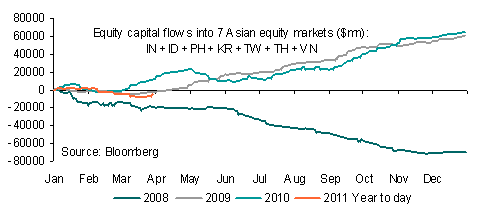
Although almost all Asian equity markets have registered outflows so far this year (total equity outflows -$6.2bn), the trend is reversing. Over the past month there has been a major slowing in capital outflows for most countries in Asia whilst India, Thailand and the Philippines have actually registered sizeable inflows. South Korea is notable in that there has been a sharp increase in equity capital inflows over the past week.

Although there has been much focus on a rotation of capital flows out of Asia and into developed economies this year, it is worth noting that the pattern of equity flows in Q1 2011 has not been too different from that witnessed in the past couple of years. In both 2009 and 2010 equity outflows were recorded over the two (2010) or three (2009) months of the year before a reversal took place. This pattern looks like it is repeating itself.

Clearly the environment for Asian equity markets is not as supportive as it was last year given the belated tightening in monetary policies being undertaken by many central banks and prospects of an end to QE2 in the US. Whilst this will result in some reduction in capital flows to the region compared to last year, the overall outlook is positive. Easing risk aversion (our risk aversion barometer has already reversed all of its post Japan earthquake spike and is trending lower), positive growth outlook and maintenance of low US rates point to more inflows.

One currency in particular that will benefit is KRW, with a further drop in USD/KRW likely over coming weeks. KRW has already strengthened by around by around 2.7% since its post Japan earthquake low making it the best performing currency since then. Further gains are likely; a test of USD/KRW 1100 is on the cards in the short-term, with the year end target standing at 1050.

Why buy KRW? 1) Korea has registered the biggest improvement in equity capital flows recently, 2) KRW has been the most sensitive Asian currency to risk over the past month and therefore benefits the most as risk appetite improves, 3) Estimated Price/Earnings ratio for Korean equities looks cheap compared to its historical z-score according to our estimates. As a result our quantitative model on USD/KRW based on commodity prices, risk aversion and equity performance highlights the potential for significantly more KRW strength.

US Dollar On A Slippery Path

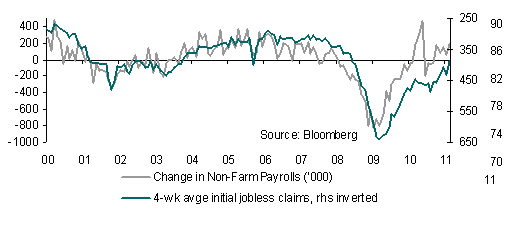
The USD has been a on a slippery path over recent weeks, weighed down by adverse interest rate differentials despite improving US economic data. Adding to the run of encouraging US data releases the February jobs report revealed a 192k increase in jobs and a drop in the unemployment rate to 8.9%.

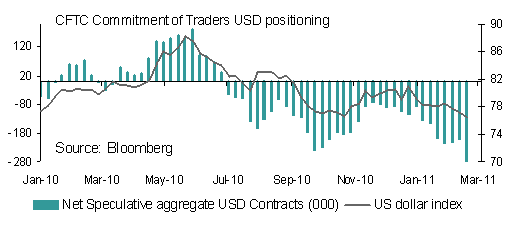
In particular the Fed’s dovish tone highlights that whilst asset purchases under QE2 will stop at the end of June, the failure to hit the Fed’s dual mandate of maximum employment and stable prices, implies that the Fed Funds rate will not be hiked for a long while yet. This dovish slant has undermined the USD to the extent that USD speculative positioning as reflected in the CFTC IMM data dropped to all time low in the week to 1 March. There is certainly plenty of scope for short-covering but the market is no mood to buy the USD yet.

This week’s releases will provide less direction, with a slight widening in the trade deficit likely in January, a healthy gain in February retail sales and a small drop in the preliminary reading of March Michigan sentiment.

In contrast, even the generally hawkish market expectations for the European Central Bank (ECB) proved too timid at last week’s Council meeting as Trichet & Co. strongly implied via “strong vigilance” that the refi rate would be hiked by 25bps in April. EUR/USD lurched higher after the ECB bombshell breaking the psychologically important 1.4000 barrier but appeared to lose some momentum at this level. Should EUR/USD sustain a break of 1.4000, the next level of resistance is at 1.4281 (November high), with support seen around 1.3747.

The lack of major eurozone data releases this week, with only industrial production data in Germany and France of interest, suggests that EUR may consolidate over the short-term with the main interest on the informal Heads of State meeting at the end of the week to determine whether credible plans can be drawn up to restore confidence in the periphery.

This week it is the turn of the Bank of England (BoE) to decide on monetary policy but unlike the ECB we do not expect any surprises with an unchanged decision likely. Further clues will only be available in the Monetary Policy Committee (MPC) minutes on 23 March. However, markets may be nervous given that it could feasibly only take another two voters aside from the three hawkish dissenters last month, to result in a policy rate hike. Notably one possible hawkish dissenter, Charles Bean did not sound overly keen on higher rates in a speech last week, a factor that weighed on GBP alongside some weaker service sector Purchasing Managers Index (PMI) data.

UK manufacturing data will be the main data highlight of the calendar but this will be overshadowed by the BoE meeting. GBP/USD could continue to lag the EUR and given a generally bullish EUR backdrop, our preferred method of playing GBP downside remains via a long EUR/GBP position.

GBP troubles, KRW too weak

The Fed FOMC minutes for the January meeting revealed that behind the unanimous vote to leave policy settings unchanged there was some unease about the completion of QE2. Nonetheless, the USD was left weaker given the Fed’s sanguine view on inflation and worries about unemployment. Inflation data will garner most market attention today but the fact that the core rate of CPI inflation is expected to remain well below the Fed’s preferred level could undermine the USD and add a further barrier to the USD’s recovery so far in February. Jobless claims data will also be of interest given the sharp drop last week. Another firm outcome will help to dispel worries about job market recovery.

As warned in my last post, downside risks to GBP were high given the long GBP speculative positioning overhang and hawkish expectations for the BoE Quarterly Inflation Report. In the event the Report revealed a downward growth forecast revision and an upward inflation forecast revision but importantly showed some reluctance to play into market expectations of an early UK policy rate hike. Following on from a weaker than expected UK January jobs report in which unemployment increased, GBP was hit on both counts. GBP/USD is unlikely to veer far from the 1.6000 level, but with markets reassessing interest rate expectations downside risks are beginning to open up.

News yesterday that Moody’s ratings agency has placed Australia and New Zealand’s major banks on review for possible downgrades went down like a lead balloon but once again AUD and NZD showed their usual resilience and acted as if little has happened. AUD and NZD have weakened since the turn of the year. Weaker data and a paring back in policy tightening expectations have contributed to the weaker performance of the AUD and NZD, but markets have gone too far in scaling back the timing and magnitude of interest rate hikes, suggesting that both currencies may bounce back as interest rate expectations become more hawkish.

Asian currencies continue to register mixed performances largely influenced by capital flows. Most equity markets in the region have registered outflows so far in 2011, with the exception of Taiwan and Vietnam. This has been reflected in Asian FX performance, with the strongest performer being the IDR, but its gains have only been around 0.72% versus USD, coinciding with the fact that it has registered some of the least capital outflows this year. Interestingly the worst performing currency has been the THB, one of last year’s star performers. Korea has also registered strong equity capital outflows but this will not persist and a resumption of inflows taken together with positive fundamentals and higher interest rates will boost the KRW this year.

China Hikes Rates, More On the Cards

In an otherwise unexciting day China livened things up by raising its 1 year deposit and lending rates by 25 basis points. The hike, the third in the last four months, should not have come as a surprise, given the growing emphasis by China’s central bank PBoC, to dampen inflation pressures. Indeed, more hikes are on the cards, with at least another two more in prospect over H1. The other tool to combat inflation is CNY appreciation further gains in the currency over coming months should be expected to around 6.3 by year-end versus USD.

Global markets largely shrugged of China’s move, with generally positive market sentiment continuing. Even in the eurozone, where there was some disappointment at the surprise drop in German December industrial production, market sentiment continued to improve as Egypt and local debt worries eased further. EUR was particularly resilient despite calls from a Belgian think tank that Greece needs to restructure its debt to avoid a long and painful path ahead. Commodity currencies also showed impressive resilience to China’s rate hike, with both the AUD and NZD holding up well.

The overall positive risk background is supportive for Asian currencies and other risk trades. Currencies in Asia remain highly correlated with portfolio capital inflows and so far this year the weakness in the INR and THB has matched the strong equity outflows from India and Thailand. However, this appears to be reversing, especially in the case of India registering positive equity flows this month, helping the INR to reverse some of its losses.

In the absence of key data releases markets will turn their attention to the testimony by Fed Chairman Bernanke to the House budget committee where he will give comments on the economy, jobs and the budget. Dallas Fed’s Fisher stated overnight that whilst he expects the Fed to complete QE2 he would not support another round of quantitative easing. Fisher’s comments on QE were similar to Atlanta Fed’s Lockhart who notes there is a “high bar” for more QE. Bernanke is unlikely to deviate from this tone in his speech today whilst also maintaining his view that there should be a long term commitment to fiscal retrenchment.

Against the background of improving risk appetite the USD is likely to stay under mild pressure although it is difficult to see a break of recent ranges for most currency pairs. EUR/USD ought to find strong support around its 100-day moving average 1.3535 whilst USD/JPY will be supported around 81.10. Equity sentiment is being supported by US data which remains encouraging. On cue the NFIB Small Business Optimism index duly rose in January to 94.1 as sentiment in this sector continued its improving trend.

Taken together with firmer equities, encouraging data is taking its toll on US bond markets, resulting in a back up in yields. Bond market sentiment wasn’t helped by a relatively poor 3-year auction. For example, US 2-year bond yields have backed up by over 30bps since 28 January. Bad news for bond is good news for the USD however, as higher relative US bond yields will likely help prevent a deeper USD sell-off, with EUR/USD in particular most reactive to relative eurozone / US bond yield differentials.

Econometer.org has been nominated in FXstreet.com’s Forex Best Awards 2011 in the “Best Fundamental Analysis” category. The survey is available at http://www.surveymonkey.com/s/fx_awards_2011