Risk on, US dollar pressure

FX markets have plenty of different factors to digest these days and after a harrowing couple of weeks markets began this week on a firmer footing. The overall tone into this week is to load up on risk assets. News that the nuclear situation in Japan may closer to stabilising has helped, whilst markets easily shook off another hike in China’s reserve ratio and ongoing conflict in Libya as Allied forces step up their campaign in the face of continuing resistance from Gaddafi’s forces.

Improved risk appetite has helped to keep the JPY on the defensive along with the continued threat of FX intervention, with further official JPY selling likely in the days ahead. Interestingly the intervention last Friday was estimated at only JPY 530 billion ($6.2 billion), much lower than previously thought. USD/JPY 80 remains a major line in the sand and any sign of another breach of this level will likely be met with official JPY selling. I suspect that the Japanese authorities will not be content until USD/JPY is far higher. In this respect its worth noting an official report released earlier in March highlighting that Japanese companies are not profitable at a USD/JPY rate below 86.

The EUR looks overbought around the 1.42 level but seems to be a beneficiary of Japanese FX intervention (perhaps a recycling of USDs into EUR) as well as comments by European Central Bank (ECB) Council members reiterating their intention to hike the refi policy rate, likely at the April ECB meeting. In a similar vein to the recycling of intervention USDs into EUR, Middle East entities may also be recycling petrodollars into EUR whilst news that Russia has permitted one of its oil related funds to buy Spanish debt has given a lift to sentiment for the EUR. Over the near term EUR/USD may struggle to make much headway above 1.42, with further direction coming from the EU leaders meeting on 24/25 March.

GBP is also doing well, having jumped close to the 1.6400 level versus USD, with UK February CPI giving the currency a further lift. The outcome at 4.4% YoY, which was not as bad as rumoured but in any case worse than consensus will give the hawks in the Bank of England MPC further ammunition to push for a policy rate hike. The fact that core inflation also increased suggests that the jump in headline inflation cannot merely be brushed under the table. A BoE rate hike is increasingly looking like a done deal. Renewed inflation worries in the UK and the hawkish rhetoric from ECB officials is sufficient to keep the USD under pressure.
Exhausted

No the title is not meant to describe how I felt this morning when I woke up but how I feel the market is looking at present in terms of risk trades. Firmer than feared economic data in the US and China and the agreement in Basel on new bank capital ratios boosted risk appetite but the moves are already beginning to fade. It would be easy to jump on the bandwagon but after the sharp gains registered over recent days I would suggest taking a cautious stance on jumping into risk trades at present.

The EUR has played a degree of catch up to risk currencies, rallying sharply against the USD, helped in part by the European Commission which raised its forecasts for the eurozone economy from 0.9% for 2010 to 1.7%. Although the change in forecasts should come as little surprise give that it is now in line with the European Central Bank’s (ECB) expectations the news bolstered the view of economic resilience in the eurozone. Unfortunately as the ECB noted following its last meeting there are plenty of downside risks to growth next year and upcoming data releases will be viewed to determine how sharply growth momentum will slow into next year.

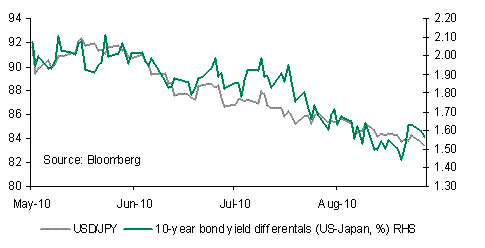
One currency that strengthened was the JPY and this was mainly due the view that Prime Minister Kan will win the contest for leadership of the governing DPJ party in Japan. The race remains very close, with Prime Minister Kan having a slight lead according to Japanese press. The FX market will pay particular attention to the result given that the other contender Ichiro Ozawa has stated his willingness to drive the JPY lower as well as increase fiscal spending. The results of the election will be known shortly and should Ozawa win USD/JPY will likely find support although the bigger influence is likely to be a shift in relative US/Japan bond yields which due to the sell off in US Treasuries over recent days has become more supportive of a higher USD/JPY.

GBP has lagged the move in many risk currencies, failing to take advantage of the weaker USD. There was some relief overnight from an increase in consumer confidence in August according to the Nationwide index, which rose 5 points to 61, from a 14-month low in July. However, any boost to GBP sentiment will have been outweighed by a fall in UK house prices according to RICS, which revealed the sharpest one-month fall in August since June 2004. The data supports the view that the rally in UK house prices could soon be over. Weaker housing activity will also likely limit any further improvement in consumer confidence. Some of this is already priced into GBP however, and over the short-term EUR/GBP may struggle to breach the 0.8400 level.

Another underperformer overnight was the NZD which was hit by disappointing retail sales data for July, which fell 0.4%. Although the drop followed a strong gain in the previous month the data supports the view that the consumer remains cautious in New Zealand, a factor that will likely play into the view that New Zealand’s central bank, the RBNZ will keep policy on hold when they meet tomorrow. NZD slipped off its highs around 0.7347 overnight and also managed to dampen the upside momentum for AUD/USD which will likely struggle to sustain a break through resistance around 0.9350.

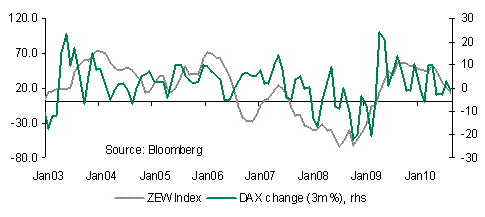
Today’s data will provide further direction for the days ahead, with the September German ZEW survey of investor confidence likely to be closely scrutinized. A drop in the economic sentiment gauge to around 10 is expected from 14 in August, highlighting that eurozone growth momentum is beginning to wane. Hard data in the form of eurozone industrial production will also record a weaker performance, likely to drop 0.3% in July. The data will likely cap the EUR today.

In the US the main release is the August retail sales report for which a 0.3% gain in both headline and ex-autos sales is expected. Sales will have been helped by back to school spending although major discounting will have weighed on retailers’ profits. Nonetheless, any gain even if modest will be a welcome development for Q3 growth in the US.

Contrasting the ECB with the Fed

Whether its year end book closing/profit taking and/or renewed doubts about the shape of recovery, asset markets have turned south recently.  Investor mood appears to be souring as risk aversion creeps back into the market psyche.  A string of disappointing US data releases over the last week including core retail sales, Empire manufacturing, industrial production, and housing starts, contributed to the reduced appetite for risk, resulting in a soft finish to the week for equity markets and a firmer USD.

Things are likely to take a turn for the better this week, however. Data will shed a little more light on the pace and magnitude of economic recovery and could result in some improvement in appetite for risk trades.  Despite an expected downward revision to US Q3 GDP, forward looking data on home sales, durable goods orders and personal income and spending as well as consumer confidence are likely to reveal increases.  In the Eurozone, data economic releases will paint a similar picture, including an expected increase in the closely watched barometer of business confidence, the German IFO survey. 

At the least economic data will remove some, but by no means all doubts about a relapse in the recovery process.  There is no doubting the veracity of the recovery in equity and commodity prices, despite doubts about its sustainability. Central banks may not react uniformly to this and the policy impact could vary significantly.  Already it appears that the ECB is moving more quickly towards an exit strategy compared to the Fed.  Although ECB President Trichet highlighted that the crisis is far from over at the end of last week, the Bank announced tougher standards for asset backed securities used as collateral, indicating that the need to provide emergency support to banks is much lower than it was. 

Clearly the ECB wants to avoid letting the market become over dependent on the central bank and will look to implement measures to this aim.  In contrast, the Fed is showing little sign of beginning this process and at least one member of the FOMC, namely St. Louis Fed President Bullard, was quoted over the weekend advocating that the Fed keep its MBS buying programme beyond its scheduled close in March. Evidence of the contrasting stance is also reflected in the fact that the Fed’s balance sheet is expanding once again whilst the ECB’s is contracting.  As a result of firmer data and comments by Bullard the USD is set to go into the week under renewed pressure, albeit within well defined ranges.