What To Watch This Week

The end of last week proved to be a calmer affair than the preceding few days. There was some encouraging news on the Greek front, with Germany finally approving its share of the European Union (EU) aid package whilst Greece appeared to be on track with its budget deficit reduction as the country recorded a cash deficit of EUR 6.3billion in the first four months of the year, a 42% reduction compared to a year earlier. EU officials also agreed on tougher sanctions for countries breaching austerity rules.

There were plenty of negatives to offset the good news however, as European business surveys including the German IFO index and flash eurozone purchasing managers indices (PMIs) revealed some loss of momentum in growth as well as increased divergence. European banking sector concerns intensified as the Bank of Spain was forced to take control of CajaSur, a small savings bank holding 0.6% of total Spanish banking assets, which faced difficulties due to distressed real estate exposure. Its woes highlighted the problems faced by many Spanish savings banks due to property market exposure.

US data releases this week will confirm that economic recovery gathered steam in Q2. May consumer confidence data is likely to record a small gain, due in large part to improving job market conditions, whilst the Chicago PMI is set to retrace slightly in May, albeit from a healthy level. Both new and existing home sales are set to record gains in April, the former following a sizeable gain in March although the drop in house prices likely to be revealed by the Case-Shiller index will continue to fuel doubts about the veracity of the turnaround in the US housing market.
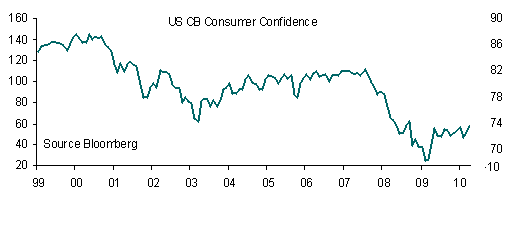
In Europe there is not much in terms of first tier releases and highlights include sentiment data such as German Gfk and French consumer confidence indices, and the May French business confidence indicator. The data are likely to be mixed, and as indicated by last week’s surveys will reflect a relatively healthy Q2 2010, but a worsening outlook for the second half of the year.

In the absence of UK data today there will be plenty of attention on the details of plans by Chancellor Osborne to cut GBP 6 billion from the budget deficit. The measures will be small change ahead of the emergency budget package on June 22nd when much bigger cuts are expected. Nonetheless, the first step today will be a crucial test of the new government’s ability to convince ratings agencies and markets that it is serious about reducing the burgeoning fiscal deficit.

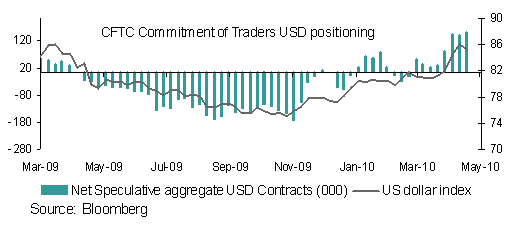
Following the massive positioning adjustments of the last week markets will look somewhat calmer over coming days but risk aversion is likely to remain elevated, suggesting little respite for most currencies against the USD. The recent moves have left net aggregate USD positioning registering an all time high according to the CFTC Commitment of Traders data, in the latest week, but after the slight retracement lower in the USD index, it is set to make further gains over coming days.
It was notable that EUR and GBP looked more composed at the tail end of the week whilst attention turned to the liquidation of long positions in CHF, AUD, NOK and SEK. These risk currencies are set to remain under pressure but there will be little respite for EUR which is set to drift lower, albeit a less aggressive pace than over recent weeks and a re-test of EUR/USD technical support around 1.2296 is likely. GBP/USD has showed some resilience over recent days but remains vulnerable to further downside pressure, with 1.4310 immediate support.

What To Watch This Week

As usual the G7 meeting will leave markets with little to chew on. G7 officials maintained their commitment to stimulus measures and timely exit strategies but there was little of note for FX markets aside from the usual comments about wanting to avoid excess FX volatility. There was certainly know step up in pressure on China to strengthen though a report prepared for the meeting did push for countries with inflexible currencies to make adjustments. Meanwhile US officials mouthed the usual “strong dollar” mantra.

Where does this leave markets this week? Well I must admit my bullish view on risk currencies is clearly suffering after a positive start to the year. The pullback in high beta currencies (those with the highest sensitivity to risk aversion) has been dramatic. I have highlighted many of the factors weighing on sentiment in previous posts and whilst I still think the US dollar will find itself under renewed pressure over coming months the current environment remains conducive to more USD and JPY buying and selling of currencies such as the AUD, NZD, CAD, GBP, NOK, SEK, ZAR etc.

Ironically the US and Japan have arguably more severe deficit/debt concerns than some of the European countries under pressure but as most of Japan’s debt is held domestically there is little worry of a collapse in JGBs. Unlike Japan foreign investors hold over half of US debt but are not yet losing confidence with US Treasuries though this may not last unless there is some tangible sign that the burgeoning US budget deficit is being reduced. For now, attention remains firmly focussed on Greece, Spain, Portugal and to a lesser extent Italy.

Like the G7 meeting the US January jobs report released at the end of last week will give little direction for markets. Although the 20k drop in payrolls and revisions to past months were slightly disappointing the surprise drop in the unemployment rate was better news. This week’s data highlights include the January US retail sales report and December trade balance. The sales data is likely to help allay some concerns about faltering economic recovery, with retail sales forecast to rise over the month despite a likely pull back in autos spending.

How will this play out for currencies this week? Overall, the risk off tone is set to continue though the moves are looking increasingly stretched. The USD, JPY and CHF will remain on the front foot whilst risk currencies will remain under pressure. The EUR is set to continue to struggle against the background of eurozone deficit concerns and after its dive through 1.40 last week 1.35 now looms large. Meanwhile, the AUD may also struggle following the recent reassessment of interest rate expectations after the recent Reserve Bank of Australia (RBA) meeting in which interest rates were left unchanged.

UK markets will focus on the Quarterly Inflation Report from the Bank of England though the political situation may hold some interesting implications for GBP if polls continue to show that the gap between the governing Labour party and Conservative opposition continues to narrow. Prospects of a hung parliament will hardly hold any positive implications for GBP, a prospect which could limit any potential for GBP to recover ahead of May elections. The drop below 1.60 for Cable (GBP/USD) could extend further, especially as the BoE has kept the door open to further asset purchases if needed.

Dollar on top as central banks deliberate

There has been a veritable feast of central bank activity and decisions with most attention having been on the Fed’s decision.  In the event the FOMC meeting delivered no surprises in its decision and statement.  Basically the Fed acknowledged the recent improvement in economic activity but continued to see inflation as subdued and maintained that policy rates will remain low for an “extended period”.  The Fed also noted that most liquidity facilities were on track to expire on 1 February suggesting that they remain on track to withdraw liquidity.  

There was similarly no surprise in the Riksbank’s decision in Sweden to leave interest rates unchanged, with the Bank reiterating that it would maintain this stance through the autumn of 2010.  The SEK has been stung by outflows due to annual payments of premiums to mutual funds by the Pension Authority but the impact of this has now largely ended leaving the currency in better position.  Norway’s Norges Bank unexpectedly raised interest rates, for a second time, increasing its deposit rate by 25bps to 1.75%, with the surprise evident in the rally in NOK following the decision.   The other central bank to surprise but in the opposite direction was the Czech central bank which cut interest rates by 25bps.  

In contrast to the Norges Bank’s hawkish surprise the RBA has helped to toned down expectations for further rate hikes in Australia, with Deputy Governor Battellino suggesting that monetary policy was back in a “normal range” in contrast to the perception that policy was still very accommodative.   Weaker than expected Q3 GDP (0.2% QoQ versus forecasts of a 0.4% QoQ rise) data fed into the dovish tone of interest rate markets fuelling a further scaling back of rate hike expectations, casting doubt on a move at the February 2010 RBA meeting and pushing the AUD lower in the process.  Against this background AUD continues to look vulnerable in the short term, especially under the weight of year end profit taking and the resurgent USD.  

There was also some surprise in the amount of lending by the ECB, with the Bank lending EUR 96.9 bn in third and final tender of 1-year cash despite the cost of the loan being indexed to the refi rate over the term of the loan rather than being fixed at 1%.  There was also a sharp decline in the number of banks bidding compared to earlier 1-year auctions but at a much higher average bid.  This implies that some banks in Europe remain highly dependent on ECB funding despite the improvement in market conditions.   The EUR continues to struggle and its precipitous drop has shown little sign of reversing, with the currency set for a soft end to the year.  A break below technical support around 1.4407 opens the door to a fall to around 1.4290.   

The USD is set to retain its firmer tone in the near term though we would caution at reading its recent rally as marking a broader shift in sentiment.  The move in large part can be attributed to position adjustment into year end and is being particularly felt by those currencies that have gained the most in recent months.  Hence, the softer tone to Asian currencies and commodity currencies which appear to be bearing the brunt of the rebound in the USD.   Going into next year USD pressure is set to resume but for now the USD is set to remain on top, with the USD index on track to break above 78.000.

Asian currencies on the up

The third quarter of 2009 has proven to be another negative one for the US dollar.  Over the period the dollar index fell by over 4%.  The only major currency to lose ground against the dollar over this period was the British pound.  Most other currencies, especially the so called “risk currencies” which had come under huge pressure at the height of the financial crisis, registered strong gains led by the New Zealand dollar, Swedish krona and Australian dollar.  Although the euro also strengthened against the dollar it lagged gains in other currencies over the quarter.

Asian currencies also registered gains against the dollar in Q3 but to a lesser extent than G10 currencies.  Asian currency appreciation was led by the Korean won, Indonesian rupiah and Singapore dollar, respectively.  The under performer over Q3 was the Indian rupee which actually depreciated against the US dollar slightly.  The reason for the smaller pace of appreciation for most Asian currencies was due mainly to intervention by Asian central banks to prevent their respective currencies from strengthening too rapidly, rather than due to any inherent weakness in sentiment.

In fact, Asian currencies would likely be much stronger if it wasn’t for such FX interventions.  A good indication of the upward pressure on Asian currencies can be found from looking at the strength of capital inflows into local stock markets over recent months.  South Korea has registered the most equity capital inflows so far this year, with close to $20 billion of flows into Korean equities year to date but in general most Asian stock markets have registered far stronger inflows compared with last year.   

For the most part, balance of payments positions are also strong.  For example, South Korea recorded a current account surplus of $28.15 billion so far this year, compared to a deficit of $12.58bn over the same period last year.  This is echoed across the region.  Although surpluses are expected to narrow over coming months due mainly to a deterioration in the terms of trade, the overall health of external positions across the region will remain strong and supportive of further currency appreciation.  

The outlook for the final quarter of 2009 is therefore likely to be positive for Asian currencies, with the US dollar set to weaken further against most currencies.  Some risk will come from a potential reversal in global equity market sentiment but overall, further improvements in risk appetite will support capital inflows into the region.  Capital will be attracted by the fact that growth in Asia will continue to out perform the rest of the world and yet again only interventions by central banks will prevent a more rapid appreciation of Asian currencies.