US Dollar On The Rise

There are plenty of US releases on tap this week but perhaps the most important for the USD will be the minutes of the April 26-27 Fed FOMC meeting. Taken together with speeches by Fed officials including Bernanke, FX markets will attempt to gauge clues to Fed policy post the end of QE2. The Fed’s stance at this point will be the major determinant of whether the USD can sustain its rally over the medium term. The lack of back up in US bond yields suggests that USD momentum could slow, with markets likely to move into wide ranges over coming weeks.

It is worth considering which currencies will suffer more in the event that the USD extends its gains. The correlation between the USD index and EUR/USD is extremely strong (even accounting for the fact that the EUR is a large part of the USD index) suggesting that the USDs gains are largely a result of the EUR’s woes. Aside from the EUR, GBP, AUD and CAD are the most sensitive major currencies to USD strength whilst many emerging market currencies including ZAR, TRY, SGD, KRW, THB, IDR, BRL and MXN, are all highly susceptible to the impact of a stronger USD.

Robust Q1 GDP growth readings in both Germany and France helped to spur gains in the EUR but this proved short-lived. Sentiment for the currency has soured and as reflected in the CFTC IMM data long positions are being scaled back. Nonetheless, there is still plenty of scope for more EUR selling given ongoing worries about the eurozone periphery, which are finally taking their toll on the EUR. A break below EUR/USD 1.4021 would open the door for a test of 1.3980.
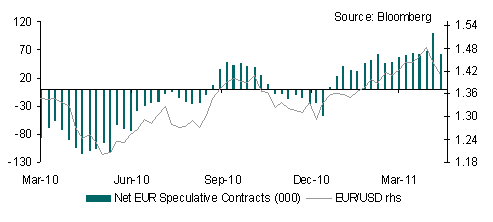
The eurogroup and ecofin meetings will be of interest to markets this week but any additional support for Greece is unlikely to be announced at this time. However, likely approval of Portugal’s bailout may alleviate some pressure on the EUR but any positive impetus will be limited. Even on the data front, markets will not be impressed with the German ZEW index of investor confidence likely to register a further decline in May.

Japanese officials have been shying away from further FX intervention by blaming the drop in USD/JPY over recent weeks on general USD weakness despite the move towards 80. However, this view is not really backed up by correlation analysis which shows that there is only a very low sensitivity of USD/JPY to general USD moves over recent months. One explanation for the strength of the JPY is strong flows of portfolio capital into Japan, with both bond and equity markets registering net inflows over the past four straight weeks.

This is not the only explanation, however. One of the main JPY drivers has been a narrowing in yield differentials. This is unlikely to persist with yield differentials set to widen sharply over coming months resulting in a sharply higher USD/JPY. As usual data releases are unlikely to have a big impact on the JPY this week but if anything, a further decline in consumer confidence, and a negative reading for Q1 GDP, will maintain the pressure for a weaker JPY and more aggressive Bank of Japan (BoJ) action although the BoJ is unlikely to shift policy this week.

Asian Currency Differentiation

Asian currencies have started the year in mixed form, but it would be wrong to generalize the performance of Asian currencies as weak. There have been marginal gains recorded year to date vs. USD in the KRW, TWD, MYR and SGD, reflecting strong capital equity inflows. This contrasts with losses in the IDR, INR, PHP and THB versus USD. Compared to the beginning of 2010 equity capital flows have been far weaker overall, with India, Indonesia, Philippines and Thailand, recording outflows, matching the performance of their currencies.

Clearly investors are discriminating more at the turn of 2011. For example Taiwan has recorded solid equity inflows over recent weeks (over $2 billion year-to-date), matching the strength of inflows registered at the beginning of 2010. It appears that Taiwan stocks have started the year as the Asian favorite, helped by growing expectations of further door opening to mainland investment and tourism. Korean equities have also registered inflows helping to support the KRW, which looks to be good buy over the short term above 1120.

This contrast with outflows registered in other Asian equity markets. A major concern responsible for some of the weakness in capital flows to Asia is the threat of inflation. For example, the selling of stocks in India appears to be closely related to inflation concerns and the hawkish rhetoric of the Reserve Bank of India, which is continuing its tightening path this year. Similarly, the PHP may be vulnerable over the short term following a failed T-bill auction on Monday. Inflation worries have clearly led to a push for higher yields but the bids were labeled as “unreasonable” by the government.

Over coming weeks, further EUR strength will likely give Asian currencies more support as the USD succumbs to further pressure. Continued strengthening in the CNY will also support other Asian currencies given that the CNY fixing has reached its highest level since the July 2005 revaluation.

Temporary relief for US Dollar

Downbeat US economic news in the form of a widening US trade deficit, increase in jobless claims and bigger than expected increase in top line PPI inflation contrasted with upbeat earnings from Google. Google shares surged over 9% in after hours trading but US data tarnished the risk on mood of markets, leaving commodity prices and equities lower and the USD firmer. Higher US Treasury yields, especially in the longer end following a poor 30 year auction, helped the USD to push higher.

The USD’s trend is undoubtedly lower but profit taking may be the order of the day ahead of a speech by Fed Chairman Bernanke on monetary policy later today and the release of the highly anticipated US Treasury Report in which China may be named as a currency manipulator. A speech by the Minneapolis Fed’s Kocherlatoka (non voter) this morning sounded downbeat, even suggesting that “Fed asset purchases may have a muted effect”. Despite such comments the Fed appears likely to embark on QE2 at its 3 November meeting.

Today is also a key data for US data releases with September data on US retail sales, and CPI and October data on Michigan confidence and Empire manufacturing scheduled for release. Retail sales are likely to look reasonable, with headline sales expected to rise 0.5% and ex-autos sales expected up 0.4%. The gauges of both manufacturing and consumer confidence are also likely to show some recovery whilst inflation pressures will remain benign. Given the uncertainty about the magnitude of QE the Fed will undertake in November, the CPI data will have added importance.

The US trade will likely have resulted in an intensification of expectations that China will be labelled as a currency manipulator in the US Treasury report later today. The August trade deficit with China widened $28.04 billion, the largest on record. At the least it will give further ammunition to the US Congress who are spoiling for a fight ahead of mid-term congressional elections, whilst heightening tensions ahead of the November G20 meeting.

Indeed currency frictions continue to increase although “currency war” seems to be an extreme label for it. Nonetheless, Singapore’s move yesterday to widen the SGD band highlighted the pressure that many central banks in the region are coming under to combat local currency strength. Singapore’s move may be a monetary tightening but it is also a tacit recognition of the costs of intervening to weaken or at least limit the strength of currencies in the region. To have maintained the previous band would have required ongoing and aggressive FX intervention which has its own costs in terms of sterilization.

This problem will remain as long as the USD remains weak and this in turn will depend on US QE policy and bond yields. A lot of negativity is priced into the USD and market positioning has become quite extreme suggesting that it will not all be a downhill bet for the currency. Many currencies breached or came close to testing key psychological and technical levels yesterday, with EUR/USD breaching 1.4000, GBP/USD breaking 1.6000, USD/CAD breaking below parity and AUD/USD coming close to testing parity. Some reversal is likely today, but any relief for the USD is likely to prove temporary.

Resisting Asian FX Appreciation

The upward momentum in Asian currencies has continued unabated over recent weeks the gyrations in risk appetite. Most Asian currencies have registered gains against the USD over 2010 with the notable exception of one of last year’s star performers, KRW which after gaining by close to 9% last year has weakened slightly this year. Last year’s best performer the IDR which raked in close to 20% gains over 2009 versus USD has continued to strengthen this year, albeit to a smaller degree. Another currency that has extended gains this year has been the THB, which is on track to beat last year’s 4% appreciation against the USD.

The strength in Asian currencies has in part reflected robust inflows into Asian equity markets. For example Indonesia has been the recipient of around $1.7 billion in equity inflows so far this year. However, India and Korea have registered even larger inflows into their respective equity markets, at around $13 billion and $7.7, respectively, yet both the INR and KRW have underperformed other Asian currencies. The explanation for this is largely due to deteriorating current account positions in both countries. Further deterioration is likely.

The fact that equity flows have had only a small impact on the INR and KRW is reflected in their low correlations with their respective equity market performance. For most other Asian currencies the correlation with equity performance has been quite high, with the THB and MYR having the strongest correlations with their respective equity market indices over the past 3-months although the SGD, PHP and IDR have also maintained statistically significant correlations.

Clearly, for many but not all Asian currencies equity market gyrations are important drivers but at a time when growth is slowing more than many had expected in the US and governments in the eurozone are implementing austerity measures which will likely result in slowing growth and a worsening trade picture in the region, central banks in Asia will become increasingly wary of allowing their currencies from strengthening too quickly.

Increasingly Asian currency strength is being met with intervention by central banks in the region buying USDs against a host of Asian currencies. Over recent weeks this intervention appears to have become more aggressive. Nonetheless, any FX intervention led weakness in Asian FX is likely to prove short lived, with renewed appreciation likely over the coming months unless risk aversion increases dramatically. In other words a drop in Asian currencies will provide better opportunities to go long.

The CNY will play an important role on the pace and pattern of Asian currency movements. Investors in the region will also have one eye on developments on the visit of US National Economic Council director Larry Summers to Beijing. The CNY has firmed over recent days but this appears to be the usual pattern when a senior US official is in town and ahead of a G20 meeting. The fact is however, that the lack of CNY appreciation since the June CNY de-pegging remains a highly sensitive issue.

China is unlikely to yield to US pressure and is set to continue to act at its own pace and comments from officials in China over the past couple of days suggest no shift in FX stance. Although the CNY has not appreciated by as much as many had hoped for or expected since the June de-pegging the path is likely to be upwards, albeit at a gradual pace. For Asian currencies a slow pace of CNY appreciation implies further reluctance to allow a fast pace of appreciation so expect plenty of FX intervention in the weeks and months ahead.

Shaping up to be a “risk on” week

It’s most definitely turning into a “risk on” week. On the earnings front both JP Morgan Chase and Intel beat forecasts whilst data releases did not disappoint either. In particular, US retail sales came in much stronger than expected. The Fed’s Beige Book also gave markets some good news to chew on. The reports from the twelve Federal Reserve Districts noted that economic activity “increased somewhat” since the March 3rd report.

The positive tone will continue today with the release of the March industrial production data, expected to show a strong gain over the month (consensus 0.7%), whilst both the Empire State and Philly Fed manufacturing surveys are set to post small gains in April, consistent with strengthening manufacturing activity in the months ahead.

Fed speakers have also been helpful for market sentiment. Fed Chairman Bernanke sounded a little more upbeat on the economy but highlighted the “significant restraints” remaining in the US economy. Bernanke maintained the “extended period” of low rates statement despite some speculation that the Fed was verging on removing this. The net impact of the testimony, improved data and earnings and firmer risk appetite is to keep the USD on pressure. In contrast, commodity currencies including AUD, NZD and CAD, will benefit, both from firmer risk appetite and an upturn in commodity prices.

Despite the positive reception to Greece’s debt auction there is not a lot of faith in the ability of Greece to weather the storm. Reports that Greece will need far more funding than has been initially promised by the EU/IMF – potentially as high as EUR 90 billion over coming years – together with worries about selling the loan package to the public in Germany and other eurozone countries, as well EU comments that Portugal will need further fiscal consolidation, have not done much good for confidence. Technically EUR/USD will see plenty of resistance around 1.3692.

After Singapore’s move to tighten monetary policy via the SGD revaluation, and following close on the heels of India, Malaysia and Vietnam, attention has turned to who’s next in line. South Korea must be a prime candidate, especially following data yesterday revealing a drop in the unemployment rate. Of course, China is very much in the spotlight and is set to embark on monetary tightening measures as well as CNY revaluation soon.

India is set to move again as early as next week, with inflation data today likely to seal the case for another hike (consensus 10.37% in March). The risk remains however, that many Asian central banks are moving too slowly to curb building inflation pressures and may find that they ultimately need to tighten more than they otherwise would have done.

China’s heavy slate of data released will if anything fuel greater expectations of an imminent CNY revaluation as well as monetary tightening. China’s economy grew a very strong 11.9% in Q1, above already strong consensus expectations, whilst CPI rose 2.4% YoY in March.

The growth data alongside further evidence of accelerating real estate prices highlight the risks of overheating in the economy and the need to act quickly to curb inflation threats. Given this expectation, firm risk appetite, and more follow through from Singapore’s FX move, the outlook for other Asian currencies remains positive.