Singapore revalues, Asian currencies jump

The positive tone to risk appetite is keeping the USD on the back foot and for once FX attention has turned away from events in Greece. Before elaborating further and staying with Greece, it’s worth highlighting that the outcome of Greece’s note auction was reasonably solid, with more debt than anticipated being sold. However, the cost of borrowing for Greece rose compared to the previous auction in January, which means that the Greece will still suffer higher funding costs to roll over debt.

The positive reception to the debt offering was not particularly surprising given that it followed so closely after the EU/IMF loan package announcement but it is difficult to see sentiment for Greece and the EUR for that matter, getting much of a lift. The main positive for the EUR is the fact that market positioning remains very short but EUR/USD is likely to struggle to make much headway above technical resistance around 1.3653.

More interestingly Asian central banks are continuing on the track towards fighting rising inflation pressure and Asian currencies, in particular the SGD, were boosted by the Monetary Authority of Singapore (MAS) decision to revalue its currency. Singapore has moved back to a policy of a “modest and gradual appreciation” of the SGD from a policy of zero appreciation, which obviously implies openness to further FX appreciation in the weeks and months ahead.
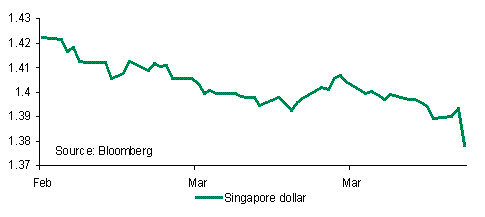
The rationale for the decision was clear and as revealed in the strong first quarter Singapore GDP data which revealed a 13.1% annual rise. Stronger growth is fuelling growing inflationary concern and to combat this Singapore’s MAS will allow greater SGD appreciation. The reaction in other Asian currencies was also positive, with markets (quite rightly in my view) that other Asian central banks will be more tolerant of currency strength in their respective currencies.

Moreover, Singapore’s move was pre-emptive, perhaps with one eye on an imminent revaluation in China. The recent easing in tensions between the US and China has if anything increased the likelihood that China revalues its currency, the CNY, sooner rather than later, and most likely before the end of Q2 2010. Whatever the rationale, strengthening inflation pressure across the region, will mean a less FX interventionist stance in Asia, and likely stronger currencies over coming months.

Respite for the dollar

Markets are increasingly discounting stronger than expected Q3 earnings.  Further gains in equities and risk appetite may be harder to achieve even if profits continue to be beat expectations, which so far around 80% of Q3 earnings have managed to do. Measures of risk such as the VIX “fear gauge” have highlighted an increasingly risk averse environment into this week.  The negative market tone could continue in the short term.

The USD has found some tentative relief, helped by the drop in equities and profit taking on risk trades.  The fact that the market had become increasingly short USDs as reflected in the latest CFTC Commitment of Traders’ (IMM) report in which aggregate short USD positions increased in the latest week (short USD positions numbered roughly twice the number of long positions), has given plenty of scope for some short covering this week.

The USD has even managed quite convincingly to shake off yet another article on the diversification of USD reserves in China.  The USD index looks set to consolidate its gains over the short term against the background of an up tick in risk aversion.  The USD index will likely remain supported ahead of the main US release this week, Q3 GDP on Thursday, but any rally in the USD is unlikely to be sustainable and will only provide better levels to short the currency.

Given the broad based nature of the reversal in risk sentiment with not only equities dropping but commodities sliding too, it suggests that high beta currencies, those with the highest sensitivity to risk will suffer in the short term.  These include in order of correlation with the VIX index over the past month, from the most to the least sensitive, MXN, AUD, MYR, SGD, NOK, EUR, CAD, INR, ZAR, BRL, TRY and NZD. The main beneficiary according to recent correlation is the USD.

EUR sentiment in particular appears to be weakening at least on the margin as reflected in the latest IMM report which revealed that net long EUR speculative positions have fallen to their lowest level in 6-weeks.  Whether this is due to profit taking as EUR/USD hit 1.50 or realisation that the currency appeared to have gone too far too quickly, the EUR stands on shakier ground this week.  EUR/USD may pull back to near term technical support around 1.4840 and then 1.4725 before long positions are re-established.

Asian currencies on the up

The third quarter of 2009 has proven to be another negative one for the US dollar.  Over the period the dollar index fell by over 4%.  The only major currency to lose ground against the dollar over this period was the British pound.  Most other currencies, especially the so called “risk currencies” which had come under huge pressure at the height of the financial crisis, registered strong gains led by the New Zealand dollar, Swedish krona and Australian dollar.  Although the euro also strengthened against the dollar it lagged gains in other currencies over the quarter.

Asian currencies also registered gains against the dollar in Q3 but to a lesser extent than G10 currencies.  Asian currency appreciation was led by the Korean won, Indonesian rupiah and Singapore dollar, respectively.  The under performer over Q3 was the Indian rupee which actually depreciated against the US dollar slightly.  The reason for the smaller pace of appreciation for most Asian currencies was due mainly to intervention by Asian central banks to prevent their respective currencies from strengthening too rapidly, rather than due to any inherent weakness in sentiment.

In fact, Asian currencies would likely be much stronger if it wasn’t for such FX interventions.  A good indication of the upward pressure on Asian currencies can be found from looking at the strength of capital inflows into local stock markets over recent months.  South Korea has registered the most equity capital inflows so far this year, with close to $20 billion of flows into Korean equities year to date but in general most Asian stock markets have registered far stronger inflows compared with last year.   

For the most part, balance of payments positions are also strong.  For example, South Korea recorded a current account surplus of $28.15 billion so far this year, compared to a deficit of $12.58bn over the same period last year.  This is echoed across the region.  Although surpluses are expected to narrow over coming months due mainly to a deterioration in the terms of trade, the overall health of external positions across the region will remain strong and supportive of further currency appreciation.  

The outlook for the final quarter of 2009 is therefore likely to be positive for Asian currencies, with the US dollar set to weaken further against most currencies.  Some risk will come from a potential reversal in global equity market sentiment but overall, further improvements in risk appetite will support capital inflows into the region.  Capital will be attracted by the fact that growth in Asia will continue to out perform the rest of the world and yet again only interventions by central banks will prevent a more rapid appreciation of Asian currencies.