Euro still looks uglier than the dollar

Currency markets continue to vacillate between US debt ceiling concerns and eurozone peripheral debt worries. Despite a lack of agreement to raise the debt ceiling, with House Republicans failing to back a proposal by House speak Boehner, the USD actually strengthened towards the end of the week as eurozone peripheral issues shifted back into focus.

The resilience of the USD to the lack of progress in raising the debt ceiling is impressive and reveals that the EUR looks even uglier than the USD, in many investors’ eyes.

Much in terms of direction for the week ahead will depend on the magnitude of any increase in the debt ceiling and accompanying budget deficit reduction measures. Assuming that a deal is reached ahead of the August 2 deadline it is not obvious that the USD and risk currencies will enjoy a rally unless the debt ceiling deal is a solid and significant one.

Given the limited market follow through following the recent deal to provide Greece with a second bailout, the EUR remains wholly unable to capitalise on the USD’s woes.

A reminder that all is not rosy was the fact that Moody’s ratings agency placed Spain’s credit ratings on review for possible downgrade while reports that the Spanish parliament will be dissolved on September 26 for early elections on November 20 will hardly help sentiment for the EUR. Compounding the Spanish news doubts that the EFSF bailout fund will be ready to lend to Greece by the next tranche deadline in mid-September and whether Spain and Italy will participate, have grown.

Some key data releases and events will also likely to garner FX market attention, with attention likely to revert to central bank decisions including the Bank of Japan, European Central Bank, Bank of England, Reserve Bank of Australia and US July jobs report. None of the central banks are likely to shift policy rates, however.

The risk for the USD this week is not only that there is disappointing result to the debt ceiling discussions, but also that there is a weak outcome to the US July jobs report. An increase of around 100k in payrolls, with the unemployment rate remaining at 9.2%, will fixate market attention on weak growth and if this increases expectations for a fresh round of Fed asset purchases the USD could be left rather vulnerable.

The RBA is highly unlikely to raise interest rates but the tone of the accompanying statement is unlikely to be dovish. The RBA noted the strong emphasis on the Q2 CPI inflation data and in the event it came in higher than expected, a fact that supports my expectation that the Bank will hike policy rates at least once more by the end of this year.

Markets have largely priced out expectations of a rate cut but there is still scope for a more hawkish shift in Australian interest rate markets, which will give the AUD a boost. However, AUD remains vulnerable to developments in the US and Europe as well as overall risk aversion, and a preferable way to play a positive AUD view in the current environment is via the NZD.
EU Deal Boosts Euro But Momentum To Fade

The European Union deal for Greece was clearly on the positive side of expectations and from that perspective helped to buoy sentiment for European assets. The fact that EU leaders managed to work over differences and emerge with a solid deal will help remove some of the uncertainty about Greece’s future and lower the risks of contagion.

To recap EU leaders announced a EUR 109 billion second aid package for Greece. Private bondholders will contribute a target of a further EUR 37 billion via bond swaps or rolling over existing debt for new bonds maturing in 30 years. Investors will have the option to exchange existing debt into four instruments. The aim is to obtain 90% participation from Greek bondholders.

Moreover, it appears that governments will guarantee any defaulted Greek debt offered as collateral until the country can return to the market. Effectively this means that even if ratings agencies declare a default rating on Greek debt, Greek banks may still be able to obtain funding from the European Central Bank (ECB) as the debt is guaranteed by national governments.

Greece, Portugal and Ireland will benefit from lower interest rates on loans and longer maturities. Moreover, the European Financial Stability Facility (EFSF) bailout fund will have a wider scope for bond buying directly from investors. This lets the ECB off the hook to avoid further use of its own bond purchase programme and removes any further impairing of its balance sheet. The idea of a tax on banks was removed, as criticism of the workability of such a plan increased.

The downside of the deal includes the fact that:
1) European tax payers are on the line for a potentially unlimited amount to guarantee defaulted Greek debt,
2) The bondholder programme is only limited to Greece, so there is no contingency should something similar be needed in other countries
3) The participation rate for private bondholders is yet to be known (but will most likely be high).
3) The deal will lead to a default on Greek debt given the programme amounts to a 21% drop in value but a credit event is unlikely to be triggered.
4) Greece still has a highly ambitious privatisation and austerity plan to implement which even some Greek officials have admitted is overly optimistic and at worst could turn into a fire sale of Greek assets.
5) EFSF bond purchases will need the “mutual agreement” of member states which is by no means guaranteed.
6) The fund size is not large enough should Italy and Spain need similar bailouts especially as leaders have stressed that the Greek package will not be replicated for other countries.

The EUR rallied on the outcome of the European talks. However, the EUR has plenty of other worries to deal with including divergence in growth across the eurozone, overly long EUR market positioning, EUR overvaluation, likely growth underperformance versus the US and a likely rebound in general for the USD over coming months especially if the Fed does not embark on QE3 and agrees a deal to raise the debt ceiling. EUR/USD is likely to remain supported in the near term, with near term resistance around 1.4467. I still suspect that the momentum will not last, with EUR/USD looking particularly rich at current levels.

Risk off mood

A ‘risk off’ tone is quickly permeating its way through the market psyche as tensions surrounding the eurozone periphery reach fever pitch. This is reflected in the sharp jump in equity volatility as indicated by the VIX ‘fear’ gauge. Equity markets and risk trades in general look set to remain under pressure in the current climate.

Moreover, the EUR which is finally succumbing to bad news about the periphery will continue to face pressure over the short-term. Against this background economic data will likely be relegated to the background this week but it worth noting that what data there is on tap, is likely to send a weaker message, with data such as durable goods orders in the US as well as various purchasing managers indices (PMI) data in the eurozone today likely to show some slippage.

The Greek saga remains at the forefront of market attention, with restructuring speculation remaining high despite various denials over the weekend by Greek and European Central Bank (ECB) officials. News that Norway has frozen payments to Greece, whilst Fitch ratings agency’s downgrades of Greece’s ratings by 3 notches and S&P’s downgrade of Italy’s ratings outlook to negative, have all contributed to the malaise afflicting the periphery.

This weekend’s local election in Spain in which Prime Minister Zapatero and his Socialist Party suffered its worst defeat in more than 30 years leading to a transfer of power in the Spanish regions, will lead to concerns about the ability of the government to carry out much needed legislative changes.

It is difficult to see any improvement in sentiment towards the peripheral Europe and consequently the EUR over the short-term. In Greece, Prime Minister Papandreou will attempt to push through further unpopular austerity measures through parliament this week in advance of a 5th bailout tranche of EUR 12 billion scheduled for next month. This comes at a time when opinion polls show the government losing more support and 80% of those surveyed saying they would not accept more austerity measures.

The deterioration in sentiment for the EUR has been rapid as reflected in the CFTC IMM data, with net long speculative positions now at their lowest since 15 February and heading further downhill. Conversely, USD short covering has been significant though there is still a hefty USD short overhang, which points to more USD short covering as EUR sentiment sours.

Nonetheless, the USD still has plenty of risks hanging over it including the fact that it still suffers from an adverse yield differential (note that 2-year Treasury yields have fallen to the lowest since 6 December 2010). Safe haven currencies in particular CHF are the key beneficiaries and notably EUR/CHF touched a record low around 1.2354 and is showing little sign of any rebound.

Eurozone peripheral tensions

The USD index remains under pressure but will likely continue to consolidate. The USD continues to be undermined by adverse interest rate differentials and is gaining little support from rising risk aversion. One factor that will help dictate USD direction over coming months is the prospects for further quantitative easing once QE2 ends.

Fed officials offered varied views on the subject. Dallas Fed President Fisher hinted he would support cutting short asset purchases before the end of June, whilst Atlanta Fed President Lockhart noted he was “very cautious” about further asset purchases. Meanwhile Chicago Fed President Evans noted that he believes the hurdle for altering the asset purchase plan is “pretty high”.

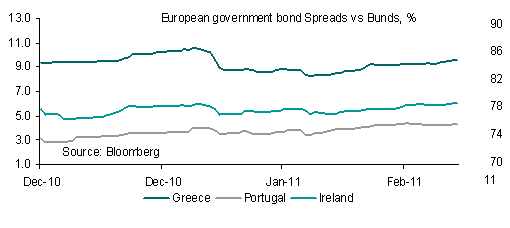
Although there is a lack of first tier data releases in the eurozone this week there is certainly plenty for markets to chew on in terms of peripheral country issues, which may just prevent the EUR from extending its gains. Eurozone peripheral debt spreads have undergone a renewed widening over recent weeks as debt fears have increased and worries that Portugal may follow Ireland and Greece in needing a bailout have risen.

Meanwhile news that Ireland’s incoming government will introduce legislation allowing the restructuring of some senior bank bonds, will add to tensions. Meanwhile, the downgrading of Greece’s government bond ratings to B1 from Ba1 dealt another blow sentiment following hot on the heels of Fitch’s downgrade of Spain’s outlook to negative although the EUR proved resilient to the news. EUR/USD continues to look as though it will consolidate around the 1.4000 level, but worsening sentiment towards the periphery may open up downside as the EUR’s resilience fades.

Upward revisions to eurozone growth and inflation forecasts and of course a hawkish shift in eurozone interest rate expectations may have justified the EUR move higher over recent weeks. However, there does not seem to be much that will provide the stimulus for further gains from current levels.

The market has already priced in an interest hike as early as next month’s European Central Bank (ECB) meeting and further tightening thereafter. The risk now appears asymmetric skewed to the downside especially if tensions between the eurozone core and peripheral countries deepen. How long the EUR can ignore such tensions?

It’s not only the eurozone periphery that should worry about ratings. Japan’s ratings agency R&I has warned that it may be forced to cut Japan’s sovereign ratings before April’s local elections due to current political problems. R&I’s concern revolve around the potential for political problems to delay fiscal reforms. As usual the JPY remains unmoved by political issues and is moving to the stronger side of its recent range against the background of elevated risk aversion.

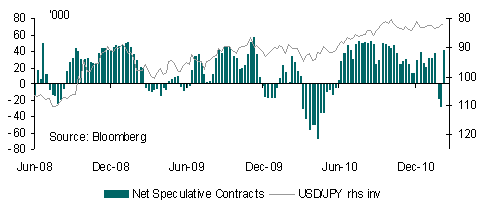
Although the JPY has not been particularly sensitive to risk over recent months shorter-term correlations shows that its sensitivity has increased. Given that Middle-East tensions do not appear to be easing the JPY will remain well supported. Indeed, speculative positioning data reveals the highest JPY net long position since November 2010. As risk appetite improves JPY positioning will be pared back but this is unlikely to be imminent, with USD/JPY set to remain close to support around 81.10.

Temporary Euro Relief

Eurozone peripheral country travails continue to garner most market attention. There was at least a semblance of improvement on this front as peripheral bond spreads with German bunds narrowed on Tuesday but this was largely due to European Central Bank (ECB) bond buying than any improvement in sentiment. The fact that German bund yields also rose helped to narrow bund-peripheral spreads further.

A clearer test of sentiment will be today’s debt sales by Portugal followed by actions by Spain and Italy tomorrow. ECB buying of Portuguese bonds has given some relief to other debt, with Spanish and Italian debt spreads narrowing too. Even Greece managed to sell short term debt (EUR 1.95 bn of 26 week T-bills) but at a higher cost than the previous sale.

Perhaps a stronger boost to sentiment will come from the news that European Union (EU) governments are discussing an increase in the EUR 440 billion bailout fund in recognition of the fact that the fund may prove too small to cope if the crisis spreads to Spain. However, don’t expect a decision anytime soon, with next week’s meeting of EU finance ministers unlikely to agree to such a move. Support (or lack) of from Germany may prove to be a sticking point against the background of domestic political pressure.

Other options being considered include the possibility of the EFSF (European Financial Stability Facility) purchasing bonds in the secondary market and lowering interest rates on EFSF bailout loans. News that Japan will buy 20% of EFSF bonds this month as well as recent supportive comments from China suggest that an increase in the size of the EFSF may be easily funded by such investors. The EUR will gain some support against the background of such speculation but its upside may be restrained around its 200-day moving average at EUR/USD 1.3071.

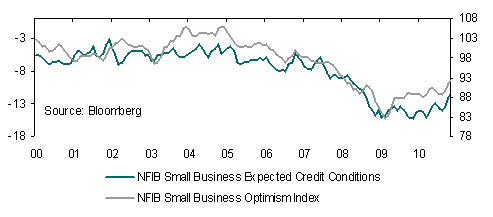
In the US the economic news was not so positive for a change as the National Federation of Independent Business (NFIB) small business optimism survey came in weaker than expected in December, an outcome that will come as a blow given that it suggests some stuttering in the recovery process as well as hiring.

There is only secondary data scheduled today, with most attention on the Fed’s Beige Book later tonight. The survey of Federal Reserve districts will likely reveal a broad based but moderate improvement in economic conditions with the exception of housing activity. A speech by the Fed’s Fisher on Monetary policy will also be in focus. Like the Fed’s Plosser overnight he may highlight some caution about the impact of Fed quantitative easing (QE).

The AUD is increasingly feeling the impact of the flooding in Queensland Australia as the extent of economic damage is revealed. Reserve Bank of Australia (RBA) board member McKibbin estimated that it could knock off at least 1% from economic growth. This may prove too negative and although the flooding will result in a significantly negative impact on growth in Q1 rebuilding and reconstruction will mean that overall growth for 2011 will not be as significantly impacted. Nonetheless, a paring back in RBA policy tightening expectations will see the AUD come under further pressure, with a move down to around AUD/USD 0.9634 on the cards over the short-term.