Euro weaker despite hawkish ECB

The bounce in EUR/USD following the European Central Bank (ECB) press statement following its unchanged rate decision proved short-lived with the currency dropping sharply as longs were quickly unwound, with EUR/USD hitting a low around 1.4478. The sell off occurred despite the fact that the ECB delivered on expectations that it would flag a July rate hike, with the insertion of “strong vigilance” in the press statement.

The reaction was a classic ‘buy on rumour, sell on fact’ outcome and highlights just how long EUR the market was ahead of the ECB meeting. Interestingly the interest rate differential (2nd futures contract) has not widened versus the USD despite the hawkish ECB message and in any case interest rate differentials are not driving EUR/USD at present as reflected in low correlations.

This leaves the EUR susceptible to Greek developments and the news on this front is less positive. ECB President Trichet ruled out any direct participation (ie no rollover of ECB Greek debt holdings) in a second Greek bailout whilst potentially accepting a plan of voluntary private participation in any debt rollover. The ECB’s stance is at odds with that put forward by German Finance Minister Schaeuble pressuring investors to accept longer maturities on their Greek debt holdings.

In contrast the USD appears to be finding growing relief from the fact that the Federal Reserve is putting up a high hurdle before QE3 is considered. As highlighted by Fed Chairman Bernanke earlier this week the Fed is not considering QE3 despite a spate of weak US data. This was echoed overnight by the Fed’s Lockhart and Plosser, with the former noting that there would need to be a substantially weaker economy and the latter noting that there would have to be a “pretty extraordinary” deterioration in the economy to support QE3.
EUR Supported, AUD dives, NZD jumps

Today is probably not the best day to sell EUR given that the ECB policy decision looms on the horizon. Whilst there is a risk of a ‘buy on rumour, sell on fact’ impact on the EUR following the European Central Bank (ECB) decision later today the relatively high probability that the ECB flags a rate hike in July will likely give further support to the EUR especially as it is not fully priced in by the market.

Of course should ECB President Trichet fail to mention “strong vigilance” in his press conference the EUR could suffer but this is likely to be a lower probability event. Some justification for higher rates will come from an upward revision in the ECB’s inflation forecasts. Consequently EUR/USD looks well supported around 1.4450.

The Bank of England is unlikely to deliver any surprises today, with an unchanged policy rate outcome and asset purchases target likely. The outcome will keep GBP restrained versus USD but given the likely contrast with the ECB, EUR/GBP could head higher as the currency pair continues to set its sights on the 0.90 level.

Even against the USD, GBP is unlikely to extend its gains, with 1.6474 likely providing a near term technical cap. The dichotomy of weaker activity and higher inflation is clearly causing a problem for policy makers but we still believe a rate hike is likely later in the year. In the meantime GBP remains vulnerable to further data disappointments over coming weeks.

There was more bad news for the AUD today in the form of a weak than forecast May employment report. The data will reinforce expectations that the RBA will not hike interest rates over coming months, with July and August effectively ruled out, though a hike in September remains probable.

The data had major impact on AUD which dropped sharply below the 1.0600 handle versus USD. Clearly the combination of the RBA statement and weak jobs data has resulted in a major headwind against further near term AUD appreciation. AUD will remain under downward pressure in the short-term, with technical support seen at 1.0440.

Unlike the RBA the Reserve Bank of New Zealand (RBNZ) opened the door for higher interest rates following its unchanged policy decision today, with the Bank stating that “a gradual increase in the overnight cash rate over the next two years will be required”. Despite noting some caution about the strength of the NZD and its impact on the economy the Kiwi strengthened versus the USD

US Dollar On A Slippery Path

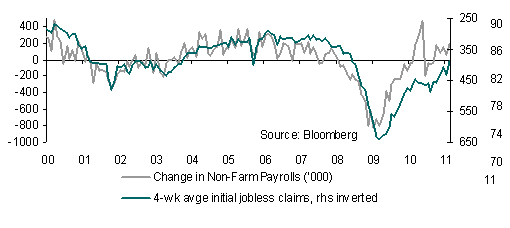
The USD has been a on a slippery path over recent weeks, weighed down by adverse interest rate differentials despite improving US economic data. Adding to the run of encouraging US data releases the February jobs report revealed a 192k increase in jobs and a drop in the unemployment rate to 8.9%.

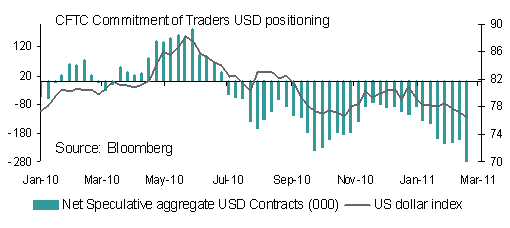
In particular the Fed’s dovish tone highlights that whilst asset purchases under QE2 will stop at the end of June, the failure to hit the Fed’s dual mandate of maximum employment and stable prices, implies that the Fed Funds rate will not be hiked for a long while yet. This dovish slant has undermined the USD to the extent that USD speculative positioning as reflected in the CFTC IMM data dropped to all time low in the week to 1 March. There is certainly plenty of scope for short-covering but the market is no mood to buy the USD yet.

This week’s releases will provide less direction, with a slight widening in the trade deficit likely in January, a healthy gain in February retail sales and a small drop in the preliminary reading of March Michigan sentiment.

In contrast, even the generally hawkish market expectations for the European Central Bank (ECB) proved too timid at last week’s Council meeting as Trichet & Co. strongly implied via “strong vigilance” that the refi rate would be hiked by 25bps in April. EUR/USD lurched higher after the ECB bombshell breaking the psychologically important 1.4000 barrier but appeared to lose some momentum at this level. Should EUR/USD sustain a break of 1.4000, the next level of resistance is at 1.4281 (November high), with support seen around 1.3747.

The lack of major eurozone data releases this week, with only industrial production data in Germany and France of interest, suggests that EUR may consolidate over the short-term with the main interest on the informal Heads of State meeting at the end of the week to determine whether credible plans can be drawn up to restore confidence in the periphery.

This week it is the turn of the Bank of England (BoE) to decide on monetary policy but unlike the ECB we do not expect any surprises with an unchanged decision likely. Further clues will only be available in the Monetary Policy Committee (MPC) minutes on 23 March. However, markets may be nervous given that it could feasibly only take another two voters aside from the three hawkish dissenters last month, to result in a policy rate hike. Notably one possible hawkish dissenter, Charles Bean did not sound overly keen on higher rates in a speech last week, a factor that weighed on GBP alongside some weaker service sector Purchasing Managers Index (PMI) data.

UK manufacturing data will be the main data highlight of the calendar but this will be overshadowed by the BoE meeting. GBP/USD could continue to lag the EUR and given a generally bullish EUR backdrop, our preferred method of playing GBP downside remains via a long EUR/GBP position.