Asian currencies – What’s correlated with what?

Asian currencies as reflected in the performance of the ADXY index have been on bit of a rollercoaster ride over recent weeks, dropping sharply in the face of a resurgent USD (note most Asian currencies have had a high correlation with the movements in the USD index over the past three-months) only to strengthen briefly before resuming weakness. Since the end of last month almost all Asian currencies are weaker, with the biggest falls led by MYR, KRW, SGD and INR.

Correlation analysis shows that Asian currencies are not particularly being influenced by yield differentials at present, with only USD/IDR and USD/PHP possessing a significant correlation with 2-year bond differentials. In the case of the IDR there has been a narrowing in the yield differential with the US over recent weeks as Indonesian yields have dropped, a factor that could be undermining the IDR at present.

Similarly risk aversion does not appear to be playing a major role in influencing Asian currencies, with a low correlation registered between my Risk Aversion Barometer and all Asian currencies over the past three-months. However, equity performance is more important for some currencies, with the SGD, THB, PHP, IDR and TWD all having a high sensitivity to the performance of their local equity market. Interestingly the INR is less sensitive to equity performance even though India has recorded heavy outflows of equity capital over recent weeks.

Asian currencies are likely to continue to track the gyrations of the USD in general over the short-term as has been the case over recent weeks but it will not be a one way bet for the USD. Whilst I remain bullish on the USD’s prospects over the medium term I am cautious about the ability of the USD to sustain its currency bounce given that there has not been any back up in US bond yields or any clarification on what the Fed will do after QE2 has been completed.

Against this background I do not expect Asian currency weakness to extend much further. Top picks for the year are KRW and PHP as well as the CNY. In any case given the strong influence of general USD direction on Asian currencies, I suggest playing long Asian FX positions versus EUR over coming months, especially given that the EUR is likely to slide much further against the USD by year end, with 1.30 remaining my target.
US Dollar On The Rise

There are plenty of US releases on tap this week but perhaps the most important for the USD will be the minutes of the April 26-27 Fed FOMC meeting. Taken together with speeches by Fed officials including Bernanke, FX markets will attempt to gauge clues to Fed policy post the end of QE2. The Fed’s stance at this point will be the major determinant of whether the USD can sustain its rally over the medium term. The lack of back up in US bond yields suggests that USD momentum could slow, with markets likely to move into wide ranges over coming weeks.

It is worth considering which currencies will suffer more in the event that the USD extends its gains. The correlation between the USD index and EUR/USD is extremely strong (even accounting for the fact that the EUR is a large part of the USD index) suggesting that the USDs gains are largely a result of the EUR’s woes. Aside from the EUR, GBP, AUD and CAD are the most sensitive major currencies to USD strength whilst many emerging market currencies including ZAR, TRY, SGD, KRW, THB, IDR, BRL and MXN, are all highly susceptible to the impact of a stronger USD.

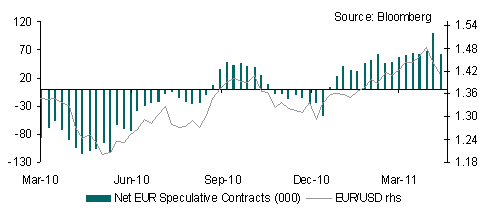
Robust Q1 GDP growth readings in both Germany and France helped to spur gains in the EUR but this proved short-lived. Sentiment for the currency has soured and as reflected in the CFTC IMM data long positions are being scaled back. Nonetheless, there is still plenty of scope for more EUR selling given ongoing worries about the eurozone periphery, which are finally taking their toll on the EUR. A break below EUR/USD 1.4021 would open the door for a test of 1.3980.

The eurogroup and ecofin meetings will be of interest to markets this week but any additional support for Greece is unlikely to be announced at this time. However, likely approval of Portugal’s bailout may alleviate some pressure on the EUR but any positive impetus will be limited. Even on the data front, markets will not be impressed with the German ZEW index of investor confidence likely to register a further decline in May.

Japanese officials have been shying away from further FX intervention by blaming the drop in USD/JPY over recent weeks on general USD weakness despite the move towards 80. However, this view is not really backed up by correlation analysis which shows that there is only a very low sensitivity of USD/JPY to general USD moves over recent months. One explanation for the strength of the JPY is strong flows of portfolio capital into Japan, with both bond and equity markets registering net inflows over the past four straight weeks.

This is not the only explanation, however. One of the main JPY drivers has been a narrowing in yield differentials. This is unlikely to persist with yield differentials set to widen sharply over coming months resulting in a sharply higher USD/JPY. As usual data releases are unlikely to have a big impact on the JPY this week but if anything, a further decline in consumer confidence, and a negative reading for Q1 GDP, will maintain the pressure for a weaker JPY and more aggressive Bank of Japan (BoJ) action although the BoJ is unlikely to shift policy this week.

GBP troubles, KRW too weak

The Fed FOMC minutes for the January meeting revealed that behind the unanimous vote to leave policy settings unchanged there was some unease about the completion of QE2. Nonetheless, the USD was left weaker given the Fed’s sanguine view on inflation and worries about unemployment. Inflation data will garner most market attention today but the fact that the core rate of CPI inflation is expected to remain well below the Fed’s preferred level could undermine the USD and add a further barrier to the USD’s recovery so far in February. Jobless claims data will also be of interest given the sharp drop last week. Another firm outcome will help to dispel worries about job market recovery.

As warned in my last post, downside risks to GBP were high given the long GBP speculative positioning overhang and hawkish expectations for the BoE Quarterly Inflation Report. In the event the Report revealed a downward growth forecast revision and an upward inflation forecast revision but importantly showed some reluctance to play into market expectations of an early UK policy rate hike. Following on from a weaker than expected UK January jobs report in which unemployment increased, GBP was hit on both counts. GBP/USD is unlikely to veer far from the 1.6000 level, but with markets reassessing interest rate expectations downside risks are beginning to open up.

News yesterday that Moody’s ratings agency has placed Australia and New Zealand’s major banks on review for possible downgrades went down like a lead balloon but once again AUD and NZD showed their usual resilience and acted as if little has happened. AUD and NZD have weakened since the turn of the year. Weaker data and a paring back in policy tightening expectations have contributed to the weaker performance of the AUD and NZD, but markets have gone too far in scaling back the timing and magnitude of interest rate hikes, suggesting that both currencies may bounce back as interest rate expectations become more hawkish.

Asian currencies continue to register mixed performances largely influenced by capital flows. Most equity markets in the region have registered outflows so far in 2011, with the exception of Taiwan and Vietnam. This has been reflected in Asian FX performance, with the strongest performer being the IDR, but its gains have only been around 0.72% versus USD, coinciding with the fact that it has registered some of the least capital outflows this year. Interestingly the worst performing currency has been the THB, one of last year’s star performers. Korea has also registered strong equity capital outflows but this will not persist and a resumption of inflows taken together with positive fundamentals and higher interest rates will boost the KRW this year.

China Hikes Rates, More On the Cards

In an otherwise unexciting day China livened things up by raising its 1 year deposit and lending rates by 25 basis points. The hike, the third in the last four months, should not have come as a surprise, given the growing emphasis by China’s central bank PBoC, to dampen inflation pressures. Indeed, more hikes are on the cards, with at least another two more in prospect over H1. The other tool to combat inflation is CNY appreciation further gains in the currency over coming months should be expected to around 6.3 by year-end versus USD.

Global markets largely shrugged of China’s move, with generally positive market sentiment continuing. Even in the eurozone, where there was some disappointment at the surprise drop in German December industrial production, market sentiment continued to improve as Egypt and local debt worries eased further. EUR was particularly resilient despite calls from a Belgian think tank that Greece needs to restructure its debt to avoid a long and painful path ahead. Commodity currencies also showed impressive resilience to China’s rate hike, with both the AUD and NZD holding up well.

The overall positive risk background is supportive for Asian currencies and other risk trades. Currencies in Asia remain highly correlated with portfolio capital inflows and so far this year the weakness in the INR and THB has matched the strong equity outflows from India and Thailand. However, this appears to be reversing, especially in the case of India registering positive equity flows this month, helping the INR to reverse some of its losses.

In the absence of key data releases markets will turn their attention to the testimony by Fed Chairman Bernanke to the House budget committee where he will give comments on the economy, jobs and the budget. Dallas Fed’s Fisher stated overnight that whilst he expects the Fed to complete QE2 he would not support another round of quantitative easing. Fisher’s comments on QE were similar to Atlanta Fed’s Lockhart who notes there is a “high bar” for more QE. Bernanke is unlikely to deviate from this tone in his speech today whilst also maintaining his view that there should be a long term commitment to fiscal retrenchment.

Against the background of improving risk appetite the USD is likely to stay under mild pressure although it is difficult to see a break of recent ranges for most currency pairs. EUR/USD ought to find strong support around its 100-day moving average 1.3535 whilst USD/JPY will be supported around 81.10. Equity sentiment is being supported by US data which remains encouraging. On cue the NFIB Small Business Optimism index duly rose in January to 94.1 as sentiment in this sector continued its improving trend.

Taken together with firmer equities, encouraging data is taking its toll on US bond markets, resulting in a back up in yields. Bond market sentiment wasn’t helped by a relatively poor 3-year auction. For example, US 2-year bond yields have backed up by over 30bps since 28 January. Bad news for bond is good news for the USD however, as higher relative US bond yields will likely help prevent a deeper USD sell-off, with EUR/USD in particular most reactive to relative eurozone / US bond yield differentials.

Econometer.org has been nominated in FXstreet.com’s Forex Best Awards 2011 in the “Best Fundamental Analysis” category. The survey is available at http://www.surveymonkey.com/s/fx_awards_2011

Asian Currency Differentiation

Asian currencies have started the year in mixed form, but it would be wrong to generalize the performance of Asian currencies as weak. There have been marginal gains recorded year to date vs. USD in the KRW, TWD, MYR and SGD, reflecting strong capital equity inflows. This contrasts with losses in the IDR, INR, PHP and THB versus USD. Compared to the beginning of 2010 equity capital flows have been far weaker overall, with India, Indonesia, Philippines and Thailand, recording outflows, matching the performance of their currencies.

Clearly investors are discriminating more at the turn of 2011. For example Taiwan has recorded solid equity inflows over recent weeks (over $2 billion year-to-date), matching the strength of inflows registered at the beginning of 2010. It appears that Taiwan stocks have started the year as the Asian favorite, helped by growing expectations of further door opening to mainland investment and tourism. Korean equities have also registered inflows helping to support the KRW, which looks to be good buy over the short term above 1120.

This contrast with outflows registered in other Asian equity markets. A major concern responsible for some of the weakness in capital flows to Asia is the threat of inflation. For example, the selling of stocks in India appears to be closely related to inflation concerns and the hawkish rhetoric of the Reserve Bank of India, which is continuing its tightening path this year. Similarly, the PHP may be vulnerable over the short term following a failed T-bill auction on Monday. Inflation worries have clearly led to a push for higher yields but the bids were labeled as “unreasonable” by the government.

Over coming weeks, further EUR strength will likely give Asian currencies more support as the USD succumbs to further pressure. Continued strengthening in the CNY will also support other Asian currencies given that the CNY fixing has reached its highest level since the July 2005 revaluation.