Fed does the Twist, markets do the Shake

Although it was widely expected the Federal Reserve’s decision to implement a fresh version of Operation Twist together with a downbeat assessment of the economy came as a disappointment to equities and risk assets in general. The only surprise was the larger size of the operation at $400 billion.

Moody’s downgrade of three US banks added to the malaise as US equities dropped sharply, commodities slid, longer term Treasuries rallied whilst shorter term bonds dropped. The USD registered broad gains both on the back of the fact that no more quantitative easing was announced and due to a shift away from risk assets. At least there was no more negative news out of the eurozone as talks between the Troika (ECB, IMF, EC) and Greek officials continue on the next tranche of the bailout.

Markets will continue to digest the Fed’s outcome today and the negative tone will likely filter through markets today. There is little on the data front to result in a shift in this tone. In the US data includes weekly jobless claims while in Europe attention will be on manufacturing and service sector confidence measures.

While the potential for a positive outcome to talks in Greece may provide a short term boost to sentiment the overwhelming tone is likely to remain negative especially as Operation Twist is unlikely to change the dynamic of a weak growth trajectory for the US and developed economies over the coming months. Against this background, selling risk assets on rallies remains the preferred option.

The USD will continue to look firmest against high beta emerging market currencies in the current environment. Currencies in this group are those that have the highest correlations with risk (as m measured by my in house risk barometer) over the past 3 months including CAD, ZAR, TRY, INR, MXN, ARS & RUB. In contrast currencies that also have high correlations but actually strengthen as risk aversion increases are CNY and JPY.
US Dollar On The Rise

There are plenty of US releases on tap this week but perhaps the most important for the USD will be the minutes of the April 26-27 Fed FOMC meeting. Taken together with speeches by Fed officials including Bernanke, FX markets will attempt to gauge clues to Fed policy post the end of QE2. The Fed’s stance at this point will be the major determinant of whether the USD can sustain its rally over the medium term. The lack of back up in US bond yields suggests that USD momentum could slow, with markets likely to move into wide ranges over coming weeks.

It is worth considering which currencies will suffer more in the event that the USD extends its gains. The correlation between the USD index and EUR/USD is extremely strong (even accounting for the fact that the EUR is a large part of the USD index) suggesting that the USDs gains are largely a result of the EUR’s woes. Aside from the EUR, GBP, AUD and CAD are the most sensitive major currencies to USD strength whilst many emerging market currencies including ZAR, TRY, SGD, KRW, THB, IDR, BRL and MXN, are all highly susceptible to the impact of a stronger USD.

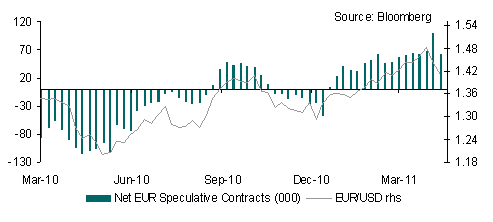
Robust Q1 GDP growth readings in both Germany and France helped to spur gains in the EUR but this proved short-lived. Sentiment for the currency has soured and as reflected in the CFTC IMM data long positions are being scaled back. Nonetheless, there is still plenty of scope for more EUR selling given ongoing worries about the eurozone periphery, which are finally taking their toll on the EUR. A break below EUR/USD 1.4021 would open the door for a test of 1.3980.

The eurogroup and ecofin meetings will be of interest to markets this week but any additional support for Greece is unlikely to be announced at this time. However, likely approval of Portugal’s bailout may alleviate some pressure on the EUR but any positive impetus will be limited. Even on the data front, markets will not be impressed with the German ZEW index of investor confidence likely to register a further decline in May.

Japanese officials have been shying away from further FX intervention by blaming the drop in USD/JPY over recent weeks on general USD weakness despite the move towards 80. However, this view is not really backed up by correlation analysis which shows that there is only a very low sensitivity of USD/JPY to general USD moves over recent months. One explanation for the strength of the JPY is strong flows of portfolio capital into Japan, with both bond and equity markets registering net inflows over the past four straight weeks.

This is not the only explanation, however. One of the main JPY drivers has been a narrowing in yield differentials. This is unlikely to persist with yield differentials set to widen sharply over coming months resulting in a sharply higher USD/JPY. As usual data releases are unlikely to have a big impact on the JPY this week but if anything, a further decline in consumer confidence, and a negative reading for Q1 GDP, will maintain the pressure for a weaker JPY and more aggressive Bank of Japan (BoJ) action although the BoJ is unlikely to shift policy this week.

Respite for the dollar

Markets are increasingly discounting stronger than expected Q3 earnings.  Further gains in equities and risk appetite may be harder to achieve even if profits continue to be beat expectations, which so far around 80% of Q3 earnings have managed to do. Measures of risk such as the VIX “fear gauge” have highlighted an increasingly risk averse environment into this week.  The negative market tone could continue in the short term.

The USD has found some tentative relief, helped by the drop in equities and profit taking on risk trades.  The fact that the market had become increasingly short USDs as reflected in the latest CFTC Commitment of Traders’ (IMM) report in which aggregate short USD positions increased in the latest week (short USD positions numbered roughly twice the number of long positions), has given plenty of scope for some short covering this week.

The USD has even managed quite convincingly to shake off yet another article on the diversification of USD reserves in China.  The USD index looks set to consolidate its gains over the short term against the background of an up tick in risk aversion.  The USD index will likely remain supported ahead of the main US release this week, Q3 GDP on Thursday, but any rally in the USD is unlikely to be sustainable and will only provide better levels to short the currency.

Given the broad based nature of the reversal in risk sentiment with not only equities dropping but commodities sliding too, it suggests that high beta currencies, those with the highest sensitivity to risk will suffer in the short term.  These include in order of correlation with the VIX index over the past month, from the most to the least sensitive, MXN, AUD, MYR, SGD, NOK, EUR, CAD, INR, ZAR, BRL, TRY and NZD. The main beneficiary according to recent correlation is the USD.

EUR sentiment in particular appears to be weakening at least on the margin as reflected in the latest IMM report which revealed that net long EUR speculative positions have fallen to their lowest level in 6-weeks.  Whether this is due to profit taking as EUR/USD hit 1.50 or realisation that the currency appeared to have gone too far too quickly, the EUR stands on shakier ground this week.  EUR/USD may pull back to near term technical support around 1.4840 and then 1.4725 before long positions are re-established.

Who’s going to follow in Brazil’s footsteps?

Last week saw a sell off in some emerging market currencies and whilst this may simply have been profit taking attributable to some large hedge funds it did coincide with the imposition of a tax on portfolio inflows in Brazil.  The tax dented sentiment as it quickly fuelled speculation that it would be followed elsewhere, especially in countries that had seen rapid FX appreciation.  

The BRL is one of the best performing currencies this year against the USD whilst the stock market has surged on strong capital inflows.  The huge increase in USD liquidity globally and substantial improvement in risk appetite has fuelled strong capital inflows into Brazil especially as the country has proven to be one of the most resilient during the crisis.

Although on the margin the tax will have a negative impact on speculative flows into Brazil it is unlikely to have a lasting impact.  Previous such measures have done little to prevent further appreciation.  The BRL is clearly overvalued by around 25-30 at present, but the tax in itself will not be sufficient to result in a move back to “fair value”. 

At best it may act a temporary break on currency appreciation and could limit the magnitude of further gains in the real but this could be at the cost of distorting resource allocation and market functioning.   The longer term solution is to enhance productivity but this will not help in the interim. The tax may make investors a little more reluctant to pile into Brazilian assets, which is what the authorities will desire but already the BRL is back on its appreciation path suggesting a short lived reaction. 

Other countries that could follow include South Africa, Turkey or South Korea but South Africa has already denied that it has any plans to move in this direction.  In South Korea’s case the central bank has chosen to intervene in currency markets to prevent the further strengthening in the won but that also has implications for sterilizing such flows limiting the extent that intervention can be carried out.    

The bottom line is that the broad based improvement in risk appetite is proving to be a strong driver of capital flows into emerging markets and the reality is that many emerging economies such as Brazil and many in Asia have been much more resilient than feared. 

Although there is clearly a limit on the extent that these countries want to allow their currencies to strengthen versus USD the upward pressure will continue, leading to more FX intervention and potential imposition of taxes or restrictions such as implemented in Brazil.   Despite this the outlook for most emerging currencies remains positive and the authorities will face an uphill struggle.