Australian Dollar Looking Stretched

Central bank decisions in Japan, Europe and UK will dictate FX market direction today. No surprises are expected by the Bank of Japan (BoJ) and Bank of England (BoE) leaving the European Central Bank (ECB) decision and press conference to provide the main market impetus. Although a hawkish message from ECB President Trichet is likely the market has already priced in a total of 75 basis points of tightening this year. We retain some caution about whether the EUR will be able to make further headway following the ECB meeting unless the central bank is even more hawkish than already priced in.

EUR/USD easily breached the 1.4250 resistance level and will now eye resistance around 1.4500. News that Portugal formally requested European Union (EU) aid came as no surprise whilst strong German factory orders provided further support to the EUR. The data highlights upside risks to today’s February German industrial production data. The EUR will find further support versus the USD from comments by Atlanta Fed’s Lockhart who noted that he doesn’t expect the Fed to hike interest rates by year end.

USD/JPY is now around 7.5% higher than its post earthquake lows. Japanese authorities will undoubtedly see a measure of success from their joint FX intervention. To a large degree they have been helped by a shift in relative bond yields (2-year US / Japan yield differentials have widened by close to 30 basis points since mid March, and are finally having some impact on USD/JPY as reflected in the strengthening in short-term correlations. Whilst the BoJ is unlikely to alter its policy settings today the fact that it is providing plenty of liquidity to money markets, having injected around JPY 23 trillion or about 5% of nominal GDP since the earthquake, is likely playing a role in dampening JPY demand.

AUD/USD has appreciated by close to 6% since mid March and whilst I would not recommend selling as yet I would be cautious about adding to long positions. My quantitative model based on interest rate / yield differentials, commodity prices and risk aversion reveals a major divergence between AUD/USD and its regression estimate. Clearly the AUD has benefitted from diversification flows as Asian central banks intervene and recycle intervention USDs. However, at current levels I question the value of such diversification into AUD.
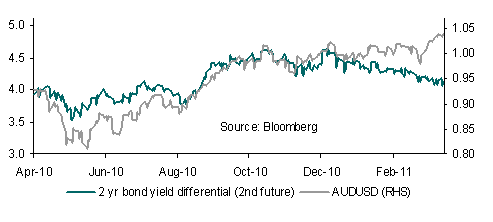
Speculative AUD/USD positioning as indicated by the CFTC IMM data reveals that net long positions are verging on all time highs, suggesting plenty of scope for profit taking / position squaring in the event of a turn in sentiment. Moreover, AUD gains do not match the performance of economic data, which have been coming in worse than expected over recent weeks. Consequently the risks of a correction have increased.
Risk on, US dollar pressure

FX markets have plenty of different factors to digest these days and after a harrowing couple of weeks markets began this week on a firmer footing. The overall tone into this week is to load up on risk assets. News that the nuclear situation in Japan may closer to stabilising has helped, whilst markets easily shook off another hike in China’s reserve ratio and ongoing conflict in Libya as Allied forces step up their campaign in the face of continuing resistance from Gaddafi’s forces.

Improved risk appetite has helped to keep the JPY on the defensive along with the continued threat of FX intervention, with further official JPY selling likely in the days ahead. Interestingly the intervention last Friday was estimated at only JPY 530 billion ($6.2 billion), much lower than previously thought. USD/JPY 80 remains a major line in the sand and any sign of another breach of this level will likely be met with official JPY selling. I suspect that the Japanese authorities will not be content until USD/JPY is far higher. In this respect its worth noting an official report released earlier in March highlighting that Japanese companies are not profitable at a USD/JPY rate below 86.

The EUR looks overbought around the 1.42 level but seems to be a beneficiary of Japanese FX intervention (perhaps a recycling of USDs into EUR) as well as comments by European Central Bank (ECB) Council members reiterating their intention to hike the refi policy rate, likely at the April ECB meeting. In a similar vein to the recycling of intervention USDs into EUR, Middle East entities may also be recycling petrodollars into EUR whilst news that Russia has permitted one of its oil related funds to buy Spanish debt has given a lift to sentiment for the EUR. Over the near term EUR/USD may struggle to make much headway above 1.42, with further direction coming from the EU leaders meeting on 24/25 March.

GBP is also doing well, having jumped close to the 1.6400 level versus USD, with UK February CPI giving the currency a further lift. The outcome at 4.4% YoY, which was not as bad as rumoured but in any case worse than consensus will give the hawks in the Bank of England MPC further ammunition to push for a policy rate hike. The fact that core inflation also increased suggests that the jump in headline inflation cannot merely be brushed under the table. A BoE rate hike is increasingly looking like a done deal. Renewed inflation worries in the UK and the hawkish rhetoric from ECB officials is sufficient to keep the USD under pressure.

GBP troubles, KRW too weak

The Fed FOMC minutes for the January meeting revealed that behind the unanimous vote to leave policy settings unchanged there was some unease about the completion of QE2. Nonetheless, the USD was left weaker given the Fed’s sanguine view on inflation and worries about unemployment. Inflation data will garner most market attention today but the fact that the core rate of CPI inflation is expected to remain well below the Fed’s preferred level could undermine the USD and add a further barrier to the USD’s recovery so far in February. Jobless claims data will also be of interest given the sharp drop last week. Another firm outcome will help to dispel worries about job market recovery.

As warned in my last post, downside risks to GBP were high given the long GBP speculative positioning overhang and hawkish expectations for the BoE Quarterly Inflation Report. In the event the Report revealed a downward growth forecast revision and an upward inflation forecast revision but importantly showed some reluctance to play into market expectations of an early UK policy rate hike. Following on from a weaker than expected UK January jobs report in which unemployment increased, GBP was hit on both counts. GBP/USD is unlikely to veer far from the 1.6000 level, but with markets reassessing interest rate expectations downside risks are beginning to open up.

News yesterday that Moody’s ratings agency has placed Australia and New Zealand’s major banks on review for possible downgrades went down like a lead balloon but once again AUD and NZD showed their usual resilience and acted as if little has happened. AUD and NZD have weakened since the turn of the year. Weaker data and a paring back in policy tightening expectations have contributed to the weaker performance of the AUD and NZD, but markets have gone too far in scaling back the timing and magnitude of interest rate hikes, suggesting that both currencies may bounce back as interest rate expectations become more hawkish.

Asian currencies continue to register mixed performances largely influenced by capital flows. Most equity markets in the region have registered outflows so far in 2011, with the exception of Taiwan and Vietnam. This has been reflected in Asian FX performance, with the strongest performer being the IDR, but its gains have only been around 0.72% versus USD, coinciding with the fact that it has registered some of the least capital outflows this year. Interestingly the worst performing currency has been the THB, one of last year’s star performers. Korea has also registered strong equity capital outflows but this will not persist and a resumption of inflows taken together with positive fundamentals and higher interest rates will boost the KRW this year.

Egypt Unrest Hits Risk Trades

Recent weeks have seen a real contrast in policy and growth across various economies. A case in point was the surprise drop in UK GDP in Q4 contrasting sharply with the solid (albeit less than forecast) rise in US Q4 2010 GDP. The resilience of the US consumer was particularly evident in the data. The European Central Bank’s (ECB) hawkish slant as reflected in comments from President Trichet compared to the dovish pitch of the Fed FOMC is another clear contrast for markets to ponder.

The ECB’s hawkish tone gave the EUR a lift but expectations of an early Eurozone rate hike looks premature. Although Eurozone inflation data (Monday) will reveal a further rise in CPI above the ECB’s target, to around 2.4% in January, this will not equate to a policy rate hike anytime soon. This message is likely to be echoed at this week’s ECB meeting where policy will be characterised as “appropriate”.

Whilst monetary tightening expectations look overdone in the Eurozone the same can be said for hopes of an expansion in the EU bailout fund (EFSF). Indeed, the fact that EU Commissioner Rehn appeared to pour cold water over an expansion in the size of the fund could hit the EUR and the currency may find itself struggling to extend gains over coming weeks especially if interest rate expectations return to reality too, with a move to EUR/USD 1.4000 looking far harder to achieve than it did only a few days ago.

It’s worth noting that a renewed widening in peripheral debt spreads will also send an ominous signal for the EUR. Against this background the EU Council meeting on February 4 will be in focus but any expectation of a unified policy resolution will be disappointed.

However, markets perhaps should not solely focus on peripheral Europe as the downgrading of Japan’s credit ratings last week highlights. Warnings about US credit ratings also demonstrate that the US authorities will need to get their act together to find a solution to reversing the unsustainable path of the US fiscal deficit, something that was not particularly apparent in last week’s State of the Union Address.

Last week ended with a risk off tone filtering through markets as unrest in Egypt provoked a sell-off in risk assets whilst worries about oil supplies saw oil prices spike. Gold surged on safe haven demand too. This week, markets will focus on events in the Middle East but there will be thinner trading conditions as Chinese New Year holidays result in a shortened trading week in various countries in Asia.

The main release of the week is the US January jobs report at the end of the week. Regional job market indicators and the trend in jobless claims point to a 160k gain in January although the unemployment rate will likely edge higher. Final clues to the payrolls outcome will be deemed from the ISM manufacturing confidence survey and ADP private sector jobs report this week. Whilst the January jobs report is unlikely to alter expectations for Fed policy (given the elevated unemployment rate) the USD may continue to benefit from rising risk aversion.

Positive Data Run Continues

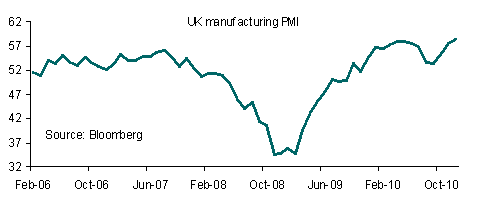
The batch of data releases in Tuesday’s trading session was generally positive. Leading the way was a stronger than expected increase in the UK manufacturing purchasing managers index (PMI) for December at 58.3 which coming in at a 16-year high. The data gave a boost to GBP though GBP/USD is unlikely to gain much of a foothold above 1.5600.

In the US, factory orders surprisingly jumped 0.7% in November and whilst the data is second tier it does maintain the run of generally upbeat US data. Meanwhile eurozone inflation came in higher than forecast at 2.2% YoY, above the European Central Bank (ECB) target level for the first time in two years. The outcome is unlikely to trigger a response from the ECB especially given that core inflation remains well behaved. After hitting a post CPI release high of 1.3433 EUR/USD is likely to drift lower in the short term.

Separately the Fed FOMC minutes of the December 14 meeting revealed little to surprise. Of note, FOMC members highlighted that the improvement in economic conditions was insufficient to warrant any change to the asset purchase program. The bottom line for the Fed is that the dual mandate of maximum employment and price stability is still not in reach and therefore they will keep the pedal to the floor in terms of policy stimulus. Although a further round of quantitative easing seems unlikely the Fed is likely to stick it out in terms of the $600 billion in planned asset purchases whilst an actual rate hike is unlikely until well into 2012.

Commodity prices dropped sharply overnight with soft commodities and energy prices in particular leading the declines. Commodity currencies fell as a result, with the AUD also impacted by growing worries about the impact of the Queensland floods. Initial estimates suggest that total damage from the flooding could reach AUD 6 billion and as Queensland represents around 19% of Australian GDP, the impact on growth could be significant. Growth could drop by a sharp -0.8% YoY in Q1 GDP. This is based on the assumptions that 40% of all exports will experience a 30% reduction

Today’s data slate in the US will be crucial to provide the final clues to Friday’s December payrolls report. The ADP jobs report, ISM non-manufacturing survey and Challenger job cuts data are all scheduled for release. The run of positive US data will help the USD to trade on a firm footing over the short term but clearer direction will await the outcome of the December jobs report whilst the beginning of the Q4 earnings season next week will also be influential. The exception to USD strength will continue to be Asian currencies where more upside is likely, but I prefer to play this via short EUR/Asian FX than the USD.