Greek Saga Rumbles On – Does Anybody Care?

The debate over Greece continues to rumble on. France and Spain requested a separate summit meeting of the 16 heads of eurozone countries immediately before the full 27-member EU summit starting tomorrow but this was met with resistance. Meanwhile, Germany has called for “a substantial contribution” from the IMF towards a Greek aid package, whilst maintaining that no EU deal will be reached for Greece at the summit.

Frankly, the whole Greek saga has become extremely boring, with the lack of agreement about how to fix it doing little to inspire confidence. In particular the fractured opinion amongst EU leaders highlights the difficulties in reaching an agreement in a union made up of so many conflicting interests. At most the summit may agree on the conditions for a rescue package for Greece rather than a package itself. This will leave markets unimpressed,

US new home sales data today is likely to paint a slightly better picture with a small gain expected, albeit following the 11.2% plunge in the previous month. Sales will be helped by the extension of the home buyer tax credit. The US February durable goods orders report is also released today, with a small increase expected. A smaller gain in transport orders suggests that the 2.6% jump last month will not be repeated.

In Europe, the key release is the March German IFO business climate survey and a rebound is likely following February’s decline, helped by warmer weather and a weaker EUR. Flash readings of Eurozone March purchasing managers indices (PMIs) are also released but these are unlikely to extend gains from the previous month. Despite expectations of firmer data the EUR/USD is vulnerable to a further decline, with support around 1.3432 in sight for an imminent test.

Attention in the UK will turn to the pre-election Budget and particularly the government’s plans to cut spending and reduce the fiscal deficit. Failure to provide a credible blue print to restore fiscal credibility will damage confidence, heightening the risks of an eventual sovereign ratings downgrade and more pressure on GBP which appears destined for another drop below 1.50 versus USD.

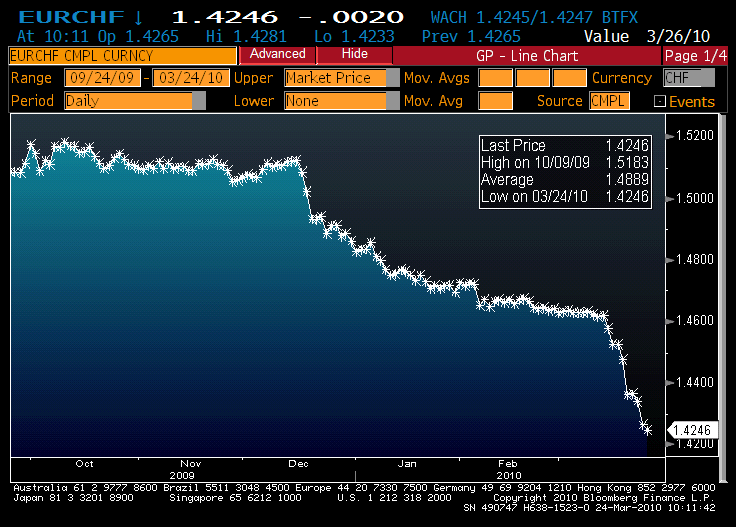
Most currencies have remained within ranges and the most interesting currency pair is EUR/CHF having failed to react to verbal warnings from the Swiss National Bank (SNB) about excessive CHF strength. EUR/CHF looks vulnerable to a further decline unless the SNB follows up rhetoric with action. Even if there is FX intervention by the SNB it may prove to be a temporary barrier to a market with an eye on the psychologically important 1.4000 level.

Despite the pressure on the Japanese government and Bank of Japan (BoJ) to engineer a weaker JPY, export performance has proven resilient, with exports jumping 45.3% on the year in February, helped by the strength of demand from Asia. Unfortunately this is doing little to end Japan’s deflation problem and even if there is less urgency for a weaker JPY to boost exports, JPY weakness will certainly help to reduce deflationary pressures in the economy. USD/JPY is stubbornly clinging to the 90.00 level, with little inclination to move in either direction.
Post US Jobs Data FX Outlook

The massive upside surprise to US payrolls could prove to be a significant indicator for the USDs fortunes in the months ahead.  To summarize, payrolls dropped by 11k, much less than expected. Net revisions totaled +148k, the workweek rose and the unemployment rate fell to 10%, also better than forecast and likely a surprise to the US administration who hinted at a rise in the unemployment rate.

Equity and bond market reaction was as would be expected; equities rallied and bonds sold off.  Gold prices dropped sharply too.  However, and this is what was most interesting, the dollar strengthened. Why is this odd? Well, over the past 9 months any news that would have been perceived as positive for risk appetite was associated with dollar weakness.  This reaction clearly did not take place following the jobs data. 

It’s worth noting that going into the payrolls data markets were very short USDs as reflected in the CFTC Commitment of Traders IMM data which revealed the biggest aggregate net short USD position since 25 March 2008. The bounce in the USD could have reflected a strong degree of short covering especially against the JPY where net long JPY positions had jumped to close to its all time high.  Going into year end expect to see more position adjustment, perhaps indicating a return of the JPY funded carry trade is back on the cards.

The dollar’s reaction to the payrolls data was reminiscent of its pre-crisis relationship of buying dollars in anticipation of a more aggressive path for US interest rates and indeed markets brought forward expectations of higher rates following the data.  It is probably too early to believe that the dollar’s movements are once again a function of interest rate differentials but it is a taste of things to come. In any case, markets will be able to garner further clues from a speech by Fed Chairman Bernanke today.

The post payrolls dollar reaction could have also reflected the fact that EUR/USD failed to break above the 1.5145 high over the week resulting in a capitulation of stale long positions, especially as the move towards reducing liquidity provision by the ECB also failed to push the EUR higher. If the S&P 500 stays above 1100 EUR/USD could retrace higher for the most part a broad 1.48-1.51 range is likely to dominate over the week.  Nonetheless, a break below 1.4820 could provoke an accelerated stop loss fuelled drop in EUR/USD.  ECB President Trichet speaks today and may reiterate that the ECB’s measures to begin scaling back its liquidity provision should not be taken as a step towards monetary tightening.

USD/JPY proved interesting last week pushing higher in the wake of strong rhetoric by the Japanese authorities threatening intervention to prevent JPY strength. The BoJ’s attempt to provide more liquidity to banks also helped on the margin to weaker the JPY but the impact of the move is likely to prove limited. Nonetheless, exporters and Japanese officials may be more relaxed this week, if USD/JPY can hold above 90.00.  However, a likely sharp revision lower to Japanese Q3 GDP tomorrow will help maintain calls for a weaker JPY.

Buffer for risk trades

Firmer data, most recently in the form of the stronger than expected US consumer confidence and dovish Fed comments as reiterated in the Fed FOMC minutes will provide a buffer for risk trades, supporting the USDs role as the prime funding currency over coming weeks.  Nonetheless, any improvement in sentiment will have to push against the weight of position adjustment into year-end as investors book profits on risk trades.  The net effect could be an increase in volatility especially in thinning liquidity expected in the wake of holidays in Japan and the Thanksgiving holiday in the US.

This could make it difficult for many asset markets to sustain key psychological and technical levels.  Whether the S&P 500 can hold gains above 1100 could prove significant as could EUR/USD’s ability to hold onto gains above 1.50.  The expiry of last week’s EUR/USD 1.48/1.51 option may provoke a move out of its range but there seems to be little appetite for a sustained break above the 23rd October high around 1.5061.  Even so, an upside bias is more likely given the likely softer tone to the USD. EUR/USD looks well supported around 1.4865.

Position adjustment towards the end of the year has been particularly evident in FX markets.  For instance, the latest CFTC Commitment of Traders’ data revealed that speculative investors have sharply reduced net long EUR positions into last week whilst there was a significant degree of short covering of GBP positions.  It is worth noting however, that aggregate USD net short speculative positions actually increased, largely due to a sharp jump in net JPY positioning, suggesting that overall sentiment for the USD remains very negative.

It is difficult to see a strong reversal in USD sentiment into year-end and the Fed’s commitment to maintaining interest rates at a low-level for an “extended period” taken together with hints of extending asset purchase programmes suggests little support to the USD over the short-term unless there is a more significant increase in risk aversion and or profit taking/book closing into year-end.  It seems that the impact of improved risk appetite is winning for now, giving no respite to the USD.

Contrasting the ECB with the Fed

Whether its year end book closing/profit taking and/or renewed doubts about the shape of recovery, asset markets have turned south recently.  Investor mood appears to be souring as risk aversion creeps back into the market psyche.  A string of disappointing US data releases over the last week including core retail sales, Empire manufacturing, industrial production, and housing starts, contributed to the reduced appetite for risk, resulting in a soft finish to the week for equity markets and a firmer USD.

Things are likely to take a turn for the better this week, however. Data will shed a little more light on the pace and magnitude of economic recovery and could result in some improvement in appetite for risk trades.  Despite an expected downward revision to US Q3 GDP, forward looking data on home sales, durable goods orders and personal income and spending as well as consumer confidence are likely to reveal increases.  In the Eurozone, data economic releases will paint a similar picture, including an expected increase in the closely watched barometer of business confidence, the German IFO survey. 

At the least economic data will remove some, but by no means all doubts about a relapse in the recovery process.  There is no doubting the veracity of the recovery in equity and commodity prices, despite doubts about its sustainability. Central banks may not react uniformly to this and the policy impact could vary significantly.  Already it appears that the ECB is moving more quickly towards an exit strategy compared to the Fed.  Although ECB President Trichet highlighted that the crisis is far from over at the end of last week, the Bank announced tougher standards for asset backed securities used as collateral, indicating that the need to provide emergency support to banks is much lower than it was. 

Clearly the ECB wants to avoid letting the market become over dependent on the central bank and will look to implement measures to this aim.  In contrast, the Fed is showing little sign of beginning this process and at least one member of the FOMC, namely St. Louis Fed President Bullard, was quoted over the weekend advocating that the Fed keep its MBS buying programme beyond its scheduled close in March. Evidence of the contrasting stance is also reflected in the fact that the Fed’s balance sheet is expanding once again whilst the ECB’s is contracting.  As a result of firmer data and comments by Bullard the USD is set to go into the week under renewed pressure, albeit within well defined ranges.

US rates “low for long”

Risk appetite is failing to show much improvement this week and sharply weaker than forecast US housing data dampened sentiment further following other soft data over recent days including the Empire manufacturing survey, industrial production and retail sales less autos. The data will add to concerns about the pace and magnitude of growth in the months ahead.

A sub-par recovery and benign inflation outlook are the two main reasons why the Fed will not hike rates for a long while yet. This was echoed by St. Louis Fed President Bullard – a voting member of the FOMC – who gave a little more colour on the Fed’s “extended period” statement. He highlighted the probability that US interest rates will not be raised until the first half of 2012.

Bullard noted that following the past two recessions the Fed did not raise rates until two and half to three years after recession ended. This is accurate given that in 2001 the Fed did not begin to hike rates until around 2 ½ years after the end of the recession whilst in 1990-91 rates did not go up until close to 3 years after recession ended. This recession just passed was arguably worse than both of the past two, so why should rates rise any earlier?

One factor that could trigger an earlier rate hike is the risks from the massive global liquidity fuelled carry trade fuelled by Fed policy. Bullard highlighted that the risks of creating an asset bubble from keeping rates “too low for too long” may prompt an earlier tightening. What will be important is that the Fed gets the exit strategy right and the risk that delaying any reduction in the Fed’s balance sheet and asset purchases could turn out to be inflationary which in turn would be negative for the USD and hit confidence in US assets.

The Fed is very likely to adjust the level of quantitative easing well before contemplating raising interest rates. The market is pricing in around 50bps of rate hikes in the next 12 months but even this looks to aggressive and as has been the case of recent months the market is likely to push back the timing of expected rate hikes. The consequences for the USD are negative at least until the market becomes more aggressive in pricing in US interest rate hikes or believes the Fed is serious about its exit strategy.