Pressure, panic and carnage

Pressure, panic and carnage doesn’t even begin to describe the volatility and movements in markets last week. If worries about global economic growth and the eurozone debt crisis were not enough to roil markets the downgrade of the US sovereign credit rating after the market close on Friday sets the background for a very shaky coming few days. All of this at a time when many top policy makers are on holiday and market liquidity has thinned over the summer holiday period.

The downgrade of US credit ratings from the top AAA rating should not be entirely surprising. After all, S&P have warned of a possible downgrade for months and the smaller than hoped for $2.1 trillion planned cuts in the US fiscal deficit effectively opened the door for a ratings downgrade. Some solace will come from the fact that the other two main ratings agencies Moody’s and Fitch have so far maintained the top tier rating for the US although Fitch will make it’s decision by the end of the month.

Comparisons to 2008 are being made but there is a clear difference time this time around. While in 2008 policy makers were able to switch on the monetary and fiscal taps the ammunition has all but finished. The room for more government spending in western economies has now been totally used up while interest rates are already at rock bottom. Admittedly the US Federal Reserve could embark on another round of asset purchases but the efficacy of more quantitative easing is arguably very limited.

Confidence is shattered so what can be done to turn things around? European policy makers had hoped that their agreement to provide a second bailout for Greece and beef up the EFSF bailout fund would have stemmed the bleeding but given the failure to prevent the spreading of contagion to Italy and Spain it is difficult to see what else they can do to stem the crisis.

Current attempts can be likened to sticking a plaster on a grevious wound. Although I still do not believe that the eurozone will fall apart (more for political rather than economic reasons) eventually there may have to be sizeable fiscal transfers from the richer countries to the more highly indebted eurozone countries otherwise the whole of the region will be dragged even further down.

Where does this leave FX markets? The USD will probably take a hit on the US credit ratings downgrade but I suspect that risk aversion will play a strong counter-balancing role, limiting any USD fallout. I also don’t believe that there will be a major impact on US Treasury yields which if anything may drop further given growth worries and elevated risk aversion. It is difficult for EUR to take advantage of the USDs woes given that it has its own problems to deal with.

Despite last week’s actions by the Swiss and Japanese authorities to weaken their respective currencies, CHF and JPY will remain in strong demand. Any attempt to weaken these currencies is doomed to failure at a time when risk aversion remains highly elevated, a factor that is highly supportive for such safe haven currencies. From a medium term perspective both currencies are a sell but I wouldn’t initiate short positions just yet.
Contest of the uglies

Although there is plenty of event risk in the form of the Greek confidence motion today market sentiment has taken a turn for the better as a ‘risk on’ mood has filtered through. There was little justification in the turn in sentiment aside from some reassuring comments from the EU’s Juncker but clearly markets are hoping for the best.

The contest of the ugly currencies continues and recently the EUR is running neck and neck with the USD. News that a final decision on a further tranche of aid for Greece and a second bailout package will not take place until early July was not digested well by European markets, although EUR/USD managed to show its resilience once again overnight.

EUR/USD looks like it will settle into a range over the short-term, with support around the 100 day moving average of 1.4170 and resistance around the 15 June high of 1.4451. A weak German June ZEW investor confidence survey may result in the EUR facing some resistance but the data is likely to be overshadowed by events in Greece.

Although Greece continues to dominate the headlines, the looming Fed FOMC meeting and press briefing tomorrow may just keep USD bulls in check especially given the likelihood of downward growth revisions by the Fed and no change in policy settings. Ahead of this news on the housing market is likely to remain bleak, with a likely drop in May existing home sales as indicated by pending home sales data.

USD/JPY continues to flirt with the 80 level but as yet it has failed to sustain a breach below this level. Contrary to speculation the JPY is not particularly reactive to risk aversion at present but instead continues to be driven higher by narrowing US – Japan bond yield differentials. This is pretty much all due to declining US Treasury yields rather than any increase in Japanese bond (JGB) yields.

However, while Japanese officials continue to back off the idea of FX intervention, even at current levels, data releases such as the May trade balance yesterday continue to build a strong case for weakening the JPY. Even economy minister Yosano sounded worried on the trade front in his comments yesterday. Despite such concerns, it will take a renewed widening in bond yield differentials to result in renewed JPY weakness which will need an improvement in US data to be forthcoming.

US Ratings Under Threat

The USD succumbed to further pressure overnight as Moody’s Investor Service threatened to place the US Aaa rating on review for downgrade if there is no agreement reached on raising the US debt ceiling. Although the news prompted a rise in US Treasury yields it did little for the USD.

News that the Federal Reserve’s balance sheet expanded to a record $2.772 trillion in the week ending June 1 highlights the ongoing headwinds to the USD from Fed asset purchases. The fact that there is even talk of QE3 in the wake of weak US data suggests that the headwinds will not dissipate quickly.

Direction today will come from the US May jobs report though this is unlikely to deliver any good news for the USD. Forecasts for non-farm payrolls have likely been revised lower to sub 100k compared to the published consensus forecast of 165k following the weaker indications from the May ADP jobs report and ISM data this week. A weak payrolls outcome will only intensify worries about the depth and length of the US ‘soft patch’.

Although market expectations are also likely to have been downwardly revised, something that may cushion the blow to the USD, it will be difficult to get away from the fact that growth in Q2 is weaker than many had thought.

EUR was well supported overnight, boosted by a relatively successful Spanish bond auction yesterday and reports that officials have agreed in principle to a 3-year adjustment plan for Greece covering funding needs to 2013 although there was no confirmation of such an agreement.

As a result, EUR/USD tested 1.45 and looks supported ahead of today’s US payrolls data. EUR’s recovery in general has been impressive but gains above 1.45 are likely to prove more difficult even if an agreement on Greece is close to being achieved.

As usual Japan’s political gyrations are having little impact on the JPY as the currency is instead buffeted by risk aversion swings and yield differentials. In fact USD/JPY has been rather well behaved over recent weeks as indicated by implied options volatility.

Prime Minister Kan’s success in winning a no-confidence motion came at a cost and may provide very little political stability. Kan said will resign as soon as post-earthquake recovery efforts are completed and once he is gone there is likely to be some realignment of existing political parties.

As for the JPY it will remain unscathed by political events. Over the near term USD/JPY is likely to cling to the 81 handle but we maintain our bearish view on the JPY in the medium term under the assumption that there is a sharp widening in US – Japan bond yield differentials.

US Economic Data Disappointments

Risk gyrations continue, with a sharp shift back into risk off mood for markets driven in large part by yet more disappointing US economic data as the May ADP jobs report came in far weaker than expected at 38k whilst the ISM manufacturing index dropped to 53.5 in May, its lowest reading since September 2009. This was echoed globally as manufacturing purchasing managers indices (PMI) softened, raising concerns that the global ‘soft patch’ will extend deeper and longer than predicted.

The market mood was further darkened by news that Moodys downgraded Greece’s sovereign credit ratings to Caa1 from B1, putting the country on par with Cuba and effectively predicting a 50% probability of default.

The resultant jump in risk aversion was pretty extensive, with US Treasury yields dipping further, commodity prices dropping led by soft commodities, and equity volatility spiking although notably implied currency volatility has remained relatively well behaved.

Global growth worries led by the US have now surpassed Greek and eurozone peripheral country concerns as the main driver of risk aversion, especially as it increasingly looks as though agreement on a further bailout package for Greece is moving closer to being achieved. Moreover, it seems as though a ‘Vienna initiative’ type of plan is moving towards fruition involving a voluntary rollover of debt.

The lack of first tier economic data releases today suggests that it will be a case of further digestion or perhaps indigestion of the weak run of US data releases over recent weeks and the implications for policy. For instance, it is no coincidence that QE3 is now being talked about again following the end of QE2 although it still seems very unlikely.

Bonds may see some respite from the recent rally given the lack of data today although this may prove short-lived as expectations for the May US jobs report tomorrow are likely to have been revised sharply lower in the wake of the weak ADP jobs data and ISM survey yesterday, with an outcome sub 100k now likely for May US non-farm payrolls.

Meanwhile, FX markets are caught between the conflicting forces of higher risk aversion and weaker US data, leaving ranges to dominate. On balance, risk currencies will likely remain under pressure today and the USD may get a semblance of support in the current environment.

This may be sufficient to prevent EUR/USD from retesting its 1 June high around 1.4459 as markets wait for further developments on the Greek front. Once again the likes of the CHF and to a lesser extent JPY will do well in a risk off environment whilst the likes of the AUD and NZD will suffer.

USD Pressured As Yields Dip

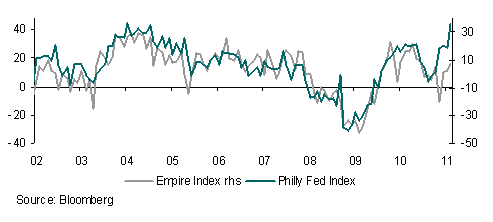
The USD came under pressure despite a higher than forecast reading for January US CPI and a strong jump in the February Philly Fed manufacturing survey. On the flip side, an increase in weekly jobless claims dented sentiment. The overnight rally in US Treasury yields was a factor likely weighing on the USD. The US calendar is light today leaving markets to focus on the G20 meeting and to ponder next week’s releases including durable goods orders, existing and new home sales.

The jump in the European Central Bank (ECB) marginal facility borrowing to EUR 15 billion, its highest since June 2009, provoked some jitters about potential problems in one or more eurozone banks. At a time when there are already plenty of nerves surrounding the fate of WestLB and news that Moody’s is reviewing another German bank for possible downgrade, this adds to an already nervous environment for the EUR.

Nonetheless, EUR/USD appears to be fighting off such concerns, with strong buying interest on dips around 1.3550. The G20 meeting under France’s presidency is unlikely to have any direct impact on the EUR or other currencies for that matter, with a G20 source stating that the usual statement about “excess volatility and disorderly movements in FX” will be omitted.

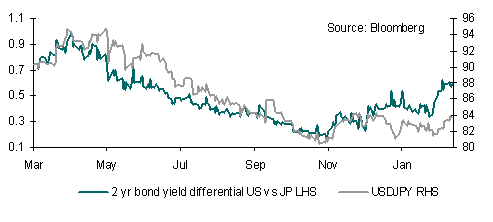
Although USD/JPY has been a highly sensitive currency pair to differentials between 2-year US and Japanese bonds (JGBs), this sensitivity has all but collapsed over recent weeks. USD/JPY failed to break the 84.00 level, coming close this week. There appears to be little scope to break the current range ahead of next week’s trade data and CPI.

Given the recent loss in momentum of Japan’s exports the data will be instructive on how damaging the strength of the JPY on the economy. In the near term, escalating tensions in the Middle East will likely keep the JPY supported, with support around USD/JPY 83.09 on the cards.

It seems that the jump in UK CPI this week (to 4.0%) provoked even more hawkish comments than usual from the Bank of England BoE’s Sentance, with the MPC member stating that the Quarterly Inflation Report understates the upside risks to inflation indicating that interest rates need to rise more quickly and by more than expected. Specifically on GBP he warned that the Bank should not be relaxed about its value.

Although these comments should not be particularly surprising from a known hawk, they may just help to underpin GBP ahead of the January retail sales report. Expectations for a rebound in sales following a weather related drop in the previous month will likely help prop up GBP, with GBP/USD resistance seen around 1.6279.