Risk Aversion Back With A Vengeance

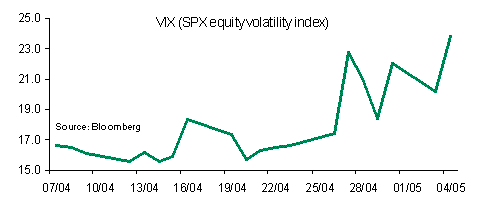
Risk aversion is back with a vengeance as reflected in the rise in equity volatility (VIX), drop in equity markets and rally in US Treasuries.  European peripheral debt markets sold off despite the EU/IMF aid package for Greece, whilst EUR/USD slid below 1.3000.  Various rumours dealt a blow to markets including talk of a sovereign ratings downgrade and a EUR 280 billion bailout for Spain.   The message is clear.  This situation is becoming increasingly dire by the day.  Europe is in big trouble and the whole euro project is under threat of unravelling.  
Concerns about parliamentary approvals, implementation/execution risk, prospects for relatively weaker growth in Europe, as well as contagion to Spain and Portugal, has tempered any enthusiasm towards the EU/IMF bailout package.  In addition, despite the large size of the EUR 110 billion loan package there are growing worries that it will be insufficient to cover Greece’s funding requirements over the next three years.  All of this implies that the EUR will remain under pressure for some time yet.  I have previously spoken about a drop to around EUR/USD 1.25 but the risk is for a much sharper decline is growing.

The USD is the clear winner, spiking to its highest level since May 2009 and is looking well set to consolidate its gains over the short-term despite the fact that net aggregate USD speculative positioning has already reached its highest level since September 2008 (according to the CFTC Commitment of Traders IMM data) in contrast to EUR positioning, which is at a record low.  This is unlikely to stand in the way of further downside for EUR/USD, with the next technical support level seen at 1.2885, which would match the previous lows see in April 2009.

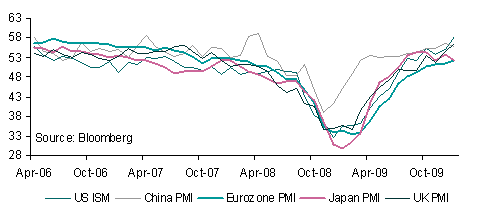
A combination of worries including contagion to Spain and Portugal, policy tightening in China, debt concerns in the UK and Japan, all threaten to undo the positive message from recent positive economic data including further strengthening in Purchasing Managers Indices globally.   The immediate attention remains on Greece and growing scepticism about the ability of Greece to carry out austerity measures in the face of rising domestic opposition, including a nationwide strike today. 
The rout in US and European markets will spill over to Asia, putting equity markets and Asian currencies under pressure.  Another risk currency to suffer is the AUD, which has dropped sharply following the Reserve Bank of Australia (RBA) meeting, in which the Bank indicated that rates were close to peaking.  Speculative positioning has dropped for the past two weeks as longs are taken off but AUD/USD weakness is set to be temporary, with buyers likely to emerge around near term support seen around 0.9001.

Shaking Off The Bad News

Markets managed to shake off the initial shock of the SEC’s fraud case against Goldman Sachs following news that the charge was not approved unanimously, but with a 3-2 vote. This was interpreted by some to imply that there was more of a political rather than economic bias behind the charge, with two Democrats voting for and two Republicans voting against and SEC Chairman Schapiro siding with the Democrats.

Stronger than forecast earnings from Citigroup and a bigger than expected 1.4% jump in US March leading indicators also helped to calm market nerves, with US equities closing higher and the VIX volatility index reversing some of its spike higher. Attention is still firmly fixed on earnings and with 121 S&P 500 companies due to release earnings this week including Apple, Goldman Sachs, Johnson & Johnson and Yahoo today.

Nonetheless, it is difficult to see sentiment improve too much against the background of ongoing worries about Greece as reflected in the renewed widening in Greek debt spreads yesterday. Moreover, the negative economic impact of the spread of volcanic ash from Iceland, and potential for more lawsuits related to CDOs from regulators as well as investors, against banks, will continue to act as a drag on market risk appetite.

Earnings have been positive so far into the season and as seen overnight, this is helping to counter market negatives, giving risk appetite some support. In turn, this will give risk currencies some relief but given the gyrations between positive and negative news it is difficult to see most currencies breaking out of recent ranges.

My overall bias is for positive earnings and data to overcome the negatives this week, leaving the likes of the AUD, NZD and CAD as well Asian currencies firmer. The EUR and GBP are likely to remain the weakest links, with both currencies set to retrace lower and EUR/USD finding plenty of sellers above 1.3500.

Respite for the dollar

Markets are increasingly discounting stronger than expected Q3 earnings.  Further gains in equities and risk appetite may be harder to achieve even if profits continue to be beat expectations, which so far around 80% of Q3 earnings have managed to do. Measures of risk such as the VIX “fear gauge” have highlighted an increasingly risk averse environment into this week.  The negative market tone could continue in the short term.

The USD has found some tentative relief, helped by the drop in equities and profit taking on risk trades.  The fact that the market had become increasingly short USDs as reflected in the latest CFTC Commitment of Traders’ (IMM) report in which aggregate short USD positions increased in the latest week (short USD positions numbered roughly twice the number of long positions), has given plenty of scope for some short covering this week.

The USD has even managed quite convincingly to shake off yet another article on the diversification of USD reserves in China.  The USD index looks set to consolidate its gains over the short term against the background of an up tick in risk aversion.  The USD index will likely remain supported ahead of the main US release this week, Q3 GDP on Thursday, but any rally in the USD is unlikely to be sustainable and will only provide better levels to short the currency.

Given the broad based nature of the reversal in risk sentiment with not only equities dropping but commodities sliding too, it suggests that high beta currencies, those with the highest sensitivity to risk will suffer in the short term.  These include in order of correlation with the VIX index over the past month, from the most to the least sensitive, MXN, AUD, MYR, SGD, NOK, EUR, CAD, INR, ZAR, BRL, TRY and NZD. The main beneficiary according to recent correlation is the USD.

EUR sentiment in particular appears to be weakening at least on the margin as reflected in the latest IMM report which revealed that net long EUR speculative positions have fallen to their lowest level in 6-weeks.  Whether this is due to profit taking as EUR/USD hit 1.50 or realisation that the currency appeared to have gone too far too quickly, the EUR stands on shakier ground this week.  EUR/USD may pull back to near term technical support around 1.4840 and then 1.4725 before long positions are re-established.

Catching up with reality

Markets have had an exhilarating run up over recent weeks.  Since the start of the month the S&P 500 has risen by close to 7%,gaining around 58% from its March low, as the evidence of global economic turnaround has strengthened and the outlook for earnings improved.

Nonetheless, the rally in equities has meant that valuations are starting to look stretched again. For instance the price / earnings ratio on the S&P 500 has risen to its highest level since January 2004, perhaps hinting at the need for a degree of investor caution in the days and weeks ahead.

Other factors aside from the pace of the move also call for some restraint to market optimism such as the potential for escalation in trade tensions between the US and China, the imposition of regulations on banks and the timing of reversal of extreme stimulus measures. 

As the panic has left markets over recent months volatility has eased as reflected in the VIX index which has dropped to around its lowest level since September 2008, just before it spiked massively higher in a matter of weeks in the wake of the Lehman’s blow up. 

This has been almost perfectly echoed in the move in currency volatility, which has dropped to around the levels last seen a year ago for major currencies.  These levels are not quite pre-crisis levels but for the most part pre-date the collapse of Lehman Brothers, reversing almost all the spike in risk aversion that took place from a year ago. 

It is probably not too much of a stretch to state that having expunged the shock of Lehmans and the worst fears about the global economy from measures of risk and volatility the room for further improvements may be somewhat more limited.  This may be countered by the fact that economic data continues to deliver positive surprises relative to consensus, providing fuel for a further rally in risk appetite. 

However, a lot of good news must surely be in the price by now and it is likely that even the most bearish of forecasters has to acknowledge that an upswing in activity is underway. This ought to ensure that consensus forecasts catch up with reality, leaving less room for positive surprises and perversely less support for equity markets. 

The rally in risk appetite and equity markets has taken its toll on the US dollar which has had a gruelling few weeks during which the US dollar index (a basket of currencies versus USD including EUR, JPY, GBP, CAD, SEK and CHF) has hit new lows almost on daily basis.  Any pause in dollar selling driven by a softer tone to equities is likely to provide better opportunities for investors to take short positions in the currency given that little else has changed in terms of USD sentiment.   How far can the dollar drop?  Well for a start the April 2008 low around 71.329 for the USD index beckons and after that its into uncharted territory.

The best funding currency

The dollar was beaten up over the past week, finally breaking through some key levels against many major currencies; the dollar index touched 76.457, the lowest since September 25, 2008.  The usual explanation for dollar weakness over recent months has been an improvement in risk appetite.  However, this explanation fails to adequately explain the drop in the currency over recent days.   

Although we have seen a multi month trend of improving risk appetite it is not clear that there was any further improvement last week.  On the one hand the ongoing rise in equity markets points to a continued improvement in risk appetite; the S&P 500 recorded its biggest weekly gain since July.  Equity volatility has also declined, reflected by the decline in the VIX index.   

On the other hand, other indicators reveal a different picture.  The ultimate safe haven and inflation hedge, namely gold, registered further gains above $1000 per troy ounce. That other safe haven, US Treasuries underwent the strongest demand in almost 2 years (bid-cover ratio 2.92) for the $12 billion 30-year note auction, whilst the earlier 10 year note auction also saw solid demand (bid-cover ratio 2.77) as well as strong interest from foreign investors.  

The massive increase in bond issuance to fund the burgeoning fiscal deficit continues to be well absorbed by the market for now, whilst the drop in the dollar does not appear to be putting foreign investors off US assets.  The strong demand for Treasuries could reflect a lack of inflation concerns but may also reflect worries about recovery, quite a contrast to the move in equities.

The fact that the Japanese yen and Swiss franc strengthened against the dollar also contrasts with the view that risk appetite is improving.  The yen was the biggest beneficiary currency during the economic and financial crisis but has continued to strengthen even as risk appetite improves.  USD/JPY dropped close to the psychologically important level of 90 last week which actually indicates a drop in risk appetite.  Perhaps the move is more of an indication of general dollar pressure rather than yen strength.  

A likely explanation for the drop in the dollar is that it is increasingly becoming a favoured funding currency, taking over the mantle from the Japanese yen; investors borrow dollars and then use it to take short positions against higher yielding currencies.  US dollar 3-month libor rates fell below those of the yen and Swiss franc for the first time since November, effectively making the dollar the cheapest funding currency and fuelling broad based weakness in the currency.

Although the historically strong relationship between currencies and interest rates has yet to establish itself to a significant degree, ultra low interest rates suggests that the dollar will remain under pressure for a while yet, especially as the Fed continues to highlight that US interest rates are not going to go up in a hurry.