Emerging market currencies under pressure

One of the key factors that have provoked the current bout higher risk aversion was the sub-50 Chinese manufacturing confidence gauge (PMI) which has intensified concerns about slowing growth . Additionally reports regulators in China have issued warnings about credit to the coal industry has reinforced debt fears in the country.

Domestic fundamental and political pressures in other currencies have contributed to the malaise in emerging markets, with a major drop in the Argentine peso and pressure on many other high beta emerging market currencies (including the usual suspects Turkish lira, South African rand and Indian rupee).

A deteriorating outlook for many emerging markets currencies based on concerns about the impact of Fed tapering and slowing emerging markets growth appears to be increasingly intensifying. Competition for capital as the Fed tapers will make things worse. The pressure is unlikely to ease quickly leaving many EM currencies vulnerable to a further sell off.

Bracing for a world without steroids

The sell off of risk assets in the wake of the Fed’s surprisingly direct FOMC communication continues unabated. Hopes that Fed chief Bernanke would attempt to assuage market concerns about tapering have been blown apart and instead the reality of forthcoming tapering continues to bite leading to higher US yields, weaker stocks and commodities and a firmer USD. In fact the USD appears to have finally re-established its positive relationship with yields and risk aversion.

The situation hasn’t been helped by the fact that data out of China has disappointed while local money market rates had risen sharply this week. Separately Japan’s reform momentum appears to have stalled ahead of Upper House elections as Prime Minister Abe’s third arrow missed target.

In combination these factors mean that markets are bracing for the day that they no longer have steroid injections to keep them going. Instead fundamentals will become important to sustain gains in risk assets. Why should anyone be surprised? US growth is recovering and at some point tapering has to occur. Unfortunately risk assets were just not ready for this revelation.

Ongoing volatility and uncertainty is likely to persist over the coming weeks as markets transition to an environment of Fed tapering, but this will give way to a renewed improvement in risk appetite and lower volatility later in the year.

The USD index continued to rise overnight having corrected around a third of its losses since 22 May. Gains remain broad based with gains registered against major and emerging market currencies. US Treasury yield differentials with other countries continue to widen across the board leaving the USD in strong form (10 year Treasury yield has risen by close to 80 basis points since early May).

Going forward firmer US data, taken together with higher US yields, will continue to drive the USD higher against major currencies, while some improvement in risk appetite as investors become accustomed to the prospects of Fed tapering will allow emerging market currencies to recover some, but not all lost ground against the USD.

Many currencies have become highly sensitive to US yields, with the TRY, NZD and INR the most sensitive over the past three months although notably most Asian currencies are near the top in terms of sensitivities.

Against this background unsurprisingly Asia continues to register capital outflows. All Asian countries have registered capital outflows this month, with total equity outflows of $10.2 billion registered, led by South Korea and Taiwan. Obviously the bigger concern is for deficit countries including India and Indonesia, with their currencies remaining particularly vulnerable to capital outflows.

Recent market volatility has meant that the prospects of Japanese investors stepping up their outflows have diminished over the near term. The latest data released yesterday showed that Japanese investors repatriated capital for a fifth straight week.

It is only a matter of time before outflows pick up as risk appetite improves as US yields move higher. The US 10Y Treasury yield advantage has widened versus Japanese JGBs to around 153bp and I expect this to widen further to around 185bp by the end of 2013. This will be consistent with a renewed slide in the JPY versus USD.

Fed does the Twist, markets do the Shake

Although it was widely expected the Federal Reserve’s decision to implement a fresh version of Operation Twist together with a downbeat assessment of the economy came as a disappointment to equities and risk assets in general. The only surprise was the larger size of the operation at $400 billion.

Moody’s downgrade of three US banks added to the malaise as US equities dropped sharply, commodities slid, longer term Treasuries rallied whilst shorter term bonds dropped. The USD registered broad gains both on the back of the fact that no more quantitative easing was announced and due to a shift away from risk assets. At least there was no more negative news out of the eurozone as talks between the Troika (ECB, IMF, EC) and Greek officials continue on the next tranche of the bailout.

Markets will continue to digest the Fed’s outcome today and the negative tone will likely filter through markets today. There is little on the data front to result in a shift in this tone. In the US data includes weekly jobless claims while in Europe attention will be on manufacturing and service sector confidence measures.

While the potential for a positive outcome to talks in Greece may provide a short term boost to sentiment the overwhelming tone is likely to remain negative especially as Operation Twist is unlikely to change the dynamic of a weak growth trajectory for the US and developed economies over the coming months. Against this background, selling risk assets on rallies remains the preferred option.

The USD will continue to look firmest against high beta emerging market currencies in the current environment. Currencies in this group are those that have the highest correlations with risk (as m measured by my in house risk barometer) over the past 3 months including CAD, ZAR, TRY, INR, MXN, ARS & RUB. In contrast currencies that also have high correlations but actually strengthen as risk aversion increases are CNY and JPY.

US Dollar On The Rise

There are plenty of US releases on tap this week but perhaps the most important for the USD will be the minutes of the April 26-27 Fed FOMC meeting. Taken together with speeches by Fed officials including Bernanke, FX markets will attempt to gauge clues to Fed policy post the end of QE2. The Fed’s stance at this point will be the major determinant of whether the USD can sustain its rally over the medium term. The lack of back up in US bond yields suggests that USD momentum could slow, with markets likely to move into wide ranges over coming weeks.

It is worth considering which currencies will suffer more in the event that the USD extends its gains. The correlation between the USD index and EUR/USD is extremely strong (even accounting for the fact that the EUR is a large part of the USD index) suggesting that the USDs gains are largely a result of the EUR’s woes. Aside from the EUR, GBP, AUD and CAD are the most sensitive major currencies to USD strength whilst many emerging market currencies including ZAR, TRY, SGD, KRW, THB, IDR, BRL and MXN, are all highly susceptible to the impact of a stronger USD.

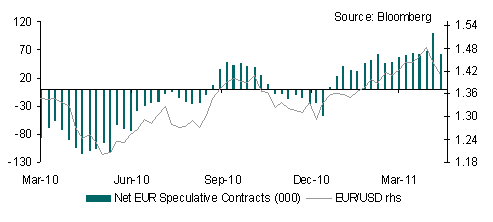
Robust Q1 GDP growth readings in both Germany and France helped to spur gains in the EUR but this proved short-lived. Sentiment for the currency has soured and as reflected in the CFTC IMM data long positions are being scaled back. Nonetheless, there is still plenty of scope for more EUR selling given ongoing worries about the eurozone periphery, which are finally taking their toll on the EUR. A break below EUR/USD 1.4021 would open the door for a test of 1.3980.

The eurogroup and ecofin meetings will be of interest to markets this week but any additional support for Greece is unlikely to be announced at this time. However, likely approval of Portugal’s bailout may alleviate some pressure on the EUR but any positive impetus will be limited. Even on the data front, markets will not be impressed with the German ZEW index of investor confidence likely to register a further decline in May.

Japanese officials have been shying away from further FX intervention by blaming the drop in USD/JPY over recent weeks on general USD weakness despite the move towards 80. However, this view is not really backed up by correlation analysis which shows that there is only a very low sensitivity of USD/JPY to general USD moves over recent months. One explanation for the strength of the JPY is strong flows of portfolio capital into Japan, with both bond and equity markets registering net inflows over the past four straight weeks.

This is not the only explanation, however. One of the main JPY drivers has been a narrowing in yield differentials. This is unlikely to persist with yield differentials set to widen sharply over coming months resulting in a sharply higher USD/JPY. As usual data releases are unlikely to have a big impact on the JPY this week but if anything, a further decline in consumer confidence, and a negative reading for Q1 GDP, will maintain the pressure for a weaker JPY and more aggressive Bank of Japan (BoJ) action although the BoJ is unlikely to shift policy this week.

Dubai’s aftermath

Dubai’s bolt out of the blue is hitting markets globally, with the aftershock made worse by the thin liquidity conditions in the wake of the US Thanksgiving holiday and Eid holidays in the Middle East.  The sell off followed news by government owned Dubai Holdings of a six month debt freeze.  Estimates of exposure to Dubai vary considerably, with European banks estimated to have around $40 billion in exposure though what part of this is at risk is another question. 

The lack of information surrounding the Dubai announcement made matters worse.  The aftermath is likely to continue to be felt over the short term, with further selling of risk assets likely.  Indeed, there is still a lot of uncertainty surrounding international exposure to Dubai or what risk there is to this exposure and until there is further clarity stocks look likely to face another drubbing.

The most sensitive currencies with risk aversion over the past month have been the JPY, and USD index, which benefit from rising risk aversion whilst on the other side of the coin, most Asian currencies especially the THB and KRW as well as the ZAR, and AUD look vulnerable to any rise in risk aversion.  JPY crosses look to be under most pressure, with the likes of AUD/JPY dropping sharply and these currencies are likely to drop further amidst rising risk aversion. 

The rise in the JPY has been particularly dramatic and has prompted a wave of comments from Japanese officials attempting to talk the JPY lower including comments by Finance Minister Fujii that he “will contact US and Europe on currencies if needed”.  So far, these comments have had little effect, with USD/JPY falling briefly through the key psychological level of 85.00, marking a major rally in the JPY from a high of 89.19 at the beginning of the week.  Unless markets believe there is a real threat of FX intervention by Japan the official comments will continue to be ignored.

It’s not all about risk aversion for the JPY, with interest rate differential playing a key role in the downward move in USD/JPY over recent weeks.  USD/JPY has had a high 0.79 correlation with interest rate differentials over the past month.  The US / Japan rate differential narrowed sharply (ie lower US rate premium to Japan) to just around 4.5bps from around 100bps at the beginning of August.  With both interest rate differentials and risk aversion playing for a stronger JPY the strong JPY bias is set to continue over the short term.

Is this the beginning of a new rout in global markets?  It is more likely another bump on the road to recovery, with the impact all the larger due to the surprise factor of Duba’s announcement as it was widely thought that Dubai was on the road to recovery.  The fact that the news took place on a US holiday made matters worse whilst the weight of long risk trades suggests an exaggerated fall out over the short term.