All Eyes On Jackson Hole

It’s all about Jackson Hole and ahead of the Fed symposium the USD index is likely to maintain its place in towards the middle end of its recent 73.47 – 75.12 range helped by weaker equity markets. Expectations or hopes that Fed Chairman Bernanke will announce or at least hint at a fresh round of quantitative easing have receded allowing the USD to escape further pressure. Bernanke will likely keep all options open but there are still some in the FOMC who do not want to embark on QE3.

Although the USD may be saved from a further drubbing the commitment to maintain exceptionally accommodative monetary policy through Q2 2013 has contributed to a relative reduction in US bond yields and in turn is acting to restrain the US currency. A likely revision lower to US Q2 GDP will not help the USD in this respect.

One currency in particular that is reactive to yield differentials is USD/JPY, which registers an impressively high correlation with US – Japan yield differentials. Attempts this week by the Japanese authorities to encourage capital outflows and a downgrade of Japan’s credit ratings by Moody’s have done little to weaken the JPY.

Even the usually bearish JPY Japanese margin traders have been scaling back their long USD/JPY positions over recent weeks while speculative investors remain overly long (well above the three-month average) JPY according to IMM data. The risk of a shake out of long JPY positions is high but unless yield differentials reverse renewed JPY weakening looks unlikely in the short-term.

Eurozone peripheral issues will be put on the backburner ahead of the Jackson Hole meeting but that doesn’t mean they have gone away. As the continued pressure on Greek bonds shows markets continue to be fixated on the country’s problems and there may be growing nervousness ahead of the decision to distribute the next IMF loan tranche at the end of September. Nervousness also extended to Germany, with ratings agencies having to confirm the country’s AAA rating.

So far this week EUR has shown impressive resilience despite weak data in the form the German August IFO business and ZEW investor confidence surveys. However, there is a risk of EUR weakness should Bernanke not hint at QE3, with the currency already trading around the bottom of its multi-day range.

AUD has failed to recoup its end July losses and is still some 5% below its high above 1.10 versus USD. There is scope for some AUD appreciation especially as AUD speculative positioning has dropped sharply over recent weeks reducing sharply the net long overhang in the currency.

Moreover, markets have become overly aggressive in pricing in interest rate cuts in Australia and as evidenced from the AUD bounce following RBA Governor Stevens comments this morning (in which he referred to inflation data as still being concerning) there is an asymmetric risk to the AUD on the upside.

Nonetheless, AUD has experienced an increase in sensitivity to risk over recent weeks and will continue to be driven by gyrations in risk appetite. In this respect it is too early to assume the worst is over, suggesting that any further gains in AUD will be limited.

Contest of the uglies

Although there is plenty of event risk in the form of the Greek confidence motion today market sentiment has taken a turn for the better as a ‘risk on’ mood has filtered through. There was little justification in the turn in sentiment aside from some reassuring comments from the EU’s Juncker but clearly markets are hoping for the best.

The contest of the ugly currencies continues and recently the EUR is running neck and neck with the USD. News that a final decision on a further tranche of aid for Greece and a second bailout package will not take place until early July was not digested well by European markets, although EUR/USD managed to show its resilience once again overnight.

EUR/USD looks like it will settle into a range over the short-term, with support around the 100 day moving average of 1.4170 and resistance around the 15 June high of 1.4451. A weak German June ZEW investor confidence survey may result in the EUR facing some resistance but the data is likely to be overshadowed by events in Greece.

Although Greece continues to dominate the headlines, the looming Fed FOMC meeting and press briefing tomorrow may just keep USD bulls in check especially given the likelihood of downward growth revisions by the Fed and no change in policy settings. Ahead of this news on the housing market is likely to remain bleak, with a likely drop in May existing home sales as indicated by pending home sales data.

USD/JPY continues to flirt with the 80 level but as yet it has failed to sustain a breach below this level. Contrary to speculation the JPY is not particularly reactive to risk aversion at present but instead continues to be driven higher by narrowing US – Japan bond yield differentials. This is pretty much all due to declining US Treasury yields rather than any increase in Japanese bond (JGB) yields.

However, while Japanese officials continue to back off the idea of FX intervention, even at current levels, data releases such as the May trade balance yesterday continue to build a strong case for weakening the JPY. Even economy minister Yosano sounded worried on the trade front in his comments yesterday. Despite such concerns, it will take a renewed widening in bond yield differentials to result in renewed JPY weakness which will need an improvement in US data to be forthcoming.

US Dollar On The Rise

There are plenty of US releases on tap this week but perhaps the most important for the USD will be the minutes of the April 26-27 Fed FOMC meeting. Taken together with speeches by Fed officials including Bernanke, FX markets will attempt to gauge clues to Fed policy post the end of QE2. The Fed’s stance at this point will be the major determinant of whether the USD can sustain its rally over the medium term. The lack of back up in US bond yields suggests that USD momentum could slow, with markets likely to move into wide ranges over coming weeks.

It is worth considering which currencies will suffer more in the event that the USD extends its gains. The correlation between the USD index and EUR/USD is extremely strong (even accounting for the fact that the EUR is a large part of the USD index) suggesting that the USDs gains are largely a result of the EUR’s woes. Aside from the EUR, GBP, AUD and CAD are the most sensitive major currencies to USD strength whilst many emerging market currencies including ZAR, TRY, SGD, KRW, THB, IDR, BRL and MXN, are all highly susceptible to the impact of a stronger USD.

Robust Q1 GDP growth readings in both Germany and France helped to spur gains in the EUR but this proved short-lived. Sentiment for the currency has soured and as reflected in the CFTC IMM data long positions are being scaled back. Nonetheless, there is still plenty of scope for more EUR selling given ongoing worries about the eurozone periphery, which are finally taking their toll on the EUR. A break below EUR/USD 1.4021 would open the door for a test of 1.3980.

The eurogroup and ecofin meetings will be of interest to markets this week but any additional support for Greece is unlikely to be announced at this time. However, likely approval of Portugal’s bailout may alleviate some pressure on the EUR but any positive impetus will be limited. Even on the data front, markets will not be impressed with the German ZEW index of investor confidence likely to register a further decline in May.

Japanese officials have been shying away from further FX intervention by blaming the drop in USD/JPY over recent weeks on general USD weakness despite the move towards 80. However, this view is not really backed up by correlation analysis which shows that there is only a very low sensitivity of USD/JPY to general USD moves over recent months. One explanation for the strength of the JPY is strong flows of portfolio capital into Japan, with both bond and equity markets registering net inflows over the past four straight weeks.

This is not the only explanation, however. One of the main JPY drivers has been a narrowing in yield differentials. This is unlikely to persist with yield differentials set to widen sharply over coming months resulting in a sharply higher USD/JPY. As usual data releases are unlikely to have a big impact on the JPY this week but if anything, a further decline in consumer confidence, and a negative reading for Q1 GDP, will maintain the pressure for a weaker JPY and more aggressive Bank of Japan (BoJ) action although the BoJ is unlikely to shift policy this week.

FX Winners and Losers

There has been a sense of mean reversion in FX markets so far this year as some of last year’s winners have become losers. Namely NZD, CHF, JPY and AUD have all lost ground whilst EUR and GBP have gained ground. The odd one out is the SEK which has strengthened over 2010 and in 2011 versus USD. I expect this pattern to change and the likely winners over the next 3- months are NZD, AUD and CAD, with CHF and JPY the likely losers.

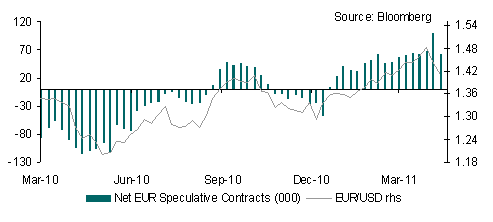
EUR held up reasonably well in the wake of slightly disappointing growth data, with eurozone GDP rising less than expected in Q4, and a smaller than expected gain in the February German ZEW investor confidence survey (economic sentiment component). My sense is that the net long EUR speculative position has already been pared back somewhat over recent days reducing the potential selling pressure on the currency in the near term.

Given that EUR/USD is one of the only major currency pairs being influenced by interest rate differentials, its direction will hinge more on policy expectations but in the near the announcement by the German Finance Minister this morning of a restructuring plan for WestLB may give the currency some support.

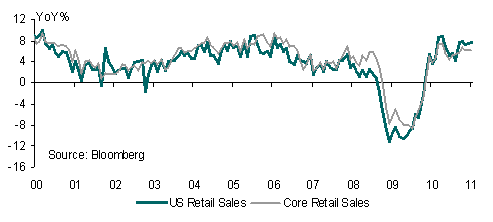
Perhaps one explanation for the stability of EUR/USD around the 1.3500 level is that US data was also disappointing yesterday. January retail sales rose less than forecast whilst revisions to back months suggest less momentum in Q4 consumer spending than previously envisaged. As with the eurozone data weather likely played a role in contributing to the outcome.

The net impact on currencies is that they are largely stuck within tight ranges. Further direction will come from the release of the Fed FOMC minutes for the January 26th meeting. The minutes may undermine the USD if a likely dovish slant continues to be expressed but given that the FOMC decision at that meeting to hold policy setting unchanged had no dissenters this should not come as a surprise.

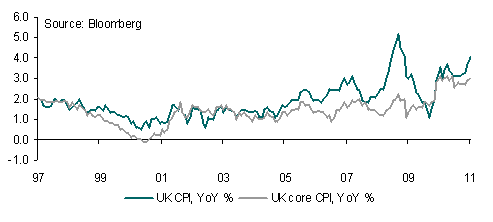
Whilst the battle between the USD and EUR ended in a stalemate GBP outperformed in the wake of the increase in UK January CPI inflation and in particular the letter from the BoE governor to the Chancellor keeping open the door to a rate hike. The Quarterly Inflation Report (QIR) today will be particularly important to determine whether the bounce in GBP is justified.

I remain hesitant to build on long GBP positions given the net long speculative overhang in the currency. The risks following yesterday’s jump in GBP are asymmetric, with a hawkish QIR likely to have less impact on the currency than the negative impact from a more dovish than expected report.

Econometer.org has been nominated in FXstreet.com’s Forex Best Awards 2011 in the “Best Fundamental Analysis” category. The survey is available at http://www.surveymonkey.com/s/fx_awards_2011