US Economic Data Disappointments

Risk gyrations continue, with a sharp shift back into risk off mood for markets driven in large part by yet more disappointing US economic data as the May ADP jobs report came in far weaker than expected at 38k whilst the ISM manufacturing index dropped to 53.5 in May, its lowest reading since September 2009. This was echoed globally as manufacturing purchasing managers indices (PMI) softened, raising concerns that the global ‘soft patch’ will extend deeper and longer than predicted.

The market mood was further darkened by news that Moodys downgraded Greece’s sovereign credit ratings to Caa1 from B1, putting the country on par with Cuba and effectively predicting a 50% probability of default.

The resultant jump in risk aversion was pretty extensive, with US Treasury yields dipping further, commodity prices dropping led by soft commodities, and equity volatility spiking although notably implied currency volatility has remained relatively well behaved.

Global growth worries led by the US have now surpassed Greek and eurozone peripheral country concerns as the main driver of risk aversion, especially as it increasingly looks as though agreement on a further bailout package for Greece is moving closer to being achieved. Moreover, it seems as though a ‘Vienna initiative’ type of plan is moving towards fruition involving a voluntary rollover of debt.

The lack of first tier economic data releases today suggests that it will be a case of further digestion or perhaps indigestion of the weak run of US data releases over recent weeks and the implications for policy. For instance, it is no coincidence that QE3 is now being talked about again following the end of QE2 although it still seems very unlikely.

Bonds may see some respite from the recent rally given the lack of data today although this may prove short-lived as expectations for the May US jobs report tomorrow are likely to have been revised sharply lower in the wake of the weak ADP jobs data and ISM survey yesterday, with an outcome sub 100k now likely for May US non-farm payrolls.

Meanwhile, FX markets are caught between the conflicting forces of higher risk aversion and weaker US data, leaving ranges to dominate. On balance, risk currencies will likely remain under pressure today and the USD may get a semblance of support in the current environment.

This may be sufficient to prevent EUR/USD from retesting its 1 June high around 1.4459 as markets wait for further developments on the Greek front. Once again the likes of the CHF and to a lesser extent JPY will do well in a risk off environment whilst the likes of the AUD and NZD will suffer.
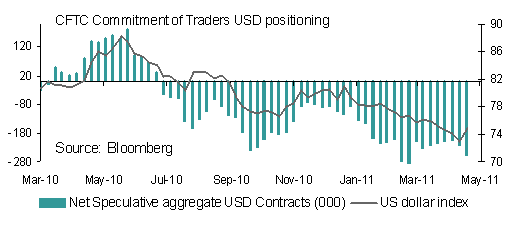
Position Unwinding Boosts USD

The USD’s multi-month fall has come to an abrupt halt, with the currency registering gains in reaction to what appears to be a major position unwinding across asset markets, led by a drop in commodity prices.

Will it continue? Whilst I am amongst the more bullish forecasters on the USD over the medium term, the current rally could prove to be short-lived in the absence of a shift in Federal Reserve rhetoric or end to quantitative easing (QE2). Nonetheless, the market had got itself very short USDs (as reflected in the CFTC IMM data as of early last week which showed an increase in net short positions) and the rally in the USD last week was likely spurred by major short-covering which could extend further into this week.

The move in the USD gained momentum as European Central Bank (ECB) President Trichet proved to be less hawkish than many expected in the press conference following last Thursday’s ECB meeting. Moreover, renewed worries about Greece at the end of last week, with a report in the German Der Spiegel, later denied by Greek officials, that the country was planning to leave the Eurozone dented the EUR,

Taken together with the improving trend in US April non-farm payrolls (April registered +244k increase, with private payrolls 268k), these factors colluded to provide further positive stimulus to the USD and negative fallout on the EUR. The room for EUR downside is evident in the net long EUR speculative position, which rose to its highest since December 2007 as of 3rd May.

This week’s batch of US releases including March trade data, April retail sales and CPI, are unlikely to result in a reversal in last week’s trend though a trend like reading for core CPI, with the annual rate below the Fed’s comfort zone will reinforce expectations of dovish Fed policy being maintained, which could inject a dose of caution into the USD’s rally.

Against the background of a likely widening in the US trade deficit in March there will plenty of attention on the annual strategic and economic dialogue beginning today, with markets interested in discussions on Chinese worries about the gaping US fiscal deficit and US concerns about China’s exchange rate policy.

Greece’s denial of plans to leave the eurozone and discussions over a further adjustment to Greece’s bail out package, may help limit any drop in the EUR this week though it will by no means mark the end of such speculation about the periphery especially with this weeks’ Q1 GDP data releases across the eurozone likely to further highlight the divergence between the core and the periphery even if the headline eurozone reading rebounds strongly as we expect.

In the UK the Bank of England Quarterly Inflation Report will be the main influence on GBP. Downward growth revisions will play into the view that inflation will eventually moderate, capping expectation of higher interest rates over the coming months. However, the likely upward revision to near term inflation forecasts will help limit any damage to GBP.

GBP has lost ground to the USD but it should be noted that it has outperformed the EUR over recent days, reversing some of the recent run up in EUR/GBP. Given that EUR sentiment is likely to remain fragile this week, GBP may continue to capitalise, with a test of EUR/GBP 0.8672 on the cards.

Edging Towards A Bailout

A confluence of factors have come together to sour market sentiment although there appeared to be some relief, with a soft US inflation reading (core CPI now at 0.6% YoY) and plunge in US October housing starts reinforcing the view that the Fed will remain committed to carry out its full QE2 program, if not more.

However any market relief looks tenuous. Commodity prices remain weak, with the CRB commodities index down 7.4% in just over a week whilst the Baltic Dry Index (a pretty good forward indicator of activity and sentiment) continues to drop, down around 21% since its recent high on 27 October. Moreover, oil prices are also sharply lower. Increasingly the drop in risk assets is taking on the form of a rout and many who were looking for the rally to be sustained into year end are getting their fingers burnt.

Worries about eurozone peripheral countries debt problems remains the main cause of market angst, with plenty of attention on whether Ireland accepts a bailout rumoured to be up EUR 100 billion. Unfortunately Ireland’s reluctance to accept assistance has turned into a wider problem across the eurozone with debt in Portugal, Greece and also Spain suffering. An Irish bailout increasingly has the sense of inevitability about it. When it happens it may offer some short term relief to eurozone markets but Ireland will hardly be inspired by the fact that Greece’s bailout has had little sustainable impact on its debt markets.

Ireland remains the primary focus with discussions being enlarged to include the IMF a well as ECB and EU. What appears to be becoming clearer is that any agreement is likely to involve some form of bank restructuring, with the IMF likely to go over bank’s books during its visit. Irish banks have increasingly relied on ECB funding and a bailout would help reduce this reliance. Notably the UK which didn’t contribute to Greece’s aid package has said that it will back support for Ireland, a likely reaction to potential spillover to UK banks should the Irish situation spiral out of control. Any bailout will likely arrive quite quickly once agreed.

Although accepting a bailout may give Ireland some breathing room its and other peripheral county problems will be far from over. Uncertainties about the cost of recapitalising Ireland’s bank will remain whilst there remains no guarantee that the country’s budget on December 7 (or earlier if speculation proves correct) will be passed. Should Ireland agree to a bailout if may provide the EUR will some temporary relief but FX markets are likely to battle between attention on Fed QE2 and renewed concerns about the eurozone periphery, suggesting some volatile price action in the days and weeks ahead.

Reports of food price controls of and other measures to limit hot money inflows into China as well as prospects for further Chinese monetary tightening, are attacking sentiment from another angle. China’s markets have been hit hard over against the background of such worries, with the Shanghai Composite down around 10% over the past week whilst the impact is also being felt in many China sensitive markets across Asia as well as Australia. For instance the Hang Seng index is down around 7% since its 8 November high.

What to watch this week

Over recent days trading has been characterised by dollar weakness, stronger equities, rising commodity prices and most recently an increase in US bond yields, the latter driven by some slightly hawkish Fed comments. Whether the tone of stronger attraction to risk trades continues will largely depend on US Q3 earnings however, with many earnings reports scheduled this week.

Given the plethora of Fed officials on the wires over recent days and the mixed comments from these officials there may more attention on US CPI on Thursday than usual but the data is unlikely to fuel any concern about inflation risks. Instead there will be more interest on the Fed FOMC minutes on Wednesday which will once again be scrutinised for the timing of an exit strategy.

Over the week there is plenty for markets to digest aside from earnings reports. US consumer and manufacturing reports will garner most attention. The key release is US September retail sales (Wed) where some payback for the “cash for clunkers” related surge in sales over the last month is likely to result in a drop in headline retail sales, though underlying sales will likely post a modest rise.

Fed speeches will also be monitored and speakers include Kohn, Dudley, Tarullo and Bullard this week. Recent comments have hinted that some Fed members are becoming increasingly concerned about the timing of policy reversal and further signs of this in this week’s speeches may give the dollar some comfort but this will prove limited given that the Fed is still a long way off from reversing policy.

Even if the market believes the Fed is starting to contemplate the timing of reversing its current policy setting it is unclear that the dollar will benefit much in the current environment. Sentiment remains bearish; speculative dollar sentiment deteriorated sharply over the past week according to the CFTC Commitment of Traders (IMM) data, to levels close to the lowest for the year.

Moreover, the correlation between interest rate differentials and currencies is still insignificant in most cases suggesting that even a jump in yields such as the move prompted by last week’s comments by Fed Chairman Bernanke should not automatically be expected to boost the dollar. Once markets become more aggressive in pricing in higher US interest rates this may change but there is little sign of this yet

In contrast the euro continues to benefit from recycling of central bank reserves and recorded a jump in speculative appetite close to its highest level this year according to the IMM data. Reserve flows from central banks may contribute to EUR/USD taking aim at its year high around 1.4844 (last tested on 24 September 09) over coming days.