EUR falls, JPY retraces after intervention

Risk aversion has come back in full force, with various concerns weighing on markets. Once again attention is firmly fixed on the eurozone and worryingly last week’s European Union (EU) rescue agreement has failed to prevent a further widening in eurozone peripheral bond spreads. This will come as a blow to eurozone officials as the agreement was aimed to prevent exactly this.

A lack of detail in the plans announced last week has come back to haunt markets. Moreover, given the event risk of the RBA, ECB and Fed central bank meetings this week plus the US October jobs report at the end of the week, nerves will likely remain frayed over coming days. Overall, the tone will likely be on of selling risk assets on rallies over the short term.

The EUR has unwound a significant part of its gains from last week as various doubts about the eurozone rescue package have surfaced. The measures announced by EU officials have failed to prevent a jump in Italian and Spanish bond yields. News that MF Global has filed for bankruptcy while the Greek Prime Minister has called for a referendum on the EU’s debt deal dealt markets a blow overnight.

As it was doubts had been creeping in due to the lack of detail in the rescue package including but not limited to the lack of specifics on the leveraging of the EFSF bailout fund. The pattern appears to have followed the reaction to previous EU announcements to stem the crisis, namely short lived euphoria followed by a sell off in risk assets. The EUR is likely to struggle further over the near term, with the current pull back likely to extend to around the 21 October low of 1.3705.

Japanese officials had blamed the strength of the JPY on speculative flows and have threatened more FX intervention following yesterday’s Judging by the price action this morning the threat has been followed up by action. In order for USD/JPY to sustain a move higher it will require both a widening in yield differentials and easing risk aversion. Neither are guaranteed to happen any time soon as was evident overnight with risk aversion rising. US data has improved but it is insufficient to provoke a sharp back up in US bond yields.

Consequently in the coming weeks USD/JPY topside momentum will be limited. A break above USD/JPY’s 200 day moving average level of 79.89 could prove decisive in terms of JPY long capitulation and once above this level USD/JPY will target the 11 July high of 80.83. However, this will require further intervention otherwise the underlying trend in JPY will continue to remain positive.
Plenty of event risk

This week is heavy with event risk, with a lot expected from EU leaders. So far the risk on tone to markets has held up, with for example the VIX fear gauge resting below the key 30.0. The G20 meeting over the weekend set the deadline for action for concrete solutions to the eurozone debt crisis for the October 23 EU Summit.

However, there will be little detail on issues such as banking sector recapitalisation, private sector involvement in any debt restructuring or ‘leveraging’ the EFSF bailout fund until the report on Wednesday night by the Troika on Greece. The reward to EU leaders would be the potential for more aid from the IMF but even now it seems that a German government official has poured cold water of a plan being announced at the EU Summit which will disappoint markets.

There are also plenty of data releases for markets to digest over coming days including inflation releases, manufacturing surveys and industrial production data in the US while in Europe the German IFO and ZEW surveys are scheduled for release. The data will follow on from the better than expected September US retail sales releases at the end of last week continuing to dampen expectations that the global economy is falling in recession though there will be a marked deceleration in European data.

Meanwhile the US Q3 earnings season rolls. The risk on tone will likely continue to weigh on the USD and weigh on bonds but unlike a few weeks ago when a lot of bad news was priced in, the scope for disappointment is becoming increasingly high.

Many currencies remain highly correlated with gyrations in risk and in this respect the improvement in risk appetite is good news for high beta / commodity. AUD, NZD, CAD and JPY are amongst the most sensitive currencies and therefore prone to a bigger reaction as risk improves, with the former three strengthening and the JPY weakening. Asian currencies poised to benefit from firmer risk appetite include INR and KRW, both with relatively high correlations with risk.

EUR/USD has made a solid recovery over recent days from its lows around 1.3146 spurred by hopes of action by European officials. Such hopes may yet be dashed but the EUR looks supported over coming days ahead of the EU summit Speculative positioning also reflects a slight improvement in EUR sentiment as IMM short positions have declined in the last week but its worth noting that this week’s European data are unlikely to be supportive for the EUR.

High Hopes

EUR/USD has rallied over recent days from a low around 1.3146 last week. Market hopes of a eurozone solution may fall flat but the pressure on officials has ratcheted higher, and the risks of failure are now too significant to jeopardize with half measures. Weekend promises of banking sector recapitalisation by Germany and France have helped but will not be enough should such promises prove empty. Markets will likely give the benefit of the doubt to eurozone officials ahead of the delayed October 23 EU Summit and the November 3 G20 meeting.

Consequently EUR will find some support over coming days and could extend gains as risk appetite improves; having broken above 1.3600 the next big resistance level for EUR/USD is 1.3800. The fact that EUR speculative positioning is very negative (biggest short position since June 2010 according to IMM data) highlights the potential for short covering.

Possible good news in Greece, with an announcement by the Troika (ECB, EU and IMF) on talks over the next tranche of the bailout will likely provide more EUR support. One stumbling block for the EUR could come from the Slovakian vote on EFSF bailout fund enhancement, which is by no means guaranteed to pass.

The JPY remains firm benefitting from higher risk aversion, registering one of the highest correlations with risk over recent months. However, the reason why the JPY is not even stronger is that bond yield differentials (especially 2-year) with the US have widened out in favour of the USD over recent days. If the recent improvement in risk appetite continues, combined with widening yield differentials it could push USD/JPY to finally move higher and sustain a break above 77.00.

GBP/USD has made an impressive bounce over recent days from a low around 1.5272 last week despite the Bank of England’s announcement of more quantitative easing last week and credit ratings downgrades of several UK banks. This resilience is impressive but it appears that GBP is caching onto the coat tails of a firmer EUR rather than benefitting from a domestically led improvement in sentiment. Nonetheless, there is scope for further gains in GBP given that speculative positioning in the currency moved close to its all time low early last week in anticipation of BoE QE.

Euro fails too hold on to gains

Any improvement in sentiment following the USD liquidity support announcement by various central banks last week is already filtering away against the background of European Union (EU) officials’ failure to make any headway at the Ecofin meeting over the weekend, a delay in the approval of the next bailout tranche for Greece and ongoing collateral dispute between Greece and Finland. On top of all of this German Chancellor Merkel suffered a further setback in regional elections over the weekend.

Greece will remain in focus this week and markets will look for signs that the country is back on track on its austerity plans and its next loan tranche. Prime Minister Papandreou cancelled a trip to the US while the Greek cabinet are apparently deciding on new fiscal measures. Attention will turn to a teleconference today from the Greek Finance Minister with EU and IMF officials.

Speculative sentiment for the EUR has already soured further and according to the latest CFTC IMM report, positioning in EUR is at its lowest since the end of June 2010. EUR/USD will continue to look very vulnerable having already dropped sharply from a high of around 1.3899 in Asian morning trading as the bad weekend news hit the currency. EUR/USD will find some technical support just below 1.3500 this week but any upside is set to prove limited unless some concrete announcements are delivered relating to Greece over coming days.

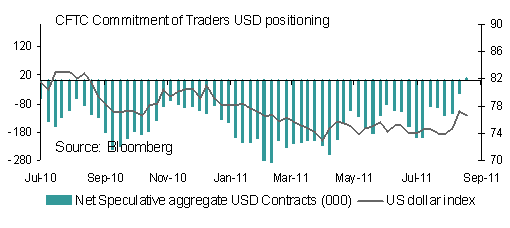
In contrast to the EUR, USD speculative appetite has turned net long for the first time since July 2010. The extended Fed FOMC meeting will help to dictate USD sentiment as markets wait for further measures to stimulate the economy. The Federal Reserve has already committed to hold rates steady until at least mid 2013 and the extended two day meeting this week will likely discuss further options. However, more quantitative easing (QE3) appears unlikely at this stage while an ‘Operation Twist’ type approach is more probable. The USD will benefit from a lack of further quantitative easing but this is largely already priced in.

Euro slides as Greek worries intensify

The USD ended last week on high a note having overcome speeches by Fed Chairman Bernanke and President Obama. Bernanke’s lack of detail on potential further Fed stimulus offered the USD a lifeline as there was no mention of QE3 but nervousness may mount ahead of the September 21 FOMC meeting.

This week’s data releases (including retail sales, inflation, industrial production and regional manufacturing surveys may offer some direction to the USD and it is likely that the data over coming days will look less negative than in past weeks, giving the USD some support. Having broken above its 200 day moving average around 76.1986 for the first time in a year the USD index is set to begin the week in positive mode and will likely extend its gains over coming days.

In sharp contrast, EUR/USD crumbled at the end of last week dropping through its 200 day moving average despite positive news from Germany (rejection of bills in the constitutional court) and Italy (passage of austerity measures). The European Central Bank (ECB) did not help the EUR’s cause however, with the change in its stance to a more balanced assessment of risks from its more hawkish stance previously.

However, the real damage occurred as speculation of a Greek default intensified and ECB hawk Stark resigned from the ECB council, highlighting the divisions within the governing board. This week attention will remain on Greece as negotiations between the Troika (ECB, EU and IMF) and Greek officials resume.

Ahead of the talks Greece approved a further EUR 2 billion in austerity measures over the weekend but nonetheless, despite denials by Greek officials speculation of a debt default will continue to hammer the EUR lower. Near term technical support is seen around 1.3525 for EUR/USD.

GBP found some relief last week following the decision by the Bank of England to leave policy unchanged though it is unlikely to be able to make much if any headway against the USD over coming sessions as expectations of further UK quantitative easing may simply have been pushed back to the November meeting.

Inflation data this week will give further clues to policy but once again there is likely to be no sign of any easing in inflation pressure, limiting the room for maneuver for the BoE. Moreover, a weak outcome for UK retail sales in August will maintain the trend of soft UK data keeping up the pressure for more BoE action. As a result GBP will struggle against the USD but given that problems in Europe look even worse, GBP will likely extend gains against the EUR this week.