EUR Supported, AUD dives, NZD jumps

Today is probably not the best day to sell EUR given that the ECB policy decision looms on the horizon. Whilst there is a risk of a ‘buy on rumour, sell on fact’ impact on the EUR following the European Central Bank (ECB) decision later today the relatively high probability that the ECB flags a rate hike in July will likely give further support to the EUR especially as it is not fully priced in by the market.

Of course should ECB President Trichet fail to mention “strong vigilance” in his press conference the EUR could suffer but this is likely to be a lower probability event. Some justification for higher rates will come from an upward revision in the ECB’s inflation forecasts. Consequently EUR/USD looks well supported around 1.4450.

The Bank of England is unlikely to deliver any surprises today, with an unchanged policy rate outcome and asset purchases target likely. The outcome will keep GBP restrained versus USD but given the likely contrast with the ECB, EUR/GBP could head higher as the currency pair continues to set its sights on the 0.90 level.

Even against the USD, GBP is unlikely to extend its gains, with 1.6474 likely providing a near term technical cap. The dichotomy of weaker activity and higher inflation is clearly causing a problem for policy makers but we still believe a rate hike is likely later in the year. In the meantime GBP remains vulnerable to further data disappointments over coming weeks.

There was more bad news for the AUD today in the form of a weak than forecast May employment report. The data will reinforce expectations that the RBA will not hike interest rates over coming months, with July and August effectively ruled out, though a hike in September remains probable.

The data had major impact on AUD which dropped sharply below the 1.0600 handle versus USD. Clearly the combination of the RBA statement and weak jobs data has resulted in a major headwind against further near term AUD appreciation. AUD will remain under downward pressure in the short-term, with technical support seen at 1.0440.

Unlike the RBA the Reserve Bank of New Zealand (RBNZ) opened the door for higher interest rates following its unchanged policy decision today, with the Bank stating that “a gradual increase in the overnight cash rate over the next two years will be required”. Despite noting some caution about the strength of the NZD and its impact on the economy the Kiwi strengthened versus the USD
Position Unwinding Boosts USD

The USD’s multi-month fall has come to an abrupt halt, with the currency registering gains in reaction to what appears to be a major position unwinding across asset markets, led by a drop in commodity prices.

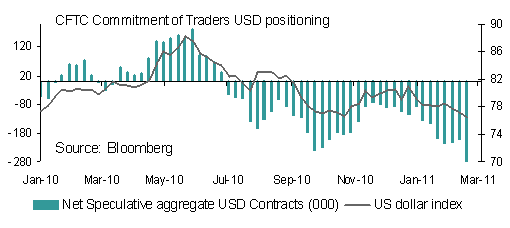
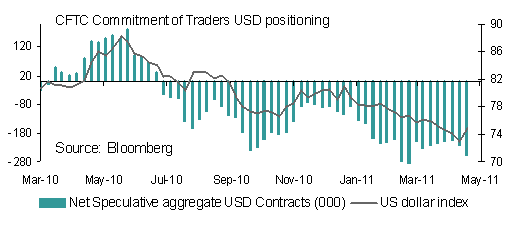
Will it continue? Whilst I am amongst the more bullish forecasters on the USD over the medium term, the current rally could prove to be short-lived in the absence of a shift in Federal Reserve rhetoric or end to quantitative easing (QE2). Nonetheless, the market had got itself very short USDs (as reflected in the CFTC IMM data as of early last week which showed an increase in net short positions) and the rally in the USD last week was likely spurred by major short-covering which could extend further into this week.

The move in the USD gained momentum as European Central Bank (ECB) President Trichet proved to be less hawkish than many expected in the press conference following last Thursday’s ECB meeting. Moreover, renewed worries about Greece at the end of last week, with a report in the German Der Spiegel, later denied by Greek officials, that the country was planning to leave the Eurozone dented the EUR,

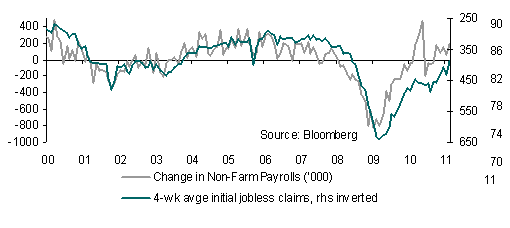
Taken together with the improving trend in US April non-farm payrolls (April registered +244k increase, with private payrolls 268k), these factors colluded to provide further positive stimulus to the USD and negative fallout on the EUR. The room for EUR downside is evident in the net long EUR speculative position, which rose to its highest since December 2007 as of 3rd May.

This week’s batch of US releases including March trade data, April retail sales and CPI, are unlikely to result in a reversal in last week’s trend though a trend like reading for core CPI, with the annual rate below the Fed’s comfort zone will reinforce expectations of dovish Fed policy being maintained, which could inject a dose of caution into the USD’s rally.

Against the background of a likely widening in the US trade deficit in March there will plenty of attention on the annual strategic and economic dialogue beginning today, with markets interested in discussions on Chinese worries about the gaping US fiscal deficit and US concerns about China’s exchange rate policy.

Greece’s denial of plans to leave the eurozone and discussions over a further adjustment to Greece’s bail out package, may help limit any drop in the EUR this week though it will by no means mark the end of such speculation about the periphery especially with this weeks’ Q1 GDP data releases across the eurozone likely to further highlight the divergence between the core and the periphery even if the headline eurozone reading rebounds strongly as we expect.

In the UK the Bank of England Quarterly Inflation Report will be the main influence on GBP. Downward growth revisions will play into the view that inflation will eventually moderate, capping expectation of higher interest rates over the coming months. However, the likely upward revision to near term inflation forecasts will help limit any damage to GBP.

GBP has lost ground to the USD but it should be noted that it has outperformed the EUR over recent days, reversing some of the recent run up in EUR/GBP. Given that EUR sentiment is likely to remain fragile this week, GBP may continue to capitalise, with a test of EUR/GBP 0.8672 on the cards.

FX sensitivities to yield differentials

A lot has been made about the hawkish language from a few Federal Reserve FOMC members over recent days and growing speculation about whether quantitative easing (QE2) will end earlier than initially planned. In turn, this has been noted as a positive factor for the USD. Undoubtedly there are a few in the Fed who are becoming more nervous about current policy settings but it is highly unlikely that the Fed will not complete its $600 billion in planned asset purchases by the end of June.

The biggest imponderable is how and when the Fed begins its exit policy and how effectively/efficiently it can be done. Whilst it is likely to be over a year before the Fed Funds rate is hiked, the USD will be sensitive to balance sheet reduction. Moreover, the way in which the Fed reduces the size of the balance will also be important given the likely active approach to liquidity withdrawal required.

For the present, it should be noted that even with the hawkish Fed rhetoric and increase in US bond yields (2 year yields have risen by close to 25bps over the last couple of weeks) the USD is actually lower versus EUR than where it was two weeks ago. The reality is that German bund yields have risen by even more than US yields ahead of the anticipated European Central Bank (ECB) rate hike on 7 April (the case for which appears to have been sealed by the above consensus 2.6% YoY reading for March eurozone CPI).

However, I would be cautious about ascribing general FX moves at present to yield / interest rate differentials given that it is only EUR crosses (including EUR/JPY, EUR/GBP, EUR/CAD, and EUR/USD) that hold a statistically significant relationship with yields. All of this implies EUR crosses look supported ahead of the upcoming ECB meeting, with EUR/USD unlikely to sustain a drop below 1.4000 ahead of the rate decision. What happens after depends on the press conference. Bearing in mind that markets have already priced in 75bps of rate hikes by the ECB it would take an even stronger tone from the ECB to push the EUR higher, something that looks unlikely

US Dollar On A Slippery Path

The USD has been a on a slippery path over recent weeks, weighed down by adverse interest rate differentials despite improving US economic data. Adding to the run of encouraging US data releases the February jobs report revealed a 192k increase in jobs and a drop in the unemployment rate to 8.9%.

In particular the Fed’s dovish tone highlights that whilst asset purchases under QE2 will stop at the end of June, the failure to hit the Fed’s dual mandate of maximum employment and stable prices, implies that the Fed Funds rate will not be hiked for a long while yet. This dovish slant has undermined the USD to the extent that USD speculative positioning as reflected in the CFTC IMM data dropped to all time low in the week to 1 March. There is certainly plenty of scope for short-covering but the market is no mood to buy the USD yet.

This week’s releases will provide less direction, with a slight widening in the trade deficit likely in January, a healthy gain in February retail sales and a small drop in the preliminary reading of March Michigan sentiment.

In contrast, even the generally hawkish market expectations for the European Central Bank (ECB) proved too timid at last week’s Council meeting as Trichet & Co. strongly implied via “strong vigilance” that the refi rate would be hiked by 25bps in April. EUR/USD lurched higher after the ECB bombshell breaking the psychologically important 1.4000 barrier but appeared to lose some momentum at this level. Should EUR/USD sustain a break of 1.4000, the next level of resistance is at 1.4281 (November high), with support seen around 1.3747.

The lack of major eurozone data releases this week, with only industrial production data in Germany and France of interest, suggests that EUR may consolidate over the short-term with the main interest on the informal Heads of State meeting at the end of the week to determine whether credible plans can be drawn up to restore confidence in the periphery.

This week it is the turn of the Bank of England (BoE) to decide on monetary policy but unlike the ECB we do not expect any surprises with an unchanged decision likely. Further clues will only be available in the Monetary Policy Committee (MPC) minutes on 23 March. However, markets may be nervous given that it could feasibly only take another two voters aside from the three hawkish dissenters last month, to result in a policy rate hike. Notably one possible hawkish dissenter, Charles Bean did not sound overly keen on higher rates in a speech last week, a factor that weighed on GBP alongside some weaker service sector Purchasing Managers Index (PMI) data.

UK manufacturing data will be the main data highlight of the calendar but this will be overshadowed by the BoE meeting. GBP/USD could continue to lag the EUR and given a generally bullish EUR backdrop, our preferred method of playing GBP downside remains via a long EUR/GBP position.

Contrasting Stance

Despite some recent Fed speakers putting doubts into the minds of the many now looking for the Fed to embark on QE2 in November, the minutes of the 21 September FOMC meeting gave the green light to the commencement of asset purchases next month. Although there is clearly no unanimity within the FOMC the majority favour further easing. Incremental data dependent asset purchases will be the most likely path.

The minutes leave the USD vulnerable to further declines but extreme short USD positioning suggest that there is plenty of risk of short covering and more likely we are probably set for a period of consolidation over coming weeks before the USD resumes its decline.

Unlike the Fed, BoJ and BoE, which remain in easing mode the ECB is already veering towards an exit strategy, albeit one that is unlikely to take effect for some time. Hawkish comments by the ECB’s Weber overnight managed to give a lift to the EUR in the wake of a further widening in interest rate differentials between the eurozone and US. Indeed, interest rate differentials (2nd contract futures) are at the widest since Feb 2009, a factor that is providing plenty of underlying support for the EUR.

Further out the follow through on the EUR will depend on whether markets believe Weber’s stance is credible. Germany’s economy is doing well but it is highly likely that Southern European officials would oppose any premature tightening in policy given the parlous state of their economies. The stronger EUR will also do some damage to growth, with its recent appreciation acting as a de facto monetary tightening.

Despite the positive influence of Weber’s comments short-term technical indicators show that the trend in EUR is vulnerable, with clear signs of negative divergence as the spot rate is still trending higher whilst the relative strength indices (RSI) are trending lower. Moreover, EUR speculative positioning is at its highest in a year, albeit still well of its all time highs. Speculators may be reluctant to build on longs in the near term. A clean and sustained break above EUR/USD 1.4000 level still looks like a stretch too far though any downside is likely to be limited to strong support around 1.3895.

Unlike the perception that the ECB is highly unlikely to follow the Fed in a path of QE2 the policy stance of the BoE is far more uncertain, a fact that continues to weigh on GBP, especially against the EUR. Recent data in the UK has played into the hands of the doves, with housing market activity and prices coming under renewed pressure, retail sales surveys revealing some deterioration and consumer confidence as revealed in the Nationwide survey overnight, weakening further.

BoE MPC member Miles summarized the situation by highlighting that the UK faces “some big risks” and even hinted that the BoE may “come to use QE”. UK jobs data today is unlikely to give any support to sentiment for GBP although as per its recent trend GBP is likely to remain resilient against the USD whilst remaining under pressure against the EUR, with a move to resistance around EUR/GBP 0.8946 on the cards in the short-term