US Dollar On The Rise

There are plenty of US releases on tap this week but perhaps the most important for the USD will be the minutes of the April 26-27 Fed FOMC meeting. Taken together with speeches by Fed officials including Bernanke, FX markets will attempt to gauge clues to Fed policy post the end of QE2. The Fed’s stance at this point will be the major determinant of whether the USD can sustain its rally over the medium term. The lack of back up in US bond yields suggests that USD momentum could slow, with markets likely to move into wide ranges over coming weeks.

It is worth considering which currencies will suffer more in the event that the USD extends its gains. The correlation between the USD index and EUR/USD is extremely strong (even accounting for the fact that the EUR is a large part of the USD index) suggesting that the USDs gains are largely a result of the EUR’s woes. Aside from the EUR, GBP, AUD and CAD are the most sensitive major currencies to USD strength whilst many emerging market currencies including ZAR, TRY, SGD, KRW, THB, IDR, BRL and MXN, are all highly susceptible to the impact of a stronger USD.

Robust Q1 GDP growth readings in both Germany and France helped to spur gains in the EUR but this proved short-lived. Sentiment for the currency has soured and as reflected in the CFTC IMM data long positions are being scaled back. Nonetheless, there is still plenty of scope for more EUR selling given ongoing worries about the eurozone periphery, which are finally taking their toll on the EUR. A break below EUR/USD 1.4021 would open the door for a test of 1.3980.
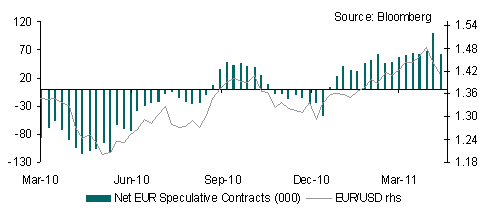
The eurogroup and ecofin meetings will be of interest to markets this week but any additional support for Greece is unlikely to be announced at this time. However, likely approval of Portugal’s bailout may alleviate some pressure on the EUR but any positive impetus will be limited. Even on the data front, markets will not be impressed with the German ZEW index of investor confidence likely to register a further decline in May.

Japanese officials have been shying away from further FX intervention by blaming the drop in USD/JPY over recent weeks on general USD weakness despite the move towards 80. However, this view is not really backed up by correlation analysis which shows that there is only a very low sensitivity of USD/JPY to general USD moves over recent months. One explanation for the strength of the JPY is strong flows of portfolio capital into Japan, with both bond and equity markets registering net inflows over the past four straight weeks.

This is not the only explanation, however. One of the main JPY drivers has been a narrowing in yield differentials. This is unlikely to persist with yield differentials set to widen sharply over coming months resulting in a sharply higher USD/JPY. As usual data releases are unlikely to have a big impact on the JPY this week but if anything, a further decline in consumer confidence, and a negative reading for Q1 GDP, will maintain the pressure for a weaker JPY and more aggressive Bank of Japan (BoJ) action although the BoJ is unlikely to shift policy this week.
Risk Aversion Creeps Higher

The USD index has dropped by around 17% since June 2010 high and despite a slight bounce this week it is unlikely to mark the beginning of a sustained turnaround. Nonetheless, I would caution about getting carried away with positioning for USD weakness. Whilst an imminent recovery looks unlikely the risk/reward of shorting the USD is becoming increasingly unfavourable.

Until then Federal Reserve comments will be watched closely for clues on policy and there are plenty of Fed speakers this week including a speech by Boston Fed’s Rosengren today and Fed Chairman Bernanke tomorrow. The USD will also gain some direction from jobs data and markets will be able to gauge more clues for Friday’s non-farm payrolls data , with the release of the April ADP employment report today.

The EUR is one currency that has suffered this week. News that Portugal’s caretaker government has reached an agreement with the European Union / International Monetary Fund on a bailout of as much as EUR 78 billion has so far been greeted with a muted response. EUR attention is still very much focussed on the ECB meeting tomorrow and prospects of a hawkish press statement suggest that EUR/USD downside will be limited, with support seen around 1.4755.

The JPY has strengthened by around 5% versus USD since its 6th April USD/JPY high around 85.53, confounding expectations that Japan’s FX intervention following the county’s devastating earthquake marked a major turning point in the currency. A combination of narrowing interest rate differentials with the US (2 year US/Japan yield differentials have narrowed by around 20bps in the past month), strong capital inflows to Japan (net bond and equity flows in the last four weeks have increased to their highest this year), and rising risk aversion have all played their part in driving the JPY higher.

As a result USD/JPY is fast approaching the psychologically important level of 80, a level that if breached will likely lead to FX intervention. Although Golden Week holidays in Japan this week suggest that JPY liquidity may be quite thin, Japanese authorities are likely to remain resistant to further gains in the JPY, likely using thinning liquidity to their advantage.

Despite the JPY’s recent strength speculative positioning over the past four weeks has remained net short JPY, whilst Japanese margin traders have also increased their long USD/JPY bets, suggesting that these classes of investors are not to blame for the JPY’s appreciation. This suggests that FX intervention may not be as successful given that the market is already short JPY.

Given the risk of intervention on USD/JPY, the CHF appears to be an easier choice for safe haven demand against the background of rising risk aversion. The currency has risen to a record high against the USD, gaining around 8.3% so far this year. Given the hints of higher interest rates by the Swiss National Bank (SNB) and resilience economic performance, downside risks for CHF are limited at present unless risk appetite improves sharply. Further gains are likely with USD/CHF likely to test the 0.8570 support level over the short-term.

RBA on hold, RBI hikes rates

News of the death of Osama Bin Laden gave the USD a lift and its gains have extended for a second day. Extreme short market positioning as well as increasing risk aversion (perhaps due to worries about retaliation following Bin Laden’s death) have helped the USD.

However, the boost to the USD could be short-lived in the current environment in which it remains the preferred global funding currency. Indeed, the fact that US bond yields have dropped sharply over recent weeks continues to undermine the USD against various currencies.

The USD firmed despite the US ISM manufacturing index dropping slightly, albeit from a high level. The survey provided some useful clues to Friday’s US jobs report, with the slight decline in the employment component of the ISM survey to 62.7 consistent with a 200k forecast for April payrolls.

Ahead of the European Central Bank (ECB) meeting on Thursday hawkish rhetoric from new Council member and Bundesbank chief Weidmann (replacing Weber) and more reassurances from Greek and EU officials that there will be no debt restructuring or haircut on the country’s debt has helped the EUR although it is notable that it could not sustain a foot hold above 1.49. Eurozone bond yields have risen by around 20bps compared to US yields over the past month, a fact that suggests that the EUR may not fall far in the short-term.

USD/JPY is trading dangerously close to levels that may provoke FX intervention by the Japanese authorities. General USD weakness fuelled a drop in USD/JPY which has been exacerbated by a rise in risk aversion over recent days (higher risk aversion usually plays in favour of a stronger JPY). The biggest determinant of the drop in USD/JPY appears to a narrowing in bond yields (2-year bond yields have narrowed by around 20bps over the past month) largely due to a rally in US bonds.

Unsurprisingly the Reserve Bank of Australia (RBA) left its cash rate on hold at 4.75%. The accompanying statement showed little inclination to hike rates anytime soon, with credit growth noted as modest, pressure from a stronger exchange rate on the traded sector and temporary prices shocks which are expected to dissipate. The only indication that rates will eventually increase is the view that longer term inflation is expected to move higher.

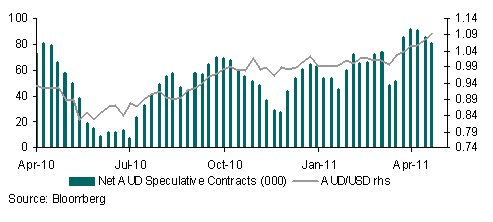
I look for further rate hikes over coming months even with the AUD at such a high level. AUD has lost a bit of ground after hitting a high just above 1.10 against the USD and on the margin the statement is slightly negative for AUD. A slightly firmer USD overall and stretched speculative positioning, with IMM AUD positions close to their all time high, points to some downside risks in the short-term.

In contrast India’s central bank the RBI hiked interest rates by more than many expected. Both the repo and reverse repo rates were raised by 50bps, with the central bank governor highlighting renewed inflation risks in his statement. The decision reveals a shift in RBI rhetoric to an even more hawkish bias in the wake of rising inflation pressures, which should be beneficial to the rupee.

Australian Dollar Looking Stretched

Central bank decisions in Japan, Europe and UK will dictate FX market direction today. No surprises are expected by the Bank of Japan (BoJ) and Bank of England (BoE) leaving the European Central Bank (ECB) decision and press conference to provide the main market impetus. Although a hawkish message from ECB President Trichet is likely the market has already priced in a total of 75 basis points of tightening this year. We retain some caution about whether the EUR will be able to make further headway following the ECB meeting unless the central bank is even more hawkish than already priced in.

EUR/USD easily breached the 1.4250 resistance level and will now eye resistance around 1.4500. News that Portugal formally requested European Union (EU) aid came as no surprise whilst strong German factory orders provided further support to the EUR. The data highlights upside risks to today’s February German industrial production data. The EUR will find further support versus the USD from comments by Atlanta Fed’s Lockhart who noted that he doesn’t expect the Fed to hike interest rates by year end.

USD/JPY is now around 7.5% higher than its post earthquake lows. Japanese authorities will undoubtedly see a measure of success from their joint FX intervention. To a large degree they have been helped by a shift in relative bond yields (2-year US / Japan yield differentials have widened by close to 30 basis points since mid March, and are finally having some impact on USD/JPY as reflected in the strengthening in short-term correlations. Whilst the BoJ is unlikely to alter its policy settings today the fact that it is providing plenty of liquidity to money markets, having injected around JPY 23 trillion or about 5% of nominal GDP since the earthquake, is likely playing a role in dampening JPY demand.

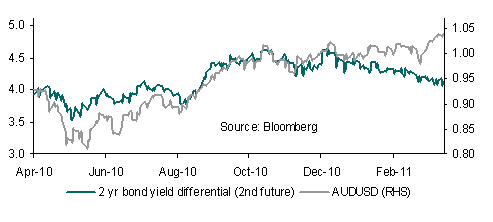
AUD/USD has appreciated by close to 6% since mid March and whilst I would not recommend selling as yet I would be cautious about adding to long positions. My quantitative model based on interest rate / yield differentials, commodity prices and risk aversion reveals a major divergence between AUD/USD and its regression estimate. Clearly the AUD has benefitted from diversification flows as Asian central banks intervene and recycle intervention USDs. However, at current levels I question the value of such diversification into AUD.

Speculative AUD/USD positioning as indicated by the CFTC IMM data reveals that net long positions are verging on all time highs, suggesting plenty of scope for profit taking / position squaring in the event of a turn in sentiment. Moreover, AUD gains do not match the performance of economic data, which have been coming in worse than expected over recent weeks. Consequently the risks of a correction have increased.

Risk on, US dollar pressure

FX markets have plenty of different factors to digest these days and after a harrowing couple of weeks markets began this week on a firmer footing. The overall tone into this week is to load up on risk assets. News that the nuclear situation in Japan may closer to stabilising has helped, whilst markets easily shook off another hike in China’s reserve ratio and ongoing conflict in Libya as Allied forces step up their campaign in the face of continuing resistance from Gaddafi’s forces.

Improved risk appetite has helped to keep the JPY on the defensive along with the continued threat of FX intervention, with further official JPY selling likely in the days ahead. Interestingly the intervention last Friday was estimated at only JPY 530 billion ($6.2 billion), much lower than previously thought. USD/JPY 80 remains a major line in the sand and any sign of another breach of this level will likely be met with official JPY selling. I suspect that the Japanese authorities will not be content until USD/JPY is far higher. In this respect its worth noting an official report released earlier in March highlighting that Japanese companies are not profitable at a USD/JPY rate below 86.

The EUR looks overbought around the 1.42 level but seems to be a beneficiary of Japanese FX intervention (perhaps a recycling of USDs into EUR) as well as comments by European Central Bank (ECB) Council members reiterating their intention to hike the refi policy rate, likely at the April ECB meeting. In a similar vein to the recycling of intervention USDs into EUR, Middle East entities may also be recycling petrodollars into EUR whilst news that Russia has permitted one of its oil related funds to buy Spanish debt has given a lift to sentiment for the EUR. Over the near term EUR/USD may struggle to make much headway above 1.42, with further direction coming from the EU leaders meeting on 24/25 March.

GBP is also doing well, having jumped close to the 1.6400 level versus USD, with UK February CPI giving the currency a further lift. The outcome at 4.4% YoY, which was not as bad as rumoured but in any case worse than consensus will give the hawks in the Bank of England MPC further ammunition to push for a policy rate hike. The fact that core inflation also increased suggests that the jump in headline inflation cannot merely be brushed under the table. A BoE rate hike is increasingly looking like a done deal. Renewed inflation worries in the UK and the hawkish rhetoric from ECB officials is sufficient to keep the USD under pressure.