Plenty of event risk

This week is heavy with event risk, with a lot expected from EU leaders. So far the risk on tone to markets has held up, with for example the VIX fear gauge resting below the key 30.0. The G20 meeting over the weekend set the deadline for action for concrete solutions to the eurozone debt crisis for the October 23 EU Summit.

However, there will be little detail on issues such as banking sector recapitalisation, private sector involvement in any debt restructuring or ‘leveraging’ the EFSF bailout fund until the report on Wednesday night by the Troika on Greece. The reward to EU leaders would be the potential for more aid from the IMF but even now it seems that a German government official has poured cold water of a plan being announced at the EU Summit which will disappoint markets.

There are also plenty of data releases for markets to digest over coming days including inflation releases, manufacturing surveys and industrial production data in the US while in Europe the German IFO and ZEW surveys are scheduled for release. The data will follow on from the better than expected September US retail sales releases at the end of last week continuing to dampen expectations that the global economy is falling in recession though there will be a marked deceleration in European data.

Meanwhile the US Q3 earnings season rolls. The risk on tone will likely continue to weigh on the USD and weigh on bonds but unlike a few weeks ago when a lot of bad news was priced in, the scope for disappointment is becoming increasingly high.

Many currencies remain highly correlated with gyrations in risk and in this respect the improvement in risk appetite is good news for high beta / commodity. AUD, NZD, CAD and JPY are amongst the most sensitive currencies and therefore prone to a bigger reaction as risk improves, with the former three strengthening and the JPY weakening. Asian currencies poised to benefit from firmer risk appetite include INR and KRW, both with relatively high correlations with risk.

EUR/USD has made a solid recovery over recent days from its lows around 1.3146 spurred by hopes of action by European officials. Such hopes may yet be dashed but the EUR looks supported over coming days ahead of the EU summit Speculative positioning also reflects a slight improvement in EUR sentiment as IMM short positions have declined in the last week but its worth noting that this week’s European data are unlikely to be supportive for the EUR.
High Hopes

EUR/USD has rallied over recent days from a low around 1.3146 last week. Market hopes of a eurozone solution may fall flat but the pressure on officials has ratcheted higher, and the risks of failure are now too significant to jeopardize with half measures. Weekend promises of banking sector recapitalisation by Germany and France have helped but will not be enough should such promises prove empty. Markets will likely give the benefit of the doubt to eurozone officials ahead of the delayed October 23 EU Summit and the November 3 G20 meeting.

Consequently EUR will find some support over coming days and could extend gains as risk appetite improves; having broken above 1.3600 the next big resistance level for EUR/USD is 1.3800. The fact that EUR speculative positioning is very negative (biggest short position since June 2010 according to IMM data) highlights the potential for short covering.

Possible good news in Greece, with an announcement by the Troika (ECB, EU and IMF) on talks over the next tranche of the bailout will likely provide more EUR support. One stumbling block for the EUR could come from the Slovakian vote on EFSF bailout fund enhancement, which is by no means guaranteed to pass.

The JPY remains firm benefitting from higher risk aversion, registering one of the highest correlations with risk over recent months. However, the reason why the JPY is not even stronger is that bond yield differentials (especially 2-year) with the US have widened out in favour of the USD over recent days. If the recent improvement in risk appetite continues, combined with widening yield differentials it could push USD/JPY to finally move higher and sustain a break above 77.00.

GBP/USD has made an impressive bounce over recent days from a low around 1.5272 last week despite the Bank of England’s announcement of more quantitative easing last week and credit ratings downgrades of several UK banks. This resilience is impressive but it appears that GBP is caching onto the coat tails of a firmer EUR rather than benefitting from a domestically led improvement in sentiment. Nonetheless, there is scope for further gains in GBP given that speculative positioning in the currency moved close to its all time low early last week in anticipation of BoE QE.

USD Pressured As Yields Dip

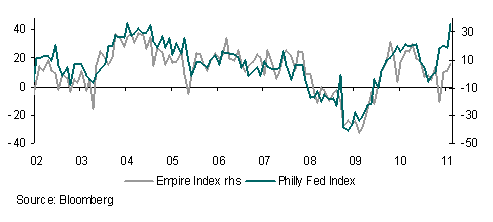
The USD came under pressure despite a higher than forecast reading for January US CPI and a strong jump in the February Philly Fed manufacturing survey. On the flip side, an increase in weekly jobless claims dented sentiment. The overnight rally in US Treasury yields was a factor likely weighing on the USD. The US calendar is light today leaving markets to focus on the G20 meeting and to ponder next week’s releases including durable goods orders, existing and new home sales.

The jump in the European Central Bank (ECB) marginal facility borrowing to EUR 15 billion, its highest since June 2009, provoked some jitters about potential problems in one or more eurozone banks. At a time when there are already plenty of nerves surrounding the fate of WestLB and news that Moody’s is reviewing another German bank for possible downgrade, this adds to an already nervous environment for the EUR.

Nonetheless, EUR/USD appears to be fighting off such concerns, with strong buying interest on dips around 1.3550. The G20 meeting under France’s presidency is unlikely to have any direct impact on the EUR or other currencies for that matter, with a G20 source stating that the usual statement about “excess volatility and disorderly movements in FX” will be omitted.

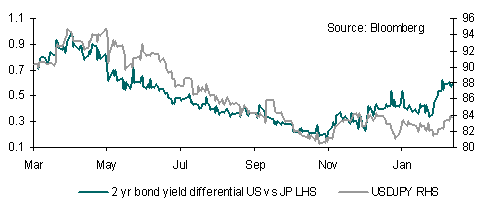
Although USD/JPY has been a highly sensitive currency pair to differentials between 2-year US and Japanese bonds (JGBs), this sensitivity has all but collapsed over recent weeks. USD/JPY failed to break the 84.00 level, coming close this week. There appears to be little scope to break the current range ahead of next week’s trade data and CPI.

Given the recent loss in momentum of Japan’s exports the data will be instructive on how damaging the strength of the JPY on the economy. In the near term, escalating tensions in the Middle East will likely keep the JPY supported, with support around USD/JPY 83.09 on the cards.

It seems that the jump in UK CPI this week (to 4.0%) provoked even more hawkish comments than usual from the Bank of England BoE’s Sentance, with the MPC member stating that the Quarterly Inflation Report understates the upside risks to inflation indicating that interest rates need to rise more quickly and by more than expected. Specifically on GBP he warned that the Bank should not be relaxed about its value.

Although these comments should not be particularly surprising from a known hawk, they may just help to underpin GBP ahead of the January retail sales report. Expectations for a rebound in sales following a weather related drop in the previous month will likely help prop up GBP, with GBP/USD resistance seen around 1.6279.

Euro pressure mounts

The effects of eurozone peripheral bond concerns are cascading through eurozone markets and hitting risk appetite in the process. The EUR is a clear casualty having dropped further against the USD and versus other currencies. EUR/Asian FX remains a sell in the current environment. Contagion outside Greece, Portugal and Ireland had been limited but Italy and Spain have also seen a growing impact on their bond markets. Having broke below support around 1.3734, EUR/USD will target 1.3508 support.

Speculation that Ireland will be forced to follow Greece in seeking international financial support has intensified. Although Ireland has sufficient funds to last until next spring, yields on its debt are already higher than Greek debt before it received funds a few months back. Attention is firmly fixed on the country’s budget on 7 December and the prospects of an agreement between the government and opposition in its austerity plans.

Not helping is the fact that the Irish government has a very slim majority. Even if the budget is passed there is no guarantee that sentiment will improve given the negative impact of even deeper fiscal tightening announced last week will have on economic growth. Moreover, Germany’s insistence that the cost of any Greek style bailout should be borne mostly by private investors has only added to market tension. Even the European Central Bank is unlikely to provide much support, with ECB member Stark suggesting that ECB bond purchases will remain limited.

This leaves eurozone markets in a precarious state and the EUR continues to look heavy as further downside opens up. Moreover, the problems in peripheral Europe are beginning to have a broader impact on risk appetite, with equity markets slipping, although some of this was related to a weaker sales forecast from Cisco in the US. Nonetheless, spreading risk aversion could also dampen sentiment for Asian currencies, which is why selling EUR/Asian FX looks a better bet than selling USD/Asian FX over the short term.

In contrast sentiment for the US is undergoing an improvement. Data releases over recent weeks have generally beaten forecasts and there is even growing speculation that the Fed’s calibrated asset purchases may end up being smaller than planned. Such speculation has boosted the USD but it is premature to suggest that the Fed is on the verge of scaling back asset purchases even as the program of purchases gets going. Although there are clearly some FOMC members who are opposed to significant asset purchases the probability that the Fed remains set to carry out its full $600 billion of planned purchases.

Attention today will focus squarely on day 2 of the G20 meeting and any resolution to disputes over trade imbalances and currencies. Unfortunately none is likely to be forthcoming. Despite a reported 80 minute meeting between US and Chinese leaders little agreement was reached, with plenty of finger pointing remaining in place. It appears that the mantra of moving towards “market-determined exchange rates” and efforts at “reducing excessive imbalances” as agreed at the G20 meeting of finance ministers and central bankers will be as far as any agreement reaches. As a result markets will be left with very little to chew on.

Peripheral debt concerns intensify

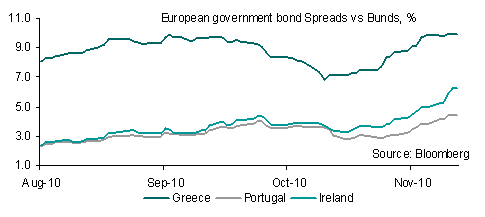
European peripheral debt concerns have allowed the USD a semblance of support as the EUR/USD pullback appears to have gathered momentum following its post FOMC meeting peak of around 1.4282. The blow out in peripheral bond spreads has intensified, with Greek, Portuguese and Irish 10 year debt spreads against bonds widening by around 290bps, 136bps and 200bps, respectively from around mid October.

The EUR appears to have taken over from the USD, at least for now, as the weakest link in terms of currencies. EUR/USD looks vulnerable to a break below technical support around 1.3732. Aside from peripheral debt concerns US bonds yields have increased over recent days, with the spread between 10-year US and German bonds widening by around 17 basis points in favour of the USD since the beginning of the month.

The correlation between the bond spread and EUR/USD is significant at around 0.76 over the past 3-months, highlighting the importance of yield spreads in the recent move in the USD against some currencies. Similarly high correlations exist for AUD/USD, USD/JPY and USD/CHF.

Data today will offer little direction for markets suggesting that the risk off mood may continue. US data includes the September trade deficit. The data will be scrutinized for the balance with China, especially following the ongoing widening in the bilateral deficit over recent months, hitting a new record of $28 billion in August. Similarly an expected increase in China’s trade surplus will add to the currency tensions between the two countries. FX tensions will be highlighted at the Seoul G20 meeting beginning tomorrow, with criticism of US QE2 gathering steam.

Commodity and Asian currencies are looking somewhat precariously perched in the near term, with AUD/USD verging on a renewed decline through parity despite robust September home loan approvals data released this morning, which revealed a 1.3% gain, the third straight monthly increase.

However, the NZD looks even more vulnerable following comments by RBNZ governor Bollard that the strength of the Kiwi may reduce the need for higher interest rates. As a result, AUD/NZD has spiked and could see a renewed break above 1.3000 today. Asian currencies are also likely to remain on the backfoot today due both to a firmer USD in general but also nervousness ahead of the G20 meeting.