US Dollar Finding Support

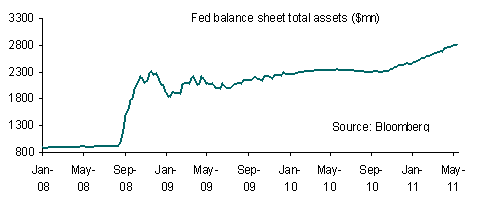
The US dollar is finding growing relief from the fact that the Fed is putting up a high hurdle before more quantitative easing (QE3) is even considered. As highlighted by Federal Reserve Chairman Bernanke last week he is not considering QE3 despite a spate of weak US data. Of course until US bond yields move higher the USD will fail to make much of a recovery and in turn this will need some improvement in US economic data.

The May retail sales release is unlikely to provide this with headline sales likely to undergo an autos related drop while core CPI released on Wednesday is set to remain benign in May. There will be better news on the US manufacturing front, with surveys and hard data likely to bounce back.

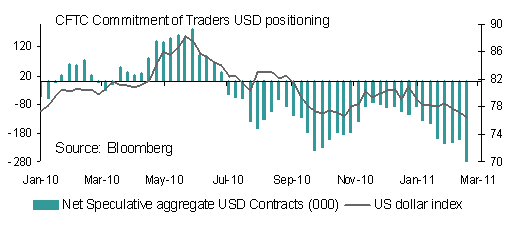
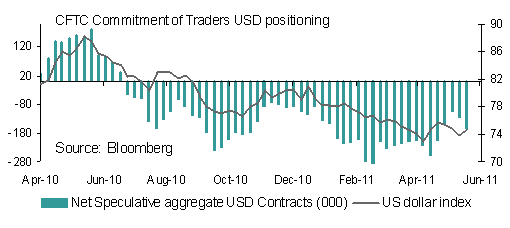
There is still plenty of scope for USD short covering as reflected in the fact that IMM USD positions fell further as of the 7th June, with the market still heavily short USDs. The USD index has likely found a short term bottom, with a break above the 50-day moving average level around 74.6874 in focus.
EUR has lost momentum , with the European Central Bank’s (ECB) confirmation of a July policy rate hike prompting a major sell off in the currency, even with interest rate markets barely flinching. The EUR is susceptible to developments regarding Greece and the news on this front is not good. Divisions between policy makers including the ECB about the extent of private sector involvement in a second bailout package threaten to prolong the pain.

Similarly divisions within the Greek parliament about further austerity measures needed to secure a second bail could also derail the process. Further negotiations this week will be closely scrutinised, likely taking more importance than data releases, with only the final reading of May inflation and industrial production of note this week.

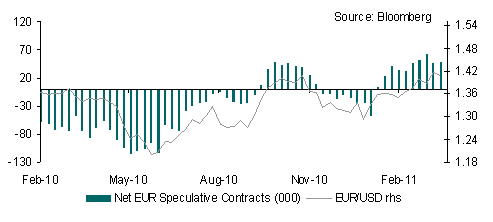
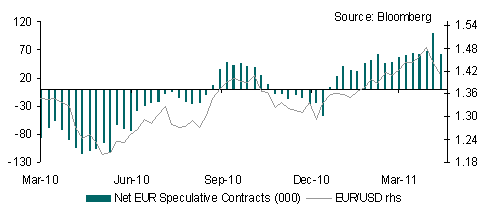
As revealed by the CFTC IMM data, EUR long positions jumped early last week leaving plenty of scope for unwinding, something that is likely to take place this week. Nonetheless, support around the 30 May low of EUR/USD 1.4256 is likely to prove difficult to break on the downside this week.

GBP took a hit in the wake of yet more weak activity data in the form of May industrial and manufacturing production data. The economic news will be no better this week, with retail sales set to drop in May and CPI inflation set to rise further in April. The data will only add further to the confusion about UK monetary policy as the dichotomy between weak data and persistently high inflation continues.

Admittedly the weak data releases can at least partially be explained away by the Royal wedding and Easter holidays but this will provide little solace to GBP bulls. GBP will likely struggle against a firmer USD this week although its worth noting that GBP speculative position has been negative for 3-straight weeks, suggesting that at least there is less room for GBP position unwinding. GBP/USD is likely to hold above support around 1.6055 this week.
Euro Resilience To Fade

There will at least be a little more liquidity in FX markets today following yesterday’s public holidays in the US and UK. Whether this means that there will be a break out of recent ranges is another matter. Clearly global growth worries as well as eurozone peripheral debt concerns are having an important impact on market dynamics but are also providing conflicting signals.

On the one hand the USD ought to garner support from Europe’s problems but on the other, safe haven demand and growth concerns is bolstering demand for US Treasuries keeping US bond yields at very low levels despite the lack of progress on increasing the US debt ceiling and agreeing on medium to long term deficit reduction.

In the wake of a run of US data disappointments including April durable goods orders, Q1 GDP and weekly jobless claims last week, fears of a loss of momentum in the US economy have intensified. Manufacturing and consumer confidence surveys in the form of the May Chicago PMI and Conference Board consumer confidence survey today will be closely scrutinised to determine whether the ‘soft patch’ in the US economy will persist.

This will have important implications for the USD as worries about growth may feed into expectations that the Fed’s ultra loose monetary policy will be sustained for longer. As it is US 2-year bond yields have dropped to their lowest level this year.

Fortunately for the USD only USD/JPY and USD/CHF have maintained a statistically strong correlation with bond yield differentials although we expect the break in relationship for other currencies to prove temporary. In the case of USD/JPY, yield differentials have narrowed between the US and Japan, a factor playing for JPY appreciation.

Perhaps the fact that unlike the US Japanese data has on balance been beating expectations notwithstanding disappointing April household spending and industrial output data has helped to narrow the yield gap with the US. One explanation is that that worst fears of post earthquake weakness have not been borne out, suggesting that economic expectations have been overly pessimistic. In any case, USD/JPY 80 is still a major line in the sand for the currency pair.

The EUR continues to show impressive resistance, with EUR/USD breaking technical resistance around 1.4345, which opens up a test of 1.4423. Reports that Greece had failed to meet any of its fiscal targets and of harsh conditions set by European officials for further aid have failed to dent the EUR. Whether the market is simply becoming fatigued or complacent will be important to determine if the EUR can gain further.

A report in the WSJ that Germany is considering dropping its push for early rescheduling of Greek debt has given some support to the EUR too. Ongoing discussions this week are unlikely to prove conclusive however, with attention turning to meetings of European officials on 20th and 24th June. I still believe EUR gains will limited, with the break above 1.4345 likely to prove shortlived.

US Dollar On The Rise

There are plenty of US releases on tap this week but perhaps the most important for the USD will be the minutes of the April 26-27 Fed FOMC meeting. Taken together with speeches by Fed officials including Bernanke, FX markets will attempt to gauge clues to Fed policy post the end of QE2. The Fed’s stance at this point will be the major determinant of whether the USD can sustain its rally over the medium term. The lack of back up in US bond yields suggests that USD momentum could slow, with markets likely to move into wide ranges over coming weeks.

It is worth considering which currencies will suffer more in the event that the USD extends its gains. The correlation between the USD index and EUR/USD is extremely strong (even accounting for the fact that the EUR is a large part of the USD index) suggesting that the USDs gains are largely a result of the EUR’s woes. Aside from the EUR, GBP, AUD and CAD are the most sensitive major currencies to USD strength whilst many emerging market currencies including ZAR, TRY, SGD, KRW, THB, IDR, BRL and MXN, are all highly susceptible to the impact of a stronger USD.

Robust Q1 GDP growth readings in both Germany and France helped to spur gains in the EUR but this proved short-lived. Sentiment for the currency has soured and as reflected in the CFTC IMM data long positions are being scaled back. Nonetheless, there is still plenty of scope for more EUR selling given ongoing worries about the eurozone periphery, which are finally taking their toll on the EUR. A break below EUR/USD 1.4021 would open the door for a test of 1.3980.

The eurogroup and ecofin meetings will be of interest to markets this week but any additional support for Greece is unlikely to be announced at this time. However, likely approval of Portugal’s bailout may alleviate some pressure on the EUR but any positive impetus will be limited. Even on the data front, markets will not be impressed with the German ZEW index of investor confidence likely to register a further decline in May.

Japanese officials have been shying away from further FX intervention by blaming the drop in USD/JPY over recent weeks on general USD weakness despite the move towards 80. However, this view is not really backed up by correlation analysis which shows that there is only a very low sensitivity of USD/JPY to general USD moves over recent months. One explanation for the strength of the JPY is strong flows of portfolio capital into Japan, with both bond and equity markets registering net inflows over the past four straight weeks.

This is not the only explanation, however. One of the main JPY drivers has been a narrowing in yield differentials. This is unlikely to persist with yield differentials set to widen sharply over coming months resulting in a sharply higher USD/JPY. As usual data releases are unlikely to have a big impact on the JPY this week but if anything, a further decline in consumer confidence, and a negative reading for Q1 GDP, will maintain the pressure for a weaker JPY and more aggressive Bank of Japan (BoJ) action although the BoJ is unlikely to shift policy this week.

Euro’s Teflon Coating Wearing Thin

EUR has suffered a setback in the wake some disappointment from the European Union summit at the end of last week and the major defeat of German Chancellor Merkel and her ruling Christian Democratic Union party in yesterday’s election in Baden-Wuerttemberg. The EUR had been fairly resistant to negative news over recent weeks but its Teflon like coating may be starting to wear thin.

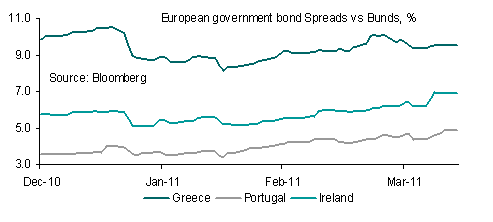
The setbacks noted above + others (see previous post) follow credit rating downgrades for Portugal by both S&P and Fitch ratings and growing speculation that the country is an imminent candidate for an EU bailout following the failure of the Portuguese government to pass its austerity measures last week and subsequent resignation of Portugal’s Prime Minister Socrates.

For its part Portugal has stated that it does not need a bailout but looming bond redemptions of around EUR 9 billion on April 15 and June 15 against the background of record high funding costs mean that the pressure for a rescue is intense. Complicating matters is the fact that fresh elections cannot be held earlier than 55 days after being announced, meaning that policy will effectively be in limbo until then. A June vote now appears likely.

After what was perceived to be a positive result of the informal EU leaders summit a couple of weeks ago, the outcome of the final summit last week failed to deliver much anticipated further details whilst more negatively the EU bailout fund’s paid-in capital was scaled back to EUR 16 billion (versus EUR 40 billion agreed on March 21) due to concerns expressed by Germany.

Ireland is also in focus ahead of European bank stress tests results on March 31. Ireland is pushing for increased sharing of bank losses with senior bondholders as part of a “final solution” for financial sector. Meanwhile the new government remains unwilling to increase the country’s relatively low corporation tax in exchange for a renegotiation of terms for the country’s bailout. This point of friction also threatens to undermine the EUR.

The bottom line is that the bad news is building up and the ability of the EUR to shake it off is lessening. Considering the fact that the market long EUR, with positioning well above the three-month average the EUR is vulnerable to position adjustment. After slipping over recent days EUR/USD looks supported above 1.3980 but its upside is looking increasingly restricted against the background of various pieces of bad news.

US Dollar On A Slippery Path

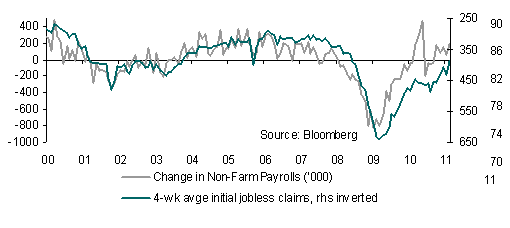
The USD has been a on a slippery path over recent weeks, weighed down by adverse interest rate differentials despite improving US economic data. Adding to the run of encouraging US data releases the February jobs report revealed a 192k increase in jobs and a drop in the unemployment rate to 8.9%.

In particular the Fed’s dovish tone highlights that whilst asset purchases under QE2 will stop at the end of June, the failure to hit the Fed’s dual mandate of maximum employment and stable prices, implies that the Fed Funds rate will not be hiked for a long while yet. This dovish slant has undermined the USD to the extent that USD speculative positioning as reflected in the CFTC IMM data dropped to all time low in the week to 1 March. There is certainly plenty of scope for short-covering but the market is no mood to buy the USD yet.

This week’s releases will provide less direction, with a slight widening in the trade deficit likely in January, a healthy gain in February retail sales and a small drop in the preliminary reading of March Michigan sentiment.

In contrast, even the generally hawkish market expectations for the European Central Bank (ECB) proved too timid at last week’s Council meeting as Trichet & Co. strongly implied via “strong vigilance” that the refi rate would be hiked by 25bps in April. EUR/USD lurched higher after the ECB bombshell breaking the psychologically important 1.4000 barrier but appeared to lose some momentum at this level. Should EUR/USD sustain a break of 1.4000, the next level of resistance is at 1.4281 (November high), with support seen around 1.3747.

The lack of major eurozone data releases this week, with only industrial production data in Germany and France of interest, suggests that EUR may consolidate over the short-term with the main interest on the informal Heads of State meeting at the end of the week to determine whether credible plans can be drawn up to restore confidence in the periphery.

This week it is the turn of the Bank of England (BoE) to decide on monetary policy but unlike the ECB we do not expect any surprises with an unchanged decision likely. Further clues will only be available in the Monetary Policy Committee (MPC) minutes on 23 March. However, markets may be nervous given that it could feasibly only take another two voters aside from the three hawkish dissenters last month, to result in a policy rate hike. Notably one possible hawkish dissenter, Charles Bean did not sound overly keen on higher rates in a speech last week, a factor that weighed on GBP alongside some weaker service sector Purchasing Managers Index (PMI) data.

UK manufacturing data will be the main data highlight of the calendar but this will be overshadowed by the BoE meeting. GBP/USD could continue to lag the EUR and given a generally bullish EUR backdrop, our preferred method of playing GBP downside remains via a long EUR/GBP position.